BROKEN PROMISES

For we must all appear before the judgment seat of Christ, so that each one may receive what is due for what he has done in the body, whether good or evil. Therefore, knowing the fear of the Lord, we persuade others. But what we are is known to God, and I hope it is known also to your conscience. [2 Corinthians 5:10-11 (ESV)]

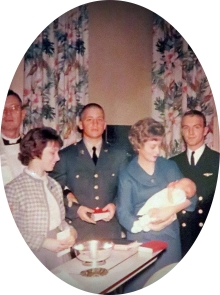
Earlier this week, I wrote about my nephew Johnny’s baptism in my mother’s hospital room. Because she was at death’s door, my brother took emergency leave and he and I served as the baby’s sponsors in Baptism (or Godparents).

As Johnny’s Godmother, I made three promises for him during the service: that he would “renounce the devil and all his works…believe all of the Articles of the Christian Faith and…keep God’s holy will and commandments.” In a perfect world, Johnny would have made those same promises again at his confirmation when he was old enough to personally know Jesus. But the world isn’t perfect; he never came to know Jesus and make those vows for himself.

As his Baptismal sponsor, I promised to make sure Johnny learned the Creed, the Lord’s Prayer, the Ten Commandments, and “all the other things which a Christian ought to know and believe to his soul’s health.” Sometimes promises are easier said than done and I did not keep my vows any better than did my nephew the promises made on his behalf. I can make all sorts of excuses for my failure—I only was 15 when I made those vows, at least 1,500 miles always separated us, and I saw him less than ten times in his 60 years. Nevertheless, I did not try to keep those promises and I will answer to God for my failure.

When I stand at God’s judgment seat, my sins will not be an issue; they already have been forgiven and my ticket to heaven is secure. But I will be asked to give an accounting for what I have done (and failed to do) since becoming a believer. While I kept my nephew in my prayers, I squandered my opportunity, small as it was, to share God’s love and the good news of the Gospel with him. I can’t say that anything I could have done would have made a difference in his troubled life but I should have tried. That weighs heavy on my heart—not because I may miss out on some heavenly reward, but because I missed an opportunity to be a disciple of Christ.

When believers stand before God, we will be judged. Since each of us have been uniquely created and gifted, my evaluation will not be the same as yours; nevertheless, each one of us will give an accounting of ourselves. What did we do with the spiritual light we had, what did we do with the opportunities given to us, and what did we do with the time, talents, and property God entrusted to us?

My nephew is one of the reasons I served our church’s children’s ministry and support both recovery ministries and programs serving the homeless and mentally ill. I suspect I continue writing these devotions as a way of atoning for not keeping the promises to God I made at my mother’s bedside 63 years ago. Older, wiser, and having more light, opportunity, time, and ability, more is expected of me now. While I no longer pray for my nephew, I continue to pray for God’s protection, grace, and mercy on others like him. As for those of us who are Christ followers, I pray that we will make good use of all that God has given us and that through our words and deeds we will live and teach the Creeds, the Lord’s Prayer, the Ten Commandments, and “all the other things which a Christian ought to know and believe to his soul’s health.”

Having gifts that differ according to the grace given to us, let us use them. [Romans 12:6 (ESV)]

Everyone to whom much was given, of him much will be required, and from him to whom they entrusted much, they will demand the more. [Luke 12:48b (ESV)]

Copyright ©2025 jsjdevotions. All rights reserved.

A CHANGE OF HEART

For you are not a true Jew just because you were born of Jewish parents or because you have gone through the ceremony of circumcision. No, a true Jew is one whose heart is right with God. And true circumcision is not merely obeying the letter of the law; rather, it is a change of heart produced by the Spirit. [Romans 2:28-29a (NLT)]

In 1962, my 2-month-old nephew Johnny and his parents traveled 1,500 miles for his Baptism. Because my mother was hospitalized (and soon would be dead), the sacrament took place at her bedside. This was the only time Johnny and his grandmother met and the last time my sister saw our mother alive.

Believing that children should be free to find their own way to God, my brother-in-law was opposed to infant baptism. Nevertheless, my father wanted that baby baptized as much as he wanted my mother to meet her first grandchild. Because children under 12 were not allowed to visit hospitals back then, he convinced my brother-in-law that a hospital baptism was the only way my mother could see and hold the little guy. The hospital was run by the Sisters of Charity so he knew the nuns wouldn’t deny his request for a bedside baptism (especially since he neglected to mention that the priest was Episcopalian rather than Roman Catholic). That we were Protestants, however, didn’t keep the nuns from joining us during the service.

Unfortunately, other than the funerals of his grandparents, Johnny’s baptism probably was the only time he came near a minister, church, Bible, prayer book, holy water, or even a nun. While his parents were good people, they never attended church and the boy had no religious education. By the time he was in his teens, the troubled youth was diagnosed with schizoaffective disorder. As often happens for people with severe mental illness, he self-medicated with drugs and alcohol. A vicious cycle began as the substance abuse exacerbated his mental illness and his disease increased the abuse.

Unable to stay on his meds and off drugs, he was a lost soul. When he wasn’t in jail, the hospital, or couch surfing through the homes of other users, Johnny lived on the streets. Sadly, it was on those streets that he died from a fentanyl overdose. While I can’t know what is in anyone’s heart, I doubt that Johnny believed in Jesus. Nevertheless, he was baptized; did that sprinkle of water mean he was saved?

As a sign of God’s covenant with Israel, all of Abraham’s descendants were to be circumcised. In Romans 2, however, Paul points out that, for the Jew, the true sign of belonging to God was not the ceremony of circumcision; it was a change of heart produced by God’s Spirit. It was God’s spiritual surgery upon the heart rather than the removal of one’s foreskin that made a Jew right with God. While there are parallels between baptism and circumcision, they symbolize two very different covenants. Nevertheless, while studying Romans and rereading today’s verse, I replaced “Jew” with “Christian” and “circumcision” with “baptism.” Indeed, Christianity has nothing to do with parentage nor does baptism bring salvation; salvation requires a change of heart.

The Book of Common Prayer (1958) calls baptism an “outward and visible sign of an inward and spiritual grace.” Without that “inward and spiritual grace,” I fear it is just a ritual. External actions like baptism, communion, genuflecting, making the sign of the cross, or church attendance are not what make us Christians. Salvation doesn’t come by works or sacraments; it comes through God’s grace through faith!

Assuming Johnny never came to know Jesus and be filled with His Holy Spirit, I fear that my nephew’s baptism didn’t make him a Christian any more than his hospital circumcision made him a Jew. While baptism is a step of obedience for every Christian, it does not save us. Our salvation is because of Jesus’ death and resurrection and is available only through faith in Jesus Christ. Let us all beware of trusting that baptism alone will bring us to heaven.

Tragically, some people believe they are going to heaven when they die just because a few drops of water were sprinkled over their heads a few weeks after their birth. They have no personal faith, have never made a personal decision, and are banking on a hollow ceremony to save them. How absurd. [Max Lucado]

If you openly declare that Jesus is Lord and believe in your heart that God raised him from the dead, you will be saved. For it is by believing in your heart that you are made right with God, and it is by openly declaring your faith that you are saved. [Romans 10:9-10 (NLT)]

Copyright ©2025 jsjdevotions. All rights reserved.

SWEETER THAN HONEY

Your words were found, and I ate them. Your words became a delight to me and the joy of my heart, for I bear your name, Lord God of Armies. [Jeremiah 15:16 (CSB)]

“Son of man,” he said to me, “feed your stomach and fill your belly with this scroll I am giving you.” So I ate it, and it was as sweet as honey in my mouth. [Ezekiel 3:3 (CSB)]

Back in 1919, pharmacist W.K. Buckley created a concoction to treat coughs, colds, and bronchitis called Buckley’s Original Mixture. Buckley’s elixir was tremendously effective but its flavor was horrid. Nevertheless, their nasty tasting blend of things like menthol, camphor, Canadian balsam, and pine needle oil is still being sold more than 100 years later. The mixture’s longevity is due as much to the company’s straightforward and humorous “awful taste” ad campaign as it is to its reputed efficacy. With the slogan, “It tastes awful. And it works!” Buckley’s is described by consumers as “the worst tasting, foulest smelling, yet most effective cough remedy.” Apparently, it is. Despite ads admitting, “People swear by it. And at it,” consumers continue to endure Buckley’s ghastly flavor. Never having used Buckley’s (and not about to try), this is not an endorsement!

While nowhere as unpleasant tasting as Buckley’s Mixture, many Christians tend to treat imbibing in God’s word as they might taking a dose of it or some other nasty tasting medication: hard to swallow and consumed only out of necessity! While Scripture’s writers sometimes likened God’s word to food or wrote of its taste, they never described it as “drinking turpentine and transmission fluid mixed together, with a hint of menthol and petroleum” as do some of Buckley’s customers!

While the Bible can be said to be “good for what ails you” and “just what the doctor ordered,” reading Scripture isn’t like taking a dose of Buckley’s or castor oil. God’s word never should be treated as a horrible-tasting medicine—something taken only when absolutely necessary. Peter likened God’s word to milk while Paul and the writer of Hebrews compared it to both milk and solid food (like meat). Job reported treasuring God’s words more than his daily food and Jeremiah, Ezekiel, and the Apostle John all wrote of eating God’s word. And, unlike those who consumed Buckley’s, there were no complaints about its foul taste. In fact, Jeremiah found God’s words a delight and the joy of his heart while Ezekiel and John said they were “sweet as honey” in their mouths. In fact, Psalms 19 and 119 refer to God’s words as even “sweeter” than honey!

When God fed the hungry Israelites in the Sinai desert, His provision included more than earthly food. Along with manna, He gave them something beautiful with which nourish their very souls—His Word! When Israel arrived in the Promised Land, the manna stopped but God’s voice didn’t; He provided mankind with a feast from Genesis through Revelation—and that feast remains with us today. As Moses told the Israelites and Jesus repeated to His followers, “Man must not live on bread alone but on every word that comes from the mouth of God.”

While God’s Word has been described as “sweet as honey” in one’s mouth, unlike cotton candy and sugary sodas, there’s more to it than a sweet taste. Rather than empty calories, God’s words were described by Charles Spurgeon as, “full of substance—they are spirit, they are life, they are to be fed upon by the spiritually hungry!” Remembering that God spoke all of creation into existence with His Word, it shouldn’t come as a surprise that God’s Word is what sustains us, as well! Fortunately, the words of Scripture are sweeter and much easier to consume than Buckley’s disagreeable mixture!

The Bible is not an end in itself, but a means to bring men to an intimate and satisfying knowledge of God, that they may enter into Him, that they may delight in His Presence, may taste and know the inner sweetness of the very God Himself in the core and center of their hearts. [A.W. Tozer]

 He humbled you by letting you go hungry; then he gave you manna to eat, which you and your ancestors had not known, so that you might learn that man does not live on bread alone but on every word that comes from the mouth of the Lord. [Deuteronomy 8:3 (CSB)]

Copyright ©2025 jsjdevotions. All rights reserved.

EASTER ISN’T OVER

Christ died for our sins, just as the Scriptures said. He was buried, and he was raised from the dead on the third day, just as the Scriptures said. He was seen by Peter and then by the Twelve. After that, he was seen by more than 500 of his followers at one time, most of whom are still alive, though some have died. Then he was seen by James and later by all the apostles. Last of all, as though I had been born at the wrong time, I also saw him. [1 Corinthians 15:3-8 (NLT)]

Station XVFound in almost every Roman Catholic church (and some Protestant and Orthodox ones), are the Stations of the Cross—a series of fourteen icons or carvings on the walls—each of which depict a moment in the Passion of Christ. Created to help people contemplate the events leading up to Christ’s crucifixion, they start with His death sentence from Pilate and end with His dead and battered body being laid in the tomb. Because Good Friday and Jesus’ death aren’t the end of the story, some churches have begun adding the resurrected Christ as a 15th station.

More recently, the idea of “Stations of the Resurrection” has taken hold in both Roman Catholic and Protestant traditions. While the Stations of the Cross depict just one day in the life of Christ, the Stations of the Resurrection illustrate the 50 days of Eastertide. There is no official list of “stations” but they usually begin with the angel speaking to the women at the empty tomb. They continue through the days Jesus remained on earth showing events like Jesus on the road to Emmaus and His appearance to the disciples on Easter, as well as His appearances to Thomas, the disciples on the shore, and the 500 mentioned by Paul. After portraying Jesus’ Ascension on the 40th day, the “stations” conclude either with the Holy Spirit’s descent on the 50th day (Pentecost) or Jesus’ appearance to Paul on the road to Damascus.

Having spent the season of Lent spiritually preparing for Good Friday and Easter Sunday, we shouldn’t need the Stations of the Cross or those of the Resurrection to help us remember Christ’s suffering, death, and rising from the dead. Nevertheless, once we put away the Easter baskets, we may not give Easter another thought until the following year. Easter, however, is more than one day; it is a liturgical season called Eastertide. Lasting for seven weeks, it concludes with Pentecost. Why not spend these weeks reading about and meditating on those 50 days in the gospels and Acts. Imagine the shock of finding an empty tomb. What was it like for Cleopas when he realized the stranger with whom he’d walked, talked, and broken bread was the resurrected Messiah? If you’d been one of His frightened followers hiding in a locked room, how would you react to seeing Jesus miraculously appear? Visualize seeing the scars on His hands and feet. What was it like to have breakfast with Him on the beach and to walk with Him, hear His voice, and witness His miracles once again? Can you imagine watching Jesus ascend into Heaven? Picture what it was like that 50th day on Pentecost when the disciples were filled with the power of the Holy Spirit. Consider how Peter, the one who denied Christ three times, became the one who boldly proclaimed Him “Lord and Messiah.” The Easter story doesn’t end at Easter, or even at Pentecost; it continues to unfold today!

Christ’s resurrection is the most powerful world-shaping event in history. It is why we are freed from our sins and live in hope not fear! The good news of Easter is so good that we should continue to celebrate Christ’s resurrection long after the rest of the world (having eaten the last of the Peeps and chocolate rabbits) is thinking about the next holiday. Remembering Easter and the events that followed should be an important part of our spiritual lives—not just for the 50 days of Eastertide—but all year long. As Augustine of Hippo said, “We are an Easter people and Alleluia is our hymn of praise!” Let us be Easter people all year long. Alleluia!

 God raised Jesus from the dead, and we are all witnesses of this. Now he is exalted to the place of highest honor in heaven, at God’s right hand. And the Father, as he had promised, gave him the Holy Spirit to pour out upon us, just as you see and hear today. … So let everyone in Israel know for certain that God has made this Jesus, whom you crucified, to be both Lord and Messiah! [Acts 2:32-33, 36 (NLT)]

Copyright ©2025 jsjdevotions. All rights reserved.

A LENTEN SOJOURN

And he was in the wilderness forty days, being tempted by Satan. And he was with the wild animals, and the angels were ministering to him. [Mark 1:13 (ESV)]

broom groundselAs I pondered my goals for this year’s Lenten practice, I remembered Alica Britt Chole’s suggestion to “consider Lent as less of a project and more of a sojourn.” While we often encounter the word ”sojourn” in Scripture, it’s not a word typically used today. Although the basic meaning of gûr, the Hebrew word translated at sojourn, is to “live, settle, dwell,” gûr usually included the sense of it being a temporary or transient stay. Typically, a sojourner was someone living outside their clan or a noncitizen in a strange place. Because of famine, Israel sojourned in Egypt for 430 years and, because of their disobedience, they sojourned forty years in the desert before entering the Promised Land. It is Jesus’ 40-day sojourn in the wilderness before entering His public ministry that is remembered in Lent.

The usual question prior to Ash Wednesday is, “What are you giving up for Lent?” and the question following Easter is, “How did you do?” If someone else doesn’t ask it, we ask it of ourselves. Were we successful in refraining from sweets, social media, criticism, shopping, or whatever we gave up? Did we meet our goal of reading the four gospels or memorizing 40 Bible verses? Was our commitment to a daily random act of kindness kept? With its clear start and end dates, Lent easily can turn into an assigned forty-day project. It’s tempting to look at our Lenten practice as we might a New Year’s resolution—we set an objective, create a plan, track our progress, and evaluate our success or failure. God, however, is a relationship, not an obligation or duty! With their thinking that salvation lay in strict observance of the oral and written Law, the Pharisees turned God into a job; we mustn’t make the same mistake with Lent.

If, however, we view Lent as a sojourn rather than an assignment, it becomes an experience instead of a chore. Rather than an objective that must be completed successfully on the 40th day, Lent becomes a temporary journey in the wilderness with God. Rather than 40 days of trying to meet goals, it becomes a blessed season of retreat—a time to hear God’s voice in the silence of the wilderness—a time to feel His presence in the stunning colors of the desert sunset, the stark contrast between sun and shadow, the enormous saguaros cactus with its upturned arms, and the wildflowers determined to grow in this parched and barren land. Without a timeline, we can pause to taste the nopales and fruit of the prickly pear and look for road runners and Gila monsters. Unhindered by city lights, we see God’s majesty in the spectacular view of the stars. Granted, we probably won’t be retreating to the desert but, when we think of Lent as a sojourn with God in the wilderness, it can become a close encounter with Him rather than a job for Him!

Describing Lent as a journey of “bright sadness,” Orthodox Reverend Alexander Schmemann says, “The purpose of Lent is not to force on us a few formal obligations, but to ‘soften’ our heart so that it may open itself to the realities of the spirit, to experience the hidden ‘thirst and hunger’ for communion with God.” Through fasting, prayer, study, and reflection, may we grow closer to God as we sojourn through the wilderness of this Lenten season into the joy of the Resurrection!

He has told you, O man, what is good; and what does the Lord require of you but to do justice, and to love kindness, and to walk humbly with your God? [Micah 6:8 (ESV)]

Copyright ©2025 jsjdevotions. All rights reserved.

SETTING THE BAR

Therefore, since we are surrounded by such a huge crowd of witnesses to the life of faith, let us strip off every weight that slows us down, especially the sin that so easily trips us up. And let us run with endurance the race God has set before us. We do this by keeping our eyes on Jesus, the champion who initiates and perfects our faith. [Hebrews 12:1-2a (NLT)]

zebra longwing butterfly“How was work today?” asked the wife in the Born Loser comic strip (drawn by Chip Sansom). Her husband answered, “Horrendous!” adding, “It feels so good that it’s over, I’m almost glad it happened!” Having had times when my prayer was simply, “Lord, just get me through this!” I understand. Sometimes, life seems so challenging and exhausting that we’re willing to settle for merely getting through it. That, dear friend, is setting the bar far too low. God has better plans for us than just getting by and none of us are born losers.

Sarah wanted a baby so much that she was willing to settle for surrogate motherhood when, in fact, God promised that she’d give birth to a nation. When he fled to Midian, Moses just wanted to escape persecution for killing an Egyptian. God’s plans were that he would lead the Hebrews to freedom. The orphaned Esther probably just wanted to settle down with a nice Jewish boy. She never imagined that God’s plans included making her a queen who would save her people from genocide. Gideon, hiding in a winepress, just wanted to get the wheat threshed so he could feed his family. God’s plans were that he’d defeat the Midianites and become Israel’s fifth judge. The widowed foreigner Ruth just wanted to feed herself and Naomi with the leavings in Boaz’s field. She never dreamt of being great-grandmother to Israel’s second king and ancestor to the Messiah. The woman at the well just wanted to fill her water jug and go home without incident when she got the living water of Jesus. Zacchaeus, the tax man, would have been happy just to catch a glimpse of the rabbi from Nazareth. He got much more when Jesus came for dinner and brought salvation with Him. What of the fishermen from Galilee who just wanted to catch enough fish to pay their bills and put food on the table? Did they ever imagine they’d break bread with God? Considering all that God can accomplish through us, it would seem that our hopes and dreams often are way too small.

The Apostle Paul doesn’t tell us just to get through the race—to schlep halfheartedly through the course set before us. He tells us to strip every weight that slows us down and run (not walk) with perseverance. Sin can trip us up, but so can our attitude. Just hoping to make it through the day (week, month, or even year) hinders our run by setting the bar too low. We must never be willing to settle for less than the best—less than the best that God has in store for us and less than the best that we have to offer Him!

Why just settle with merely getting through life? If God just met our expectations, He’d never have the opportunity to exceed them and exceed them He will! When we allow God to determine our dreams and obediently follow His plan, the result will surpass our wildest dreams. He didn’t promise a life of just getting by: He promised a life of abundance—not a life of riches—but a rich life.

The greater danger for most of us lies not in setting our aim too high and falling short; but in setting our aim too low, and achieving our mark. [Michelangelo]

The thief’s purpose is to steal and kill and destroy. My purpose is to give them a rich and satisfying life. [John 10:10 (NLT)]

May you experience the love of Christ, though it is too great to understand fully. Then you will be made complete with all the fullness of life and power that comes from God. Now all glory to God, who is able, through his mighty power at work within us, to accomplish infinitely more than we might ask or think. Amen. [Ephesians 3:19-20 (NLT)]

Copyright ©2025 jsjdevotions. All rights reserved.