WEAR YOUR OWN SHOES

Am I now trying to win the approval of human beings, or of God? Or am I trying to please people? If I were still trying to please people, I would not be a servant of Christ. [Galatians 1:10 (NIV)]

Each one should test their own actions. Then they can take pride in themselves alone, without comparing themselves to someone else, for each one should carry their own load. [Galatians 6:4-5a (NIV)]

seedboxLast Thursday night’s Bible study had been as inspiring as Easter Sunday’s sermon. As we walked out of the building, I confided to my friend that there was no way I could follow such brilliant preaching. You see, our pastor was taking a much needed vacation and I would be doing the preaching for the next two Sundays. Afraid I couldn’t possibly fill his shoes or touch people’s hearts the way he does, I asked, “How can I possibly compare to him?” My friend wisely answered, “You don’t!” He reminded me to be myself and let the Holy Spirit do the rest.

As I continued to polish my sermon, the enemy kept reminding me that I could never fill our pastor’s shoes.  I thought of the Apostles after Jesus had ascended. I’m sure their preaching, no matter how heartfelt and inspired, was no match for that of Jesus. That no one could possibly fill His holy sandals, however, didn’t stop them from speaking and spreading the gospel message. Scripture tells us that many became believers and were baptized after hearing the Apostle Paul speak. Yet Paul’s vast knowledge and speaking skills never kept Timothy, Silas, Barnabas, Titus or others from sharing God’s word.

When whispers of doubt are heard, I find it best to turn to God’s Word, so I turned to Paul’s letters to Timothy. Telling him not to be ashamed of his testimony, Paul encouraged the young man by reminding him that God’s Spirit “does not make us timid, but gives us power, love and self-discipline.” He advised the young man to let his teaching be shaped by his faith and love for Jesus and to teach others so that they could pass those teachings on to still more people. Reminding Timothy that the only approval he should seek was that of God, Paul’s instructions were simple: “Preach the word.” [4:2]

Granted, I felt a heavy responsibility. Ours is a growing young church and I didn’t want us to lose momentum or have the church flounder in our pastor’s absence. Then again, I suppose the people Paul left to pastor the churches he planted felt much the same way. Nevertheless, Paul’s words made me ask whose approval it was that I sought. Did I want to please God or the people? While I prayed that my words would manage to do both, I had to focus on pleasing God and trust Him to take care of the rest. The only approval I should be seeking was that of God.

My preaching, like my writing, is not about me; it’s about God. While I hope that it pleases people, the only one I need to please with my words is God. Saturday morning, my friend sent some more words of encouragement. He reminded me that I’m a child of God, gifted by Him in my own special way, and that all God asks of me is to be myself and “Preach the word.” That’s all God asks of any of us! None of us are expected to fill someone else’s shoes; we just have to wear our own and walk in a way that pleases God.

For the Spirit God gave us does not make us timid, but gives us power, love and self-discipline. So do not be ashamed of the testimony about our Lord. [2 Timothy 1:7-8a (NIV)]

Do your best to present yourself to God as one approved, a worker who does not need to be ashamed and who correctly handles the word of truth. [2 Timothy 2:15 (NIV)]

Copyright ©2019 jsjdevotions. All rights reserved.

THE ART OF PERSUASION (Philemon – Part 2)

Every time your name comes up in my prayers, I say, “Oh, thank you, God!” I keep hearing of the love and faith you have for the Master Jesus, which brims over to other believers. And I keep praying that this faith we hold in common keeps showing up in the good things we do, and that people recognize Christ in all of it. [Philemon 1:4-6 (MSG)]

brown pelicanPaul’s letter to Philemon on behalf of Onesimus is a lesson in the subtle art of persuasion. It’s said that we catch more flies with honey than vinegar and Paul illustrates that beautifully. A lot was on the line for the runaway slave Onesimus—if Paul didn’t convince Philemon to forgive him, the man could have been killed or sold to work in the lead mines. And, if Paul’s letter offended Philemon, the new church at Colossae could have suffered. As short as his letter is, I imagine Paul prayed and labored over it a long time.

Paul’s strategy is evident from the first line when he addresses not just Philemon but also Apphia, Archippus, and the entire church. That the letter was to be shared meant that all in the church would know of Paul’s request and Philemon’s response. Philemon is being held accountable for his decision from the first line of the letter.

Wisely, Paul begins with honey and sincerely praises Philemon and thanks him for his love, faith, hospitality and loyalty both to the church and Paul. The great thing about praise is that, while it encourages us, it also challenges us to live up to its words. Paul then tells Philemon that he prays for him so that the generosity that comes from Philemon’s faith will be put into action. Note that Paul’s prayer isn’t that Philemon will do what the apostle asks but that he’ll put his faith into action by doing the right thing.

There’s no doubt that Paul is the one with authority in this relationship and could easily pull rank on Philemon. Remarking favorably on Philemon’s character again, Paul says he knows an order isn’t necessary because his friend knows the right thing to do and so, rather than make a demand, he makes a personal request. As Paul pleads Onesimus’ case, he calls the slave both his child and a beloved brother, calls Philemon his brother and partner, and finishes by calling Onesimus and Philemon brothers. Rather than emphasizing differences in position and sending back a slave, Paul emphasizes their oneness in Christ and sends back a brother. After offering to make restitution by paying Onesimus’ debt, Paul applies gentle pressure by reminding Philemon that he has a debt to Paul (it was the Apostle who brought Philemon to Christ). By mentioning Philemon’s salvation, Paul subtly reminds him of the forgiveness we have in Christ and that Jesus saved our lives by paying a debt that wasn’t His.

Hidden in Paul’s request to prepare a room because he hopes to visit Philemon soon is the notice that Paul will soon have firsthand knowledge of Onesimus’ fate. Paul closes the letter with greetings to Philemon from others in Rome, making it clear that Paul’s request is public knowledge (and yet another reminder that Philemon will be held responsible for his actions).

Although Paul presents his request as a favor, one commentary describes it as the Apostle promising he wouldn’t twist Philemon’s arm but then our hearing the bone crack! While that’s a rather brutal description, it’s probably accurate. Nevertheless, I think of it as an example of how to use tender nudges rather than strong arm tactics. Admittedly, Paul’s letter backed Philemon into a corner, but I don’t think Philemon even knew it. The letter is written so sincerely, humbly, lovingly and gently that it wouldn’t surprise me if Philemon thought forgiving Onesimus was his idea!

The mere existence of this epistle lends credence to the belief that Onesimus was forgiven. Had Philemon not forgiven him, the letter wouldn’t have been copied and circulated throughout the early church. Philemon is thought to have become the bishop of Colossae and to have died a martyr under Nero. There also are records of a bishop in Ephesus named Onesimus that many scholars believe to have been Philemon’s repentant slave. Paul’s faith in both men seems to have been well founded.

With only 25 verses, the letter to Philemon is far shorter than the devotion I’ve written about it. I urge you to read it in both a traditional translation and a contemporary one like The Message. It is a beautiful example of how we, as Christians, should approach resolving differences. It reminds us that the power of gentle persuasion often is greater than the strong-armed power of authority; a humble request is always sweeter than a dictatorial command. Remember, we’ll always catch more flies with honey than vinegar!

Do me this big favor, friend. You’ll be doing it for Christ, but it will also do my heart good. I know you well enough to know you will. You’ll probably go far beyond what I’ve written. [Philemon 1:20-21 (MSG)]

Copyright ©2019 jsjdevotions. All rights reserved.


GLOW IN THE DARK

Jesus spoke to the people once more and said, “I am the light of the world. If you follow me, you won’t have to walk in darkness, because you will have the light that leads to life.” [John 8:12 (NLT)]

photoluminiscent exit signsA business friend took us upstairs at his corporate center and then turned out all of the lights. With blackout curtains covering the windows, we were in complete and utter darkness. As our eyes adjusted to the dark, we saw glowing strips marking the perimeter of the room and around the door. A luminous exit sign was above the door and the doorknob was marked with a glowing circle around it. In spite of the blackness, we easily found our way to the door. When we opened it, another glowing sign warned us “Caution—watch your step.” Although the stairwell was pitch black, we weren’t frightened because the hand railing, baseboards, and edges of every stair were marked with glowing strips and another exit sign, outlined door, and marked doorknob indicated the way out of the dark stairway. That luminous greenish light safely guided us even when we couldn’t see where we were going.

My friend manufactures photoluminescent tapes and signs and it was his products that were glowing in the dark. He explained that photoluminescence occurs when a substance is capable of absorbing energy photons, storing them and then emitting them as a glowing greenish or yellow light. His products also glow in the light but, because of the ambient light, our eyes don’t see the glow; they seem brightest in the darkness!

Light and dark in the Bible are usually metaphors for good and evil, God and Satan, believers and unbelievers. Maybe it’s because I write Christian devotions but, after seeing how that glowing light led us through the building, I couldn’t help but think about the light of Christ that leads us. Just as the purpose of those photoluminescent products is to give off light, Christians are called to be the light of the world. Needing neither electricity nor batteries, those tapes and signs must absorb external light before they can make light of their own and it is Christ’s light that enables us to illuminate the world’s darkness; we can’t do it on our own. And, just as those photoluminescent tapes and signs seem brightest in the dark, the light of Christ shines brightest in the shadowy and troubled times. While darkness can never overpower God’s light, His light can overpower the world’s darkness.

Photoluminescent products continually absorb ambient light and, when fully charged, can glow brightly for about 90 minutes. But, without being recharged by light, they’ll eventually run out of energy and stop glowing. While 90 minutes is more than enough time to guide one out of a burning building, Jesus expects us to have more than a mere hour-and-a-half worth of His energy in us; we are to shine 24/7! Moreover, if photoluminescent tapes and signs get dirty or covered with paint, they can’t do their job. The same goes for Christ’s followers, but it won’t be dust, mud or paint that will soil us; rather, the filth of the world can keep us from lighting the way. We must keep ourselves free from sin and continually recharge with prayer, Scripture, fellowship, study, worship, praise and thankfulness.

Jesus led us from darkness into light. Are we doing our part to lead people to the fire exit and safely home to the Lord? Do we live as people of the light and glow with the glory of the Lord?

The fundamental principle of Christianity is to be what God is, and he is light. [John Hagee]

For once you were full of darkness, but now you have light from the Lord. So live as people of light! [Ephesians 5:8 (NLT)]

You are the light of the world—like a city on a hilltop that cannot be hidden. No one lights a lamp and then puts it under a basket. Instead, a lamp is placed on a stand, where it gives light to everyone in the house. In the same way, let your good deeds shine out for all to see, so that everyone will praise your heavenly Father. [Matthew 5:14-16 (NLT)]

Copyright ©2019 jsjdevotions. All rights reserved.


YOUR GIFT IS NEEDED

There are different kinds of gifts, but they are all from the same Spirit. There are different ways to serve but the same Lord to serve. And there are different ways that God works through people but the same God. God works in all of us in everything we do. Something from the Spirit can be seen in each person, for the common good. [1 Corinthians 12:4-7 (NCV)]

turkey vultureYesterday, when I compared vultures to mankind, I did vultures a disservice. Although unattractive, smelly, and with rather disgusting eating habits, vultures play a valuable role in keeping our ecosystem healthy and clean by disposing of rotting carcasses and preventing the spread of disease.

When in Tanzania, we came upon a committee of Rüppell’s vultures gathered by an impala carcass. The animal had collided with a vehicle and lay by the roadside—perfectly intact but clearly dead. The birds, however, weren’t eating and seemed to be waiting patiently while dinner lay right in front of them. When we asked our guide why they weren’t dining, he explained they were just waiting for the arrival of more vultures (but not out of politeness). The waiting vultures, while well-equipped to stick their heads into an animal’s carcass, didn’t have strong enough beaks to tear into its unbroken hide. They were awaiting the Lappet-faced Vultures who, with their strong beaks, could tear open the impala’s tough hide and through tendons and other coarse tissue to expose its insides. Being the larger dominant birds, the Lappets eat first. Once done, plenty of food remains deeper in the carcass for the medium-sized vultures like the Rüppell’s who, with their bald heads and necks are perfectly designed for getting down and dirty into the remains. Once they’re done, the Hooded Vultures get to eat. With their smaller heads and beaks, they are perfectly designed to extract the last bits of meat found deep in the animal’s remains. Last to dine is the Bearded Vulture. Unlike its cousins, this vulture has a feathered head making it ill-suited for eating flesh; fortunately, it likes the bones. When each vulture has done its part, their job of cleaning up the carcass is complete. When we wondered how all the different vultures managed to find this one dead animal, we were told that the White-backed Vulture has excellent eye sight and will “wheel” in the sky as a sort of dinner bell to alert all the others. Unable to tear open a carcass, it eats with the Rüppell’s.

There are twenty-three different species of vultures and God has equipped each one of them in a slightly different way. They all have the same assignment—to be nature’s garbage men—but each is equipped to do that in different ways. The White-backed Vulture signals, the Lappet-faced Vultures get the job started, the Rüppell’s do the dirty work, the Hooded-Vultures pick the bones, and the Bearded Vultures finish the job. Each vulture needs to do its part if their joint mission is to be accomplished.

God gave the vultures their assignment and, in Matthew 28:19-20, He gives us ours: “So go and make followers of all people in the world. Baptize them in the name of the Father and the Son and the Holy Spirit. Teach them to obey everything that I have taught you.” Within that greater assignment of expanding God’s Kingdom, however, we each have a distinct position to fill and a gift that will enable us to fulfill it. Like the vultures, the church cannot survive unless everyone uses his or her gift but, unlike the vultures, our gifts are rarely as obvious as a strong beak or a bald head.

While the Holy Spirit has gifted us, it is our obligation to determine the nature of His gift. In all of his discussion of spiritual gifts, however, the Apostle Paul gave no directions for recognizing those gifts. Perhaps he felt no need for guidance because recognizing our gift really isn’t so terribly difficult. All we really need to do is ask ourselves where we can best serve. Are we the guys with the big strong beaks or the ones who pick the bones clean? When we find the place where we can best serve effectively, we will have discovered our spiritual gift and we can get to work using it to further God’s kingdom.

Each of you has received a gift to use to serve others. Be good servants of God’s various gifts of grace. [1 Peter 4:10 (NCV)]

The most important thing is that I complete my mission, the work that the Lord Jesus gave me—to tell people the Good News about God’s grace. [Acts 20:24 (NCV)]

Copyright ©2019 jsjdevotions. All rights reserved.


A MOUNTAINTOP EXPERIENCE – THE TRANFIGURATION

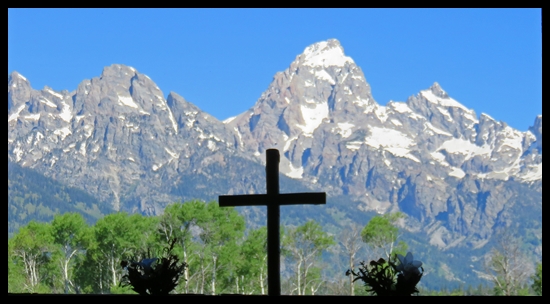
Chapel of the Transfiguration - Grand Teton National Park

Don’t misunderstand why I have come. I did not come to abolish the law of Moses or the writings of the prophets. No, I came to accomplish their purpose. [Matthew 5:17 (NLT)]

In the middle of Grand Teton Nation Park is a small log church, the Chapel of the Transfiguration. Built in 1925, it offers a beautiful view of the majestic Teton Mountain Range through a window behind the altar. When people gaze out that window, I wonder how many think of the amazing event—the transfiguration—that took place on another mountaintop more than 2,000 years ago.

About a week after Peter called Jesus “the Messiah sent from God!” and Jesus explained that He’d suffer, die, and be raised, Peter, John and James accompanied Him up a mountain to pray. While tradition says it was Mt. Tabor, both its height (only 1,800 feet) and location make that unlikely. While not as high as the 13,000 ft. Grand Teton, Mt. Hermon’s height (9,000 feet) and location make it the more likely location of this glorious event.

While praying, Jesus made a dramatic change: his face transformed and his clothes turned white and gleaming. Having only seen Jesus in his human form, His now glorious presence gave the disciples a greater understanding of his deity. Two men then appeared and spoke with Jesus about his exodus (or departure) from this world. They were Moses and Elijah—representing, at least symbolically, the Law and the Prophets. Jesus, as we know, was their fulfillment.

Amazed at what was the ultimate mountaintop experience, Peter foolishly suggested building three shelters for Jesus and his visitors. That, of course, was a mistake; neither the lawgiver not the prophet were Jesus’s equal. Furthermore, that Peter wanted this glorious event to continue would have kept Jesus from the mission He’d already explained to His disciples. A cloud then enveloped them all and a voice, unmistakably that of God, said, “This is my dearly loved Son, who brings me great joy. Listen to him.” [Matthew 17:5] The “Listen to him,” made it clear that the One who was new would be replacing the old way. After this powerfully dramatic event, the four men found themselves alone on the mountaintop.

Jesus commanded the disciples to keep silent as to what had taken place until after his resurrection. Looking for a Messiah who’d be a political deliverer rather than one who was a suffering servant, the world wouldn’t understand what had transpired. Even the disciples, the men who’d walked with Him for three years, didn’t fully understand the meaning of their mountaintop experience. It was not until Jesus joined them in that locked room on Easter that they finally understood that He’d come to conquer death rather than Romans.

The transfiguration was a foretaste of things yet to come and, someday, we all will see the fullness of Christ’s glory as did Peter, James, and John. Although Jesus told His disciples to keep his identity a secret, let us not forget that was only a temporary request. He later told them to “make disciples of all the nations.”

Jesus came and told his disciples, “I have been given all authority in heaven and on earth. Therefore, go and make disciples of all the nations, baptizing them in the name of the Father and the Son and the Holy Spirit. Teach these new disciples to obey all the commands I have given you. And be sure of this: I am with you always, even to the end of the age.” [Matthew 28:18-20 (NLT)]

Copyright ©2019 jsjdevotions. All rights reserved.

THE SERVANT SAVIOR

They replied, “When you sit on your glorious throne, we want to sit in places of honor next to you, one on your right and the other on your left.” … When the ten other disciples heard what James and John had asked, they were indignant. So Jesus called them together and said, “You know that the rulers in this world lord it over their people, and officials flaunt their authority over those under them. [Mark 10:37, 41-42 (NLT)]

great blue heron - great egretThe day’s gospel was from Mark 10 and, as the sermon began, the pastor shared having spent three hours earlier that week in a tiresome meeting on evangelism. The speakers had been lauded for the high number of “first public professions of faith” in their parishes. As the meeting went on, the pastor furtively checked his phone to see if memory had served him right. Indeed, his church far exceeded the numbers of the keynote speakers. Part of him (the bad part), like James and John, wanted to boast and be honored but the other part reminded him that ministry is about people and not numbers. He ate a little humble pie and said nothing. As often happens in long meetings, his mind wandered and he thought back to an encounter some twenty-eight years ago when he first came to the parish.

In 1991, both the church and our nation had much less liberal views about alternative lifestyles and homosexuality. An era of homophobia, there often were economic, social, and even physical repercussions to coming out. AIDS was the leading cause of death among men 25 to 44 and, in an attempt to raise AIDS awareness, the Red Ribbon Project had just launched.

That year, Wayne, an elderly retired minister in the parish approached the pastor. “This homosexual thing,” he said, “I just don’t comprehend it and I can’t condone it. But,” he added, “all people are God’s children and are of sacred worth.” Wayne then spoke of the many gay men dying in the area. In those early years, most families abandoned their gay AIDS infected sons and brothers. Fearing contagion, AIDS patients were touched only by hands in rubber gloves and, because of surgical masks, they saw only the eyes of those who attended them. Facing death and without a support system, they felt alone, unloved, and worthless. Reiterating that he neither understood nor approved of homosexuality, Wayne added that he couldn’t stand by and do nothing. He asked permission to serve AIDS patients in the local hospitals. “I don’t want them to die without feeling the touch of a warm hand, seeing a smile, or knowing that they have value. I can’t let them die alone or without telling them that Jesus loves them.” The pastor immediately agreed to Wayne’s ministry of love because being a servant is what Jesus was and what He told us to be.

As the pastor thought back to Wayne’s selfless and loving service, he understood why his church’s growth numbers are exemplary. It wasn’t evangelism techniques, community events, baseball team sponsorship, or advertising; it was that the church and its members serve as Christ’s hands and feet. Through service, they both tell and show people that Jesus loves them.

When the pastor wanted to brag about his numbers, he realized he was being like James and John when they wanted their place of honor in God’s kingdom or the other disciples who were indignant at the thought they might not be honored as well. When he thought back to Wayne, however, he thought of Jesus’ words: “For even the Son of Man came not to be served but to serve others…” As Christ followers, we don’t need to understand or condone, we just need to serve our brothers and sisters (and all are our brothers and sisters).

One of the principal rules of religion is to lose no occasion of serving God. And, since he is invisible to our eyes, we are to serve him in our neighbour; which he receives as if done to himself in person, standing visibly before us. [John Wesley]

But among you it will be different. Whoever wants to be a leader among you must be your servant, and whoever wants to be first among you must be the slave of everyone else. For even the Son of Man came not to be served but to serve others and to give his life as a ransom for many. [Mark 10:43-45 (NLT)]

Copyright ©2019 jsjdevotions. All rights reserved.