
All Scripture is inspired by God and is useful to teach us what is true and to make us realize what is wrong in our lives. It corrects us when we are wrong and teaches us to do what is right. God uses it to prepare and equip his people to do every good work. [2 Timothy 3:16-17 (NLT)]
 Broken people were drawn to Jesus but Mary Magdalene was not as broken as many people think. Magdalene was not her last name; it simply means “from Magdala” and the Gospels’ writers added it to distinguish her from the many others Marys: Jesus’ mother, Martha’s sister, the wife of Clopas, and the mother of James and Joseph.
When we first meet Mary Magdalene in Luke 8, her name is linked both with women “who had been cured of evil spirits and diseases” and those who “were contributing from their own resources to support Jesus and the disciples.” Luke then elaborates that Jesus cast seven demons from her. Nowhere does he (or any other gospel writer) say anything about Mary’s immorality. In fact, since she was one of the women helping to financially support Jesus’s ministry, it appears that she was an upstanding, respectable and wealthy woman.
Whether it was because Luke’s first reference to Mary Magdalene follows the story of the nameless sinful woman who anointed Jesus’s feet or that Mary had been cured of seven demons but the idea developed through the centuries that she was immoral and probably a prostitute. Mental illness in 1st century Palestine was attributed to evil spirits and those demons probably were a mental illness of some kind. While we don’t know if her disorder was epilepsy, depression, paranoia, psychosis, or something else, Scripture gives us no reason to question her morals. We must never make the error of confusing mental illness with immorality.
It didn’t help Mary’s reputation when, in 1324, the Roman Catholic Church established a home for “the rescue and maintenance of fallen women” and called it the “Magdalen House.” Her reputation suffered further harm when, in 1591, Pope Gregory I gave a sermon associating her seven demons with the seven vices and then fused her with both the sinful woman and Mary of Bethany (both of whom washed Jesus’s feet). When monks and priests read Gregory’s sermons rather than Scripture, the erroneous story of Mary continued to be told.
It was not until 1969 that the Roman Catholic Church declared that Mary Magdalene was not the fallen woman who washed Jesus’ feet. Unfortunately, people seem to love a juicy story and Mary’s undeserved reputation still lingers. She continues to be portrayed as a repentant prostitute, the nameless woman caught in adultery, or even as Jesus’ lover or wife. There is absolutely no Scriptural basis for any of those assumptions.
Mary Magdalene appears in all four Gospels and is mentioned thirteen times. We are given no reason to think that she was anything other than a once ill woman who helped financially support Jesus and the disciples. In fact, when she’s mentioned with other women, her name usually comes first, implying that she was their respected leader. It is only when she is standing at the foot of the cross with Jesus’ family (His mother and aunt) that her name follows those of others. What we do know from Scripture is that, when others fled, Mary Magdalene was there. She was present at the Crucifixion, sat across from the tomb with the mother of James and Joseph as Christ’s body was laid in the sepulcher, was the first person to whom Jesus appeared after his resurrection, and was the first to preach the news of His resurrection.
While I wanted to restore a good woman’s reputation with this devotion, its main purpose is to caution us as to where we get our Biblical knowledge. While it’s tempting (and often easier) to get it second-hand—from sermons, devotions, commentaries, conversations, books, websites, movies and other media—those never should be our sole source of information. God’s word is our spiritual nourishment and, just as a vitamin pill is no substitute for eating real food, there is no substitute for reading Scripture first-hand. After all, to discern between opinion, fact, and fiction, we must know the truth and the gospel truth is found only in the Gospel!
Just because it’s in print doesn’t mean it’s the Gospel. [Michael Jackson]
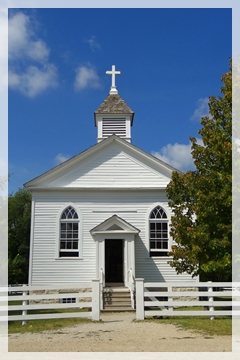 It is said that John Wesley (the founder of the Methodist movement) once dreamt of visiting the gates of Hell. Curious, he asked the gatekeeper how many in Hell were Presbyterians, Episcopalians, and Baptists. “We have many,” was the gatekeeper’s answer regarding each denomination. Nervously, Wesley then asked if there were any Methodists and was disheartened to learn there were plenty of them there, as well.
 A few weeks ago, in Charles Schultz’s classic comic Peanuts, Snoopy sat on his doghouse and decided not to tell his little bird friend Woodstock about Santa Claus. “He’ll never get any presents anyway. Santa Claus never brings presents to tiny, nondescript, nobody birds,” he thought before concluding, “It’s kind of sad at Christmastime to be a nobody bird.” I wasn’t so sure about Santa ignoring the “nobody birds.” The previous day, several from our church had participated in a project that demonstrated just how much “Santa” really does care.
 The story is told of a minister who made this announcement just before passing out the offering plates: “The good news is that God has all of the funds necessary to fund His church’s ministry.” As the congregation started to return their checks and cash to their wallets, the pastor added, “But the bad news is that it’s still in our pockets!”
 My friend called to make sure I’d be at an event and then asked, “Do you have a minute?” When people ask that, we all know they really mean twenty minutes. With a to-do list as long as my arm, I had a minute to spare but not twenty. Nevertheless, I’ve been praying for this woman and her family for several years. I knew she needed to unburden her heavy heart, so I said, “Yes.” Twenty minutes later, she asked to meet for lunch the following day. Again, I really didn’t have the time, but I knew she needed guidance, encouraging words and reassurance about some difficult decisions she’d made. She needed a friend!
 James warns of the dangers of an untamed tongue and the damage that can be done with ill-considered words. Although he was speaking of speech, the same goes for the written word. Whether we’re holding a pen, our fingers are speeding across a keyboard, or our thumbs are tapping out a text, our words are powerful. Whether we use them to build or destroy is our choice.
 Devotions of the Heart