
On the way they were asking each other, “Who will roll away the stone for us from the entrance to the tomb?” But as they arrived, they looked up and saw that the stone, which was very large, had already been rolled aside. [Mark 16:3-4 (NLT)]
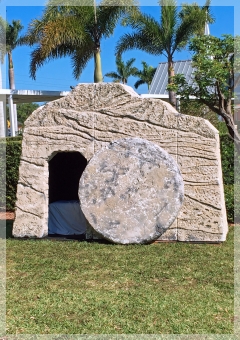 Although Jesus repeatedly predicted that He’d rise from the dead, the women didn’t bring clean clothes for a living man that Sunday morning when they went to the tomb. Instead, they brought burial spices of their own with which to anoint His dead body. Because of the Sabbath, Jesus’ burial was rushed and His body laid in a borrowed tomb. Although Joseph and Nicodemus had anointed Him, perhaps the women were concerned that, in the men’s haste to finish before sunset, they hadn’t done a proper job of preparing the body. The spices they brought would conceal the stench of decay and, out of love for Jesus, they wanted to complete the burial rites properly.
Not knowing about the guards Pilate had posted at the tomb, the women wondered how they would manage entry into it. Many Judean tombs were caves. The opening was covered by a large disc-shaped stone set into a groove cut in the bedrock. Getting the stone in place was fairly easy as it was rolled down a slight incline to cover the tomb’s opening. Several men, however, would be needed to roll it up the incline. “Who will roll the stone away?” they asked. Even though the women didn’t know how it would be done, they trusted that it could be done and proceeded in faith.
For a moment, consider that heavy stone at the cave’s opening. It was impossible to remove from within the tomb but it wasn’t removed so Jesus could exit the tomb. The Messiah who raised the dead, walked on water, and healed the sick certainly didn’t need anyone to move the stone for Him. Regardless of size, no boulder could block the way of the one whose resurrection meant that death had been conquered. That stone wasn’t moved so He could get out; it was moved so that His followers could get in, find the tomb empty, and share the good news!
The women didn’t let their reservations about moving the stone stop them from going to the burial site and serving their Lord. What about us? When we are called to serve Him, do we worry about the stones that might block our way and allow them to stop us? Let the Easter story remind us that, just as that stone was removed for the women so they could tell the good news, God will remove the barriers blocking our way from sharing the resurrected Christ!
 In writing about Blaise Pascal yesterday, I mentioned that he, along with Pierre de Fermat, laid the groundwork for probability theory back in 1654. I remember a school friend writing her term paper on probabilities who began by testing what’s called the “birthday paradox:” in a room of 23 people, there is a 50% chance that two people will have the same birthday and, out of 75 people, there is a 99.9% chance of two people’s birth dates matching. Imagine her surprise when the first two people she asked had the same birth date! That, of course was sheer coincidence but, if the next 30 people she asked also had the same birth date, another explanation would have been necessary.
 I can’t say that I’ve ever had a dream or vision as clear cut as was Paul’s. If I ever did, I’m not sure I’d be as quick as he and his companions were to trust it. In Paul’s case, however, the dream helped him understand why the Holy Spirit previously prevented the men from preaching in the provinces of Asia and Bithynia (modern day Turkey). After hearing the Macedonian man’s plea, Paul finally had a clear sense of God’s direction. Paul, Silas, Timothy, and Luke headed west to Troas, set sail across the Aegean Sea, and made their way to Philippi in the Roman province of Macedonia (northern Greece). Paul’s obedience to that call took the gospel west toward Europe and changed Western civilization forever!
 A few miles from our Illinois home, a giant ski jump towered over the treetops. Originally erected in 1905 by Carl Howelsen and a group of Norwegian skiers living in Chicago, it’s been rebuilt over the years and is still used today. In a curious coincidence, in 1913, the man who loved the mountains and deep snow found his way to the Colorado mountain town we once called our winter home. Although Howelsen returned to Norway in 1922, he left an indelible mark on the town by introducing it to recreational skiing and ski jumping. Not far from the hill named for him, stands a statue of the man known as Flying Norseman.
 In ancient times, when an iron tool became dull, another iron implement was used to give it a finer polish and sharper edge. It’s not just tools that can become dulled—so can minds and spirits. Good Christian friends who act as whetstones can make us accountable, keener, stronger, and more enthusiastic and valuable. Rather than allowing us to grow dull and settled in our comfort zones, they sharpen us with challenges that make us better disciples for Christ.
 Yesterday, I wrote about Jesus’ Parable of the Three Servants, often called the Parable of the Talents. Although I used it as an example of excuse making, that’s not what the parable is about. This parable comes right after Jesus’ description of the end times and the Parable of the Ten Bridesmaids in which He urged readiness for the Day of the Lord. Immediately following this parable about the talents, Jesus spoke about the final judgment. The story of these three servants makes it clear that, when that last day comes, the master will settle accounts: faith will be rewarded and the righteous servants separated from the false ones.

