
So Peter was kept in prison. But the church prayed earnestly to God on his behalf. … Suddenly an angel of the Lord stood there, and a light shone in the cell. The angel hit Peter on the side and woke him up. “Get up quickly!” he said. The chains fell off his hands. [Acts 12:5,7 (NTE)]
 In the early church, it was common for believers to gather together for prayer and, when Peter was imprisoned, they gathered to pray for his release at the home of Mary, the mother of John Mark. For a people who believed in prayer, it’s ironic that Peter thought the angel that freed him to be a mere vision until he found himself free on the city streets and that the church was astonished when he showed up at Mary’s house! Amazing things can happen when the church prays for its leaders. Prayers broke Peter’s chains, imagine what they can do for our pastors!
Charles Spurgeon (1834-1892), known as the “Prince of Preachers,” is said to have had a voice so strong that he could be heard (without amplification) in a crowd of 23,000. His church, the Metropolitan Tabernacle was the largest of his day. Even though it seated 5,000, his powerful preaching drew such crowds that he would ask some of his members to attend other churches to make room for newcomers the next week. In his lifetime, Spurgeon preached to over ten million people and his collected work fills at least 49 volumes. Apparently unstoppable, he also founded 66 parachurch ministries, including two orphanages, seventeen homes for widows, and a free seminary. From where did Spurgeon get the power to accomplish so much for the Lord?
The story is told that one day the legendary preacher was giving some people a tour of the Tabernacle before service began. After asking if they’d be interested in seeing the huge church’s “power plant,” he took them into the basement and led them into a room. While Spurgeon seemed the unstoppable “Energizer Bunny” of preachers, his power didn’t come from batteries or the furnace room. Spurgeon’s power came from prayers—the prayers said by the hundreds of people who gathered in that room before church every Sunday and fervently prayed for their pastor while asking God to bless his preaching!
Behind every healthy church is a commitment to prayer and, behind every good pastor is a commitment to pray for him. Will we be the “power plant” needed by our pastors today?
 Even though they have their own unique song, northern mockingbirds usually incorporate the songs of other birds into theirs. With their ability to sound like jays, thrashers, hawks, orioles, and robins (along with car alarms and frogs), rather than sounding like themselves, these masters of mimicry can sound like what they’ve heard.
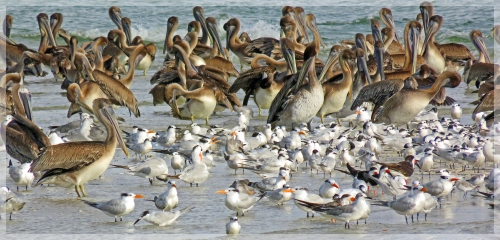 Just as our bodies have many parts and each part has a special function, so it is with Christ’s body. We are many parts of one body, and we all belong to each other. [Romans 12:4-5 (NLT)]
 We’d gathered for coffee when the conversation turned to tipping. Several who had been servers at one time or another mentioned what notoriously bad tippers church people seem to be. Rather than a tip, some only leave a religious tract. A barista admitted removing any she finds in the tip jar because her fellow workers find them incredibly offensive. Rather than bringing anyone to Jesus, they serve to further distance non-believers from any church!
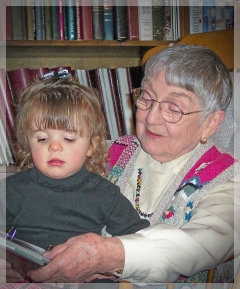 Growing up, one of my favorite hymns was, “I Sing a Song of the Saints of God.” Its author, Lesbia Scott, wrote hymns for her children as expressions of the family’s faith. Not originally intended for publication, she wrote this song to emphasize that saints lived not just in the distant past but also in the present day. My favorite verse was the final one and I recall singing it loudly with childlike enthusiasm: “The world is bright with the joyous saints who love to do Jesus’ will. You can meet them in school, on the street, in the store, In church, by the sea, in the house next door; They are saints of God, whether rich or poor, and I mean to be one too.”
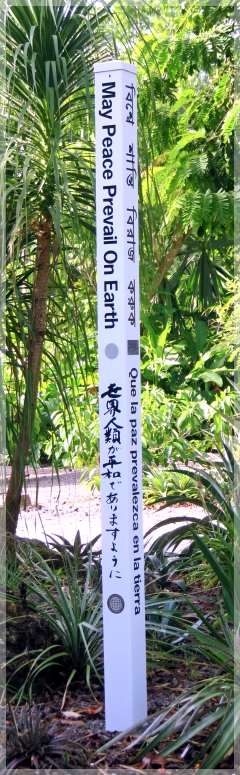 COVID kept us from the Botanic Gardens for well over a year. When we finally returned to one of our favorite places, we came upon a peace pole planted among the palms, bamboo and bromeliads. Although a similar pole is in the city park downtown, I don’t remember seeing one here when last we visited. These poles are just two of the more than 250,000 that have been erected in over 180 nations. Symbolizing the oneness of humanity, the words “May Peace Prevail on Earth” are written in eight different languages. The languages chosen for this pole were English, Arabic, Bengali, Chinese, Hawaiian, Hindi, Japanese, and Spanish—the languages of people who, like us, live at the 26th parallel north. Peace poles stand as a visual reminder to pray for peace on earth and to think, speak and act in the spirit of harmony and peace.
 Devotions of the Heart