CHRIST THE KING

“My kingdom isn’t the sort that grows in this world,” replied Jesus. “If my kingdom were from this world, my supporters would have fought, to stop me being handed over to the Judaeans. So then, my kingdom is not the sort that comes from here.” [John 18:36 (NTE)]

God’s kingdom, you see, isn’t about food and drink, but about justice, peace, and joy in the holy spirit. [Romans 14:17 (NTE)]

For those of us who attend liturgical churches, yesterday was the last Sunday of the liturgical (or church) year: Christ the King Sunday. A kind of liturgical “New Year’s Eve,” it is the climax and conclusion of the Church’s year.

Starting with Advent, the first half of the church year focuses on the events of Jesus’ life: His incarnation, birth, manifestation, temptation, suffering, death, resurrection, and ascension. The second half of the church year begins on Pentecost (with the outpouring of the Holy Spirit) and, depending on Easter’s date, lasts 23 to 28 Sundays. Sometimes called Ordinary Time, this season focuses on the teachings of Jesus. Next Sunday, we start a new year with the first Sunday in Advent and begin another journey through Scripture to remind us of who we are and to whom we belong.

Like the rest of the liturgical church calendar, Christ the King Sunday is man-made rather than ordained by God. Nevertheless, having attended a liturgical church most of my life, I find comfort in regularly celebrating not just Christmas and Easter but the entire mystery of Jesus—from His incarnation through His death, resurrection, and ascension, to the gifting of the Holy Spirit and the expectation of His glorious return.

When I first saw the words “Christ the King” on the church hymn board years ago, I didn’t know that this observance is a modern addition to the church year. It was instituted in 1925 by Pope Pius XI in response to the growth of communism, fascism, atheism, and secular ultra-nationalism in Europe at that time. Although first observed by the Roman Catholic church, Protestant denominations such as the Lutheran, Anglican, Moravian, Methodist, Nazarene, and Presbyterian churches have joined in observing this day as a reminder that Christ reigns above all earthly rulers.

In the past, cults of personality have formed around leaders like Mussolini, Hitler, Stalin, Mao Zedong, and they continue to form around some world leaders today. Christ the King Sunday is a vivid reminder that our allegiance belongs to our spiritual ruler in heaven as opposed to any earthly political “messiah.” While temporal powers will fade away, Christ’s reign and His kingdom remain eternal. Whether Roman Catholic, Orthodox, or Protestant, observing Christ the King helps to move us from the politics of people to the politics of heaven.

Indeed, Jesus is unlike any other head of state in history. While most leaders are concerned with gaining, increasing, and maintaining power, Jesus gave up His divine power to live as a man among the poor and humble and to die a criminal’s death. While the world’s “kings” strive to amass wealth; King Jesus deliberately left the grandeur of Heaven to be born in a stable and live in a small village as a carpenter’s son. Believing that might makes right, the world’s leaders use economic and military might to enforce their will but Jesus chose to love and forgive his enemies. Jesus’ kingly degrees are unlike those of any earthly ruler: love God, love our neighbors, do unto others as we would have them do to us, pray for our enemies, turn the other cheek, go the extra mile, live in peace with one another, and invite the poor, crippled, lame and blind to our banquets—hardly the typical political platform!

The Kingdom of God is a present reality in our lives and yet, at the same time, the completed Kingdom is yet to come. Theologians describe it as our living in the already—what Christ has done—and the not yet—what He is yet to do when He returns in majesty and glory. Until that day, however, there will be a struggle between the kingdoms of this world and God’s Kingdom. We might want to ask ourselves to which kingdom we owe our allegiance and evaluate whether our actions, attitudes, and words reflect that allegiance. May we always remember that Jesus is our only king; indeed, He is the King of Kings and Lord of Lords!

Then I heard something like the sound of a great crowd, like the sound of many waters, and like the sound of strong thunder, saying, “Alleluia! The Lord our God, the Almighty, has become king! Let us celebrate and rejoice and give him the glory, because the marriage of the lamb has come, and his bride has prepared herself. … On his robe, and on his thigh, is written a name: King of kings, and Lord of lords. [Revelation 19:6-7,19 (NTE)]

Copyright ©2024 jsjdevotions. All rights reserved.

THE RANSOM

For even the Son of Man came not to be served but to serve, and to give his life as a ransom for many. [Mark 10:45 (NLT)]

For you know that God paid a ransom to save you from the empty life you inherited from your ancestors. And it was not paid with mere gold or silver, which lose their value. It was the precious blood of Christ, the sinless, spotless Lamb of God. [1 Peter 1:18-19 (NLT)]

squirrelGod took Heaven’s best—the Lord Jesus Christ—to redeem earth’s worst! [Billy Graham]
What if you were held hostage and no one cared enough to pay your ransom? There was a black comedy in the 1980s called Ruthless People in which that happened. After a young woman is cheated by her contemptible boss (played by Danny DeVito), she and her husband decide to retaliate by kidnapping her boss’s wife and holding her for ransom. What they don’t know is their vile nemesis doesn’t want his wife returned. In fact, the despicable man was planning to kill her himself to gain control of her family fortune! Hoping the kidnappers will finish her off for him, the husband deliberately disobeys all of the kidnappers’ ransom demands.

The inept kidnappers find they have more than they bargained for when their victim (played by Bette Midler) turns out to be a foul-mouthed mean-tempered shrew. In the dark of the basement, however, the hostage wife sees the light and both her disposition and physique make a vast improvement. She bonds with her kidnappers over their common enemy and the three exact revenge upon her contemptible husband.

Fortunately, as Proverbs 13:8 points out, “The rich can pay a ransom for their lives, but the poor won’t even get threatened,“ so, unless we’re ultra-wealthy, the likelihood of our being held hostage for ransom by a kidnapper is pretty slim. We needn’t fear coming up with the ransom money or, worse, having a spouse unwilling to pay to get us back! Nevertheless, both rich and poor can be held hostage by sin.

While we associate a ransom with kidnapping, in the ancient world, a ransom was the price paid to buy a slave’s freedom and it was the slave-holder who determined the price and received the payment before releasing the slave. We once were slaves to sin and Satan was the one holding us hostage. It was God, however, who determined the payment amount and received the ransom and it was His Son who paid that ransom. Some 2,000 years ago, Jesus paid the price that secured our release from bondage. His blood redeemed, freed, and rescued us from sin, death, and hell. Jesus gave His life in payment to save us from the wrath of God and it is by our faith alone that we receive His gifts of atonement and forgiveness. No longer prisoners, we are free to leave sin’s captivity; all we need is faith in Him for the door to freedom to open.

Unfortunately, not everyone understands they don’t have to remain prisoners. Perhaps, having grown accustomed to wallowing in sin, guilt, and shame, they’ve fallen prey to what is known as the Stockholm syndrome and begin to have positive feelings—even compassion—toward their captor. Perhaps, not believing the price was fully paid, they’re still trying to pay their own ransom with works. Then again, maybe they just can’t believe that God would love them enough to sacrifice His only Son for them. Whatever the reason, they remain prisoners of their own free will.

Thank you, Jesus, for loving us enough to pay the ransom that released us from captivity to sin.

From the depth of sin and sadness To the heights of joy and gladness
Jesus lifted me in mercy full and free; With His precious blood He bought me,
When I knew Him not He sought me, And in love divine He ransomed me.
[Julia H. Johnston – 1916]

The law of Moses was unable to save us because of the weakness of our sinful nature. So God did what the law could not do. He sent his own Son in a body like the bodies we sinners have. And in that body God declared an end to sin’s control over us by giving his Son as a sacrifice for our sins. He did this so that the just requirement of the law would be fully satisfied for us, who no longer follow our sinful nature but instead follow the Spirit. [Romans 8:3-4 (NLT)]

Copyright ©2024 jsjdevotions. All rights reserved.

TRANSFORMING PUMPKINS

Don’t copy the behavior and customs of this world, but let God transform you into a new person by changing the way you think. Then you will learn to know God’s will for you, which is good and pleasing and perfect. [Romans 12:2 (NLT)]

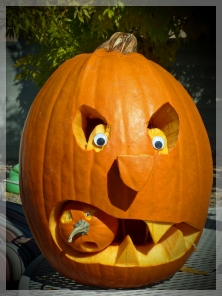
Just finishing its 5th season, the Food Network’s “Outrageous Pumpkins” features remarkable pumpkin artistry. This year’s competition matched up 14 of the nation’s best carvers into teams and challenged them to create over-the-top pumpkin creations. The pumpkin artists created horrific nightmares, constructed grisly crime scenes, and fashioned monstrous mechanical battling beasts. Using everything from melon ballers to huge saws, they they sculpted extraordinary and intricate ghouls, witches, wizards, goblins, werewolves, and monsters. As someone who is severely pumpkin-challenged (and eventually purchased a permanent Jack O-Lantern complete with an electric light), I’m amazed by the skill of these artists.
Watching those carvers transform what are nothing more than large gourds into works of art, I couldn’t help but think of another artist who is in the business of transformation: God. There are both similarities and differences between transforming pumpkins into Halloween décor and transforming people into Christians. In both cases, the finished product bears little resemblance to what it once was. But, while the pumpkins become something frightening and macabre, the Christians become more beautiful!

Both carvers and God start by selecting their subject but, unlike the pumpkin artists, God isn’t looking for perfection. He’ll take any color, size, condition, or age. Scratches, bruises, blemishes, a dried-up stem, and even a little mold or rot won’t keep anyone from His workshop. Just as the carvers cut into the pumpkins and scrape out all of the slimy stuff inside, God opens us up, as well. Rather than scooping out our guts, however, He scrapes away things like fear, anger, despair, doubt, hate, pride, and greed. Instead of an X-Acto knife, vegetable peeler, saw, or drill, God’s tools consist of His word, the church, and both blessings and challenges. Just as those artists’ imaginative pumpkin creations are unique, each one of God’s creations is a one-of-a-kind custom design.

Preferring something sinister and spooky, pumpkin carvers usually give their creations a menacing expression. Although the Christian’s outward appearance may not change, God wants His handiwork to spread faith, hope, and love rather than terror or dread so He gives us a far nicer demeanor. The carvers occasionally make small mistakes and, when that happens, they simply alter their design or use a toothpick to reattach a piece. God, however, never makes a mistake and every one of His creations is perfectly made. Pumpkin carvers transform pumpkins for only a few weeks around Halloween and I’m not sure what they do the rest of the year. On the other hand, God keeps busy transforming people all year long.

Although the carvers leave their pumpkins hollow, God fills His people with the Holy Spirit and His gifts. Wanting their creations to glow from the inside out, both the carver and God insert lights. While the carver uses a candle, light bulb, or flashlight, the Christian’s light comes from the Holy Spirit. Eventually, the pumpkin’s light will cease shining but God’s light lasts a lifetime. Unlike competitive carvers, God has no time limit and He continues tweaking us until our dying day. While the “Outrageous Pumpkins” competitors performed their artistry in hope of winning a $50,000 prize and bragging rights, God transforms His children simply out of His love for us.

Despite the hours and labor that go into their making, those fantastic pumpkin creations are temporary. Even when dipped in a mild bleach mixture, they will turn moldy and soft; eventually, they’ll end up in the trash. Not so with God’s handiwork! Unlike carved pumpkins, Christians tend to improve over time; in fact, they last forever!

A pumpkin has no choice about being chosen, washed, and transformed but we are free to reject God’s hand in transforming our lives. It’s wise to remember, however, that any pumpkins remaining in the patch after harvest will rot and decompose; the same goes for people.

This means that anyone who belongs to Christ has become a new person. The old life is gone; a new life has begun! [2 Corinthians 5:17 (NLT)]

Copyright ©2024 jsjdevotions. All rights reserved.

IT’S NOT FAIR

God saved you by his grace when you believed. And you can’t take credit for this; it is a gift from God. Salvation is not a reward for the good things we have done, so none of us can boast about it. [Ephesians 2:8-9 (NLT)]

Many years ago, while my son and his pals were playing baseball in the field next to the Miller house, the ball ended up going through the Miller’s window! When my son returned home, he asked me to call Mrs. Miller and ask for the return of his ball. Once I knew how the ball came to be in her possession, I told him he had to pay for the broken window before getting back his ball. So, for the next few weeks, the boy worked extra chores to pay off his debt.

Some people think of good works like the chores my son did to redeem his baseball. They picture a heavenly bookkeeper with a holy ledger who deposits their good deeds in the credit column and their sins in the debit. Whenever they err, a withdrawal is made from the works side to pay for the sin. It seems like a good plan. After all, my son worked off his debt so why can’t we just work off our sin debt?

If God used a balance scale with good works placed on one tray and sins on the other, how would the weight of good works and sins be determined? Would putting a dollar into the red kettle at Christmas be the same as being a hospice volunteer? Would petty theft weigh the same as grand larceny or adultery as much as mass murder? How many sins would be paid off by a mission trip? What would you need to discharge the sins of deceiving a spouse, gossiping about a neighbor, taking unfair advantage of someone, misappropriating funds, or cheating on your taxes?

Salvation, however, cannot be earned nor is it for sale. That’s good news for me since I know my sins far outweigh my good works and there’s no way I could do enough to purchase my salvation. Moreover, we can’t stock up good turns, kindness, benevolence, generosity, and service to pay for future sins. Thinking our worth comes from our works undervalues God’s gift of grace because good works aren’t what save us from spiritual bankruptcy! Salvation comes from Jesus alone! He paid our sin debt in full with his blood when He died on the cross.

When my son told me about the mishap at the Millers, he insisted he wasn’t the one who hit the ball that broke their window. Claiming his innocence, he protested paying someone else’s debt. It may not have been fair but it was necessary. Someone had to pay the Millers for their busted window and no one else came forward.

As the sinless Lamb of God, Jesus was far more innocent of any wrongdoing than my son. Nevertheless, He paid both my debt and yours! The only one who was absolutely free of sin deliberately chose to take the full weight of God’s justice for sins He didn’t commit! Jesus paid a debt He didn’t owe because mankind owed a debt that couldn’t be paid! It wasn’t fair, but it was necessary.

The Gospel is good news of mercy to the undeserving. The symbol of the religion of Jesus is the cross, not the scales. [John Stott]

For the wages of sin is death, but the free gift of God is eternal life through Christ Jesus our Lord. [Romans 6:23 (NLT)]

He himself is the sacrifice that atones for our sins—and not only our sins but the sins of all the world. [1 John 2:2 (NLT)]

He personally carried our sins in his body on the cross so that we can be dead to sin and live for what is right. By his wounds you are healed. [1 Peter 2 (NLT)]

Copyright ©2024 jsjdevotions. All rights reserved.

IMITATION

Be imitators of me, as I am of Christ. [1 Corinthians 11:1 (ESV)]

mockingbirdHearing the bird’s shrill harsh scream, I looked up expecting to see a blue jay. To my surprise, it was a mockingbird. Of all the beautiful songs it can imitate, I wondered why the mockingbird chose the strident call of the jay. Then, remembering how many blue jays inhabit our neighborhood, I realized their raucous “jaaaaay” is what the mockingbird frequently hears so that has become part of his song.

It’s not just mocking birds and parrots who mimic what they hear and see. Years ago, a retired friend told me about spending Christmas with his son’s young family in Minnesota. By December 26, he grew tired of hearing the three youngsters squabble over their new toys and this grandpa decided to enjoy some peace and quiet while shoveling the snow. When his young grandson insisted on helping, he gave the youngster a small child-sized shovel but the boy complained that he wanted the big one. Telling him it would be too heavy, Grandpa refused and started shoveling. When the child kept whining about using the big shovel, my friend used a few ill-chosen words before letting the boy give it a try. Of course, once he started with it, the child cried that it was too heavy. “$@#!&)%!” said Grandpa, “I told you so!” There were a few more profanities when the boy grew bored and started to toss snowballs. Eventually, however, the shoveling was finished. While taking off their coats in the house, the youngster proudly announced to his parents, “We just shoveled the whole $@#!&)% driveway!” You can’t blame him for the bad language; like the mockingbird, he was imitating what he’d heard!

Children never have been very good at listening to and obeying their elders but they are experts at imitating us. It’s been said that we should live in such a way that we wouldn’t be ashamed to sell our parrot to the town gossip (or have our youngsters answer questions like those asked by Art Linkletter in his 1960s show Kids Say the Darndest Things.)

Children mimic more than our words; they model our behavior, as well. For years, the kids and I watched my husband give two hard shakes to the handle after locking the front door to his business. Although he’d turn toward the car, before taking a step, he’d turn back around and give that door handle at least one more hard shake—just to make sure it was good and locked. When we returned north last May, I chuckled as I watched my son do the identical thing after locking the front door of the same business! Both our words and behavior get recycled to the next generation.

Children will imitate both the positive and negative aspects of our behavior. They can learn to be polite, considerate, positive, helpful, truthful, and modest or they can learn to be rude, selfish, negative, uncooperative, deceitful, and arrogant. Do we model the right kind of behavior—not just for youngsters but also everyone we encounter? As Christ’s followers, we should—regardless of how provoked, aggravated, or tired we may be.

My father-in-law, whose given name was Paul, was called “Bill” for most of his 96 years. When asked why, he explained that everyone called him “Bill” because he walked just like a man named Bill. Whose walk do we imitate? To be worthy of the name of “Christian,” we should be imitators of Christ and walk and speak as would He. Do we?

Whoever says he abides in him ought to walk in the same way in which he walked. [1 John 2:6 (ESV)]

Therefore be imitators of God, as beloved children. And walk in love, as Christ loved us and gave himself up for us, a fragrant offering and sacrifice to God.[Ephesians 5:1-2 (ESV)]

Copyright ©2024 jsjdevotions. All rights reserved.

THE ONLY PATH

Jesus told him, “I am the way, the truth, and the life. No one can come to the Father except through me.” [John 14:6 (NLT)]

Pope Francis recently visited Singapore and, when speaking to young people at an interfaith meeting, he is reported to have said “All religions are paths to God.” After comparing the various religions to “different languages that express the divine,” he added, “There is only one God, and each of us has a language to arrive at God. Some are Sheik, Muslim, Hindu, Christian, and they are different paths [to God].” While the pontiff was encouraging interfaith dialogue, his words are troubling. I will not presume to know the Pope’s meaning or intention with his comments. Nevertheless, I find it important to address how the world understood the pontiff’s message.

Jesus is not one of many ways to God; He is the one and only way! He spoke of Himself as the only path to heaven. He said His words are life, called Himself the ”bread of life,” and promised that His believers would have eternal life. Jesus is the only one who came down from Heaven, lived a perfect sinless life, fulfilled the Law and the Prophets, sacrificed Himself for mankind’s sins, and conquered death! As Christians, we believe salvation comes through Christ alone and that the Bible teaches us everything we need to know about God. At best, all any other religion offers is an incomplete, inaccurate, and deceptive understanding of God and His creation.

From where we live, there are no direct flights to my son’s home in San Diego. Although we have a choice of routes and airlines, we must change planes in Atlanta, Houston, Dallas, Charlotte, Chicago, or Washington. While there are different ways to get to California, if we stay in a connecting city, we’ll never get there. If we hope to see our son, we need to board the right plane—the one headed for San Diego. If, by mistake, we get on a plane going to Paris, we’d land more than 5,600 miles away from our son’s home. But, if we landed in Tijuana, we’d only be 20 miles away. Nevertheless, whether 5,600 miles or only 20 away from our destination, we wouldn’t find our son waiting there to welcome us to his home! While some flights might get us close to our journey’s end, there only is one correct place to land! It’s said that “close only counts in horseshoes and hand grenades.” That’s important to remember when it comes to both airports and God! Unless we get on another plane headed for San Diego, we won’t be seeing our boy. If we want the Son to welcome us to His heavenly home, we eventually must take the only path that leads to Him!

If we believe Christianity’s claims are true, then the claims of other religions must be wrong wherever they contradict it—and there are plenty of contradictions. For example, Islam’s condemnation of the Trinity and its rejection of the deity of Jesus, His death, resurrection, ascension, and atonement for our sins along with its denial of His Holy Spirit and the salvation of His believers don’t seem remotely close to our path. Islam seems more like deliberately heading to Paris when you’re supposed to be going west to San Diego!

While we may find wisdom and inspiration in Hinduism’s Bhagavad Gita, the Buddha’s words in the Dhammapada, the Chinese philosophy of the Tao Te-Ching, and in the rabbis’ discourse in the Talmud, we know those texts are not sacred and the words in them are man’s, not God’s. Christianity doesn’t allow for a mingling of faith in other philosophies or gods.

Saying we all worship the same God is what David Limbaugh calls “intellectual laziness.” The claim that all paths can lead to God is a statement we should never make or accept. It’s an insult to Jesus. As God incarnate, He came, suffered, and died on the cross for our sins—something totally unnecessary were there any other way to God. Whether you call them languages or paths, all religions do not lead to God. Then again, no “religion” leads to God; only faith in Jesus Christ does!

 Jesus is not one of many ways to approach God, nor is he the best of several ways; he is the only way [A.W. Tozer]

For this is how God loved the world: He gave his one and only Son, so that everyone who believes in him will not perish but have eternal life. God sent his Son into the world not to judge the world, but to save the world through him. There is no judgment against anyone who believes in him. But anyone who does not believe in him has already been judged for not believing in God’s one and only Son. [John 3:16-18 (NLT)]

Copyright ©2024 jsjdevotions. All rights reserved.