
That is why the Lord says, “Turn to me now, while there is time. Give me your hearts. Come with fasting, weeping, and mourning. Don’t tear your clothing in your grief, but tear your hearts instead.” Return to the Lord your God, for he is merciful and compassionate, slow to get angry and filled with unfailing love. [Joel 2:12-13 (NLT)]
 Although its customs and rituals have changed over time, Lent has been observed in some way by believers for centuries. In the early years of the church, the days leading up to Easter were a time of fasting and prayer in preparation for Easter baptisms and as penance for those who’d been excluded from communion. Irenaus of Lyons (c.130-200) wrote of such a season that lasted only a few days (or forty hours) and commemorated what was believed to be the duration of Christ’s time in the tomb. By the mid-third century, Bishop Dionysius spoke of a six-day fast practiced by the devout in Alexandria and, according to the Byzantine historian Socrates, the Roman Christians kept a pre-Easter fast of three weeks.
It wasn’t until the Council at Nicaea in 325 that the observance of Lent formally began. Starting six Sundays (42 days) before Easter, it ended on Holy Thursday eve. Even though people fasted on Good Friday and Holy Saturday, those days were not considered part of Lent. Whether this Lenten observance was initially intended just for those preparing for baptism or for everyone is unclear but the whole church adopted the practice in some way or another.
Even in the early church, Sunday (as a sort of mini-Easter celebrating the victory of the resurrection) was considered a feast day. In the 6th century, finding it inappropriate to fast on a feast day, Pope Gregory the Great declared that there should be no fasting on the six Sundays of Lent. This, however, cut the Lenten observance back to 34 days and the people wanted to reenact the forty days Jesus spent in the wilderness. Eventually, to make up for the missing Sundays, four more days were added to the beginning of Lent (now starting on Ash Wednesday) and the two fasting days of Good Friday and Holy Saturday were added to the end of the season, making Lent forty days long. Although fasting from food was the emphasis in the beginning, new practices evolved over time and the concept of personal sacrifice eventually became Lent’s focus. In preparation for Easter and crossing denominational lines, Lent has now become a season of self-examination, penitence, self-denial, and spiritual growth.
Lent, like Christmas and Easter, is without scriptural basis. Man-made, not God-ordained, it is a matter of choice as to if and how we keep this season. If we choose to observe Lent, we shouldn’t think of Lent’s self-denial or fasting as a second chance to keep our failed New Year’s diet resolutions. Moreover, no Lenten practice should be thought of as a way to earn salvation or score brownie points with God. We are saved by God’s grace through faith, not works! Pastor Eric Ferris reminds us that, “You could observe 1,000 Lents and it won’t ever accomplish in your life what the cross of Jesus has.”
The purpose of Lent is self-reflection, self-denial, repentance, and seeking to live more for Christ and less for self. Rather than asking what we’re going to give up for Lent, the better questions would be ones like, “What can I do to draw nearer to God?” and “How can I grow more like Christ?” Asking the questions, of course, is not enough; the next step is doing those things! In preparation for Easter, what will you do for the next six weeks?
 When Jesus forgave the unnamed woman’s sins, he caused quite a stir among the Pharisees and religious leaders who were His fellow dinner guests. People can forgive an offense against them, but they can’t forgive an offense against someone else or God! While I can forgive your $10 debt to me, I have neither the right nor the power to say you don’t have to pay the $150,000 you also owe the Bank of America, Sallie Mae, Capital One and Chase for your mortgage, college loan, car financing, and credit card purchases. A person can’t do that but God can! Because only God has the authority to forgive people’s sins, implied in Jesus’ forgiveness of the woman’s sins, is a claim that He is God.
 My grandmother lived in a beautiful large house. To the left of the foyer, behind closed French doors, was an elegant room she called the “drawing room,” but it wasn’t an artist’s studio where people drew. With its grand piano, silk draperies, formal furniture, and crystal chandelier, it was a room saved for entertaining special guests. Strategically placed near the front door, guests could go directly into it without passing through the rest of the house. As splendid as the room was, I never saw anyone in it; family and close friends always gathered in the “library.”
 Since you have heard about Jesus and have learned the truth that comes from him, throw off your old sinful nature and your former way of life, which is corrupted by lust and deception. Instead, let the Spirit renew your thoughts and attitudes. Put on your new nature, created to be like God—truly righteous and holy. [Ephesians 4:21-24 (NLT)]
 Several years ago, one of my children asked if, with the benefit of hindsight, would I do it all over again—leave school, get married at twenty, have three children, and be a stay-at-home mom. Admitting that I had no idea what marriage and motherhood entailed when I did it, I would have enjoyed having had a life of my own, a career, and an opportunity to live without parental responsibility. Nevertheless, I added, in spite of the sacrifices, challenges, and trials over the years, I wouldn’t trade the life I’ve lived or the children God gave me for anything.
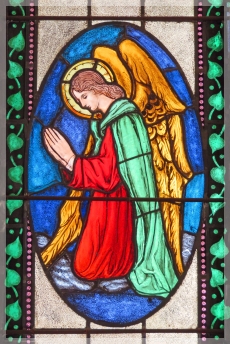 Sunday, we will light our Advent wreath’s fourth candle—the purple one known as the angel or love candle. We’ll read Nathan’s prophecy in 2 Samuel that David’s kingdom would continue forever. Although we know that David’s earthly dynasty ended some 400 years after Nathan’s words, God’s promise was fulfilled in Jesus—David’s direct descendant who now reigns forever. Jesus is tied to the Old Testament prophecies in two selections from Luke 1 in the angel’s words to Mary that her son, a descendant of David, would reign over Israel and His kingdom would never end and Mary’s beautiful song of praise known as the Magnificat in which she expresses her understanding that God is fulfilling His promises with the birth of her son.
 Devotions of the Heart