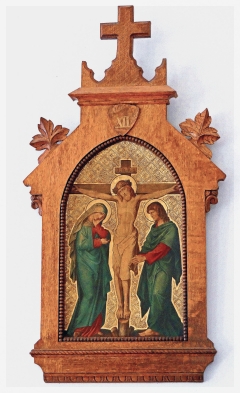
SLEEPING ON THE JOB – HOLY WEEK 2022

Jesus told them, “Tonight all of you will desert me. … Peter declared, “Even if everyone else deserts you, I will never desert you.” Jesus replied, “I tell you the truth, Peter—this very night, before the rooster crows, you will deny three times that you even know me.” “No!” Peter insisted. “Even if I have to die with you, I will never deny you!” And all the other disciples vowed the same. [Matthew 26:31,33-35 (NLT)]

prairie false indigoApparently, coffee was not served after dinner in the upper room that Thursday night. Granted, a nap is welcome after a big meal but that evening’s Passover meal was like no other and Jesus had predicted that the disciples would desert Him. After such a warning, you’d think the men would have been extra cautious. Scripture tells us Jesus was troubled and grief-stricken when He asked Peter, James, and John to keep watch with Him. Surely, that should have motivated His closest friends to keep awake, but it didn’t. Three times Jesus went to pray and three times he returned to find the men asleep. It was Jewish custom on Passover night to stay up late and talk of God’s acts of redemption so staying awake this night was something they’d all done on other Passover nights. Nevertheless, even after Peter specifically was cautioned to stay awake while praying to stand strong against temptation, the men slumbered. Shouldn’t the warning that he’d deny Jesus three times before morning been enough at least to keep Peter alert and deep in prayer? While the Lord was in anguish and prayed so intently that He sweat drops of blood, His most trusted friends took an after-dinner snooze. They were asleep on the job.

Perhaps the disciples’ biggest mistake was in their self-confidence. When told they’d abandon their beloved leader, they all protested that could never happen. Unfortunately, not one of them took the possibility of their deserting Jesus to God in prayer. Instead, they slept! They didn’t set out to deliberately desert Him but, by not praying, they failed the test before it began. Even the best of intentions won’t protect us in time of trial; for that we need prayer. Moreover, they failed a friend in need. Had the disciples stayed awake with Jesus, while they couldn’t have taken away the bitter cup He’d been given, they could have shared His pain. Sharing our prayers and strength with those in distress is what the community of faith is supposed to do.

The Jewish custom in Jesus’ day was to forgive someone for the same sin only three times. How fortunate for Peter that Jesus said we should forgive seventy times seven. Otherwise, with his three naps and three denials, he would have used his forgiveness allotment twice in just one night. Following Jesus’ resurrection, He didn’t berate the disciples for deserting Him, chastise Thomas for doubting, or rebuke Peter for his denials. In fact, He reinstated Peter and told the man to feed His sheep! From Jesus’ example we learn to love and forgive the human failings of those who disappoint us.

Like Jesus, we’ve all had friends fail us at one time or another and probably more than three times. Perhaps, like Jesus, we should come to expect them to disappoint us from time to time. After all, in spite of our good intentions, we flawed beings can be selfish, self-centered, inconsiderate, callous, inattentive, and worse. Thinking we’re invulnerable to the enemy’s attack is one of his favorite tactics and, like the disciples, we’ve been overly confident in our own abilities and self-control and, like the disciples, we frequently fail our Christian brothers and sisters. When comfortable, content, and well fed, like the disciples that night, we often become oblivious to the needs of others and stop being vigilant and prayerful. Do we pray with and keep watch over our friends during their times of suffering and difficulty or are we asleep on the job?

Why grow we weary when asked to watch with our Lord? Up, sluggish heart, Jesus calls thee! Rise and go forth to meet the Heavenly Friend in the place where He manifests Himself. [E.M. Bounds]

Keep watch and pray, so that you will not give in to temptation. For the spirit is willing, but the body is weak.” [Mark 14:38 (NLT)]

Copyright ©2022 jsjdevotions. All rights reserved.

THY WILL BE DONE

“My Father! If it is possible, let this cup of suffering be taken away from me. Yet I want your will to be done, not mine.” … Then Jesus left them a second time and prayed, “My Father! If this cup cannot be taken away unless I drink it, your will be done.” … So he went to pray a third time, saying the same things again. [Matthew 26:39,42,44 (NLT)]

water liliesThroughout His ministry, it seems that Jesus knew that the cross awaited Him but we don’t know if the human part of Him knew the exact details. Even so, it’s one thing to know what lays in the future but quite another to know it is about to begin within a matter of minutes. That night in Gethsemane, God showed Jesus the cup from which He would drink and He showed it in gruesome detail. Jesus viewed the betrayal, abandonment, sham trials, mocking, beating, flogging, and suffering torture on the cross along with the jeers of the crowd and the heartbreak and tears of His mother and the other women at the foot of the cross. Had Jesus not known exactly what the next 24-hours held, He would have been no different than the lambs brought to the Temple for sacrifice. They weren’t there of their own volition and had no knowledge of what would happen to them when presented to the priest. Rather than willing sacrifices, they were victims! The Lamb of God, however, needed to know the extraordinary cup—the horrible ordeal—that lay before him because, rather than a victim, He was a willing volunteer! His anguished prayers that night, however, tell us He didn’t look forward to it.

When we look at Jesus’ prayers that last night, there’s a condition to His request to remove the cup: “if it is possible.” If there were an alternative means to accomplish God’s will, Jesus certainly would have preferred it. Knowing exactly what He was facing, the human part of Him prayed for another way and He prayed so intensely that he sweat blood! Judas and the soldiers hadn’t yet arrived and Jesus could have quietly slipped away in the night and disappeared into Jerusalem, but He didn’t! As He prayed for deliverance, He also prayed to do God’s will. Since the Son of God had come to mankind to do His Father’s will, Jesus obediently and willingly stayed in the garden and submitted to all the horror that followed.

Looking at Jesus’ prayers in Gethsemane as a lesson in prayer, we see that since God the Father denied the request of His only Son, we shouldn’t expect God to agree to all we ask. C.S. Lewis says that Jesus’ unanswered prayers that night make it clear that prayer is not to be considered “a sort of infallible gimmick.” There is, however, a greater lesson in Jesus’ prayers in Gethsemane.

He forthrightly asked for the horror of what lay ahead to be removed which is the sort of prayer we typically offer when a loved one lies in a coma, the doctor says “inoperable,” the bank threatens foreclosure, we face 32 more radiation treatments, or a child become addicted. We pray, “Take it away, Lord—make it all right!” That, however, is usually where we stop but Jesus didn’t stop there. After asking for our difficult cup to be removed, do we add “if it is possible,” with the understanding that God’s purpose is more important than our desire? Finally, like Jesus, do we complete our prayer by fully submitting to God’s divine plan (whether we like it or not) with the words, “I want your will to be done, not mine”? Jesus submitted, will we?

If there was not an absolute necessity of his suffering them in order to their salvation, he desired that the cup might pass from him. But if sinners, on whom he had set his love, could not, agreeably to the will of God, be saved without his drinking it, he chose that the will of God should be done. He chose to go on and endure the suffering, awful as it appeared to him. [Matthew Henry]

He walked away, about a stone’s throw, and knelt down and prayed, “Father, if you are willing, please take this cup of suffering away from me. Yet I want your will to be done, not mine.” Then an angel from heaven appeared and strengthened him. He prayed more fervently, and he was in such agony of spirit that his sweat fell to the ground like great drops of blood. [Luke 22:41-44 (NLT)]

Copyright ©2022 jsjdevotions. All rights reserved.


HOW TO PRAY (Prayer – 2)

I desire then that in every place the men should pray, lifting holy hands without anger or quarreling. [1 Timothy 2:8 (ESV)]

We always knelt for prayer in the church I attended as a girl so I used to think the only way to pray was on my knees with head bowed and hands tightly clasped. While I now pray in a variety of postures, I wondered if Scripture tells us exactly how we should pray.

In Jesus’ day, both Jews and pagans usually raised their heads, stretched out their arms, and stood to pray. John tells us Jesus prayed with his head lifted before heading out to the Garden of Gethsemane but Matthew tells us He prayed prostrate on his face once he got there. When praying, Moses bowed his head before the Lord and the tax collector stood, bowed his head, and beat his breast. Solomon and Daniel both knelt in prayer, a leper knelt at Jesus’ feet when praying for healing, and the 2nd century church historian Hegesippus reported that James (the earthly brother of Jesus) spent so much time on his knees praying that “his knees became hard like those of a camel.”  Elijah climbed to the top of Mt. Caramel, bowed down, and put his face between his knees when he prayed but Israel’s army fasted, wept, and sat when they prayed at Bethel. People seemed to pray every which way.

Pictures in the Catacombs of Rome show early Christians praying with their arms extended out to the side but, at some point, arms were brought closer to the body. Perhaps it was to avoid the very thing Jesus warned about—praying in an affected or exaggerated manner to appear more pious. Then again, it simply may have been a practical matter of space when people gathered for worship.

Eventually, people started praying either with clasped hands or by crossing their arms and touching each shoulder with the opposite hand. Legend has it that monks would fold strips of leftover dough into the shape of crossed arms and, when children had memorized a prayer, they’d be rewarded with these treats called pretiola, Latin for “little reward” or preces, Latin for “prayers.” In Germany, however, the country known for pretzels, they’re called bretzels. The origin of bretzel, however, is brachium, Latin for “arms.” Whether the word initially meant reward, prayer, or arms and the validity of a monk inventing the knotted shape of the pretzel to symbolize arms crossed in prayer, we’ll never know. It does, however, make a nice story.

By the 9th century, Greek Christians claimed that the only way to pray was with the hands crossed over the breast but Pope Nicholas vehemently opposed it and defended the practice of folded hands during prayer. The Roman and Orthodox churches split in the 11th century and today it is considered proper etiquette in an Orthodox church to cross one’s arms when approaching the chalice during Communion. The Old Orthodox Prayer Book calls for the “brethren to stand with their arms folded over their breasts and their heads slightly bowed” during the reading of the Six Psalms. One source said such a stance symbolizes the folding of angels’ wings, standing before the throne of God.

Standing, sitting, kneeling, or prone? Hands clasped, arms raised, crossed, or at our sides? Eyes open or shut? While various denominations have their traditions or rules, the Bible gives no guidance as to our posture during prayer. While silent on the position of our bodies in prayer, Scripture isn’t when it comes to the position of our hearts! They should be bowed in submission to the Lord, free of anger and quarreling, and forgiving of others. Our prayers should come from an earnest, trusting, sincere, and thankful heart. We are to pray in truth and faith, in the power of the Spirit, and in Jesus’ name. How we do it, however, is up to us.

Perhaps there is no one special position for prayer because we are to pray without ceasing, meaning prayer isn’t limited to a specific time, place or situation—it is to be an essential ongoing part of our lives. Standing upright with head raised while on the battle field would be as problematic as kneeling in prayer (or closing your eyes) while driving, praying with arms crossed while serving food at the shelter, or lying face down on the floor of your workplace! As Reverend Billy Graham so aptly put it, “It is not the body’s posture, but the heart’s attitude that counts when we pray.”

A concentrated mind and a sitting body make for better prayer than a kneeling body and a mind half asleep. [C.S. Lewis]

Rejoice always, pray without ceasing, give thanks in all circumstances; for this is the will of God in Christ Jesus for you. [1 Thessalonians 5:16-18 (ESV)]

Copyright ©2022 jsjdevotions. All rights reserved.

TEACH US TO PRAY (Prayer – 1)

Once Jesus was in a certain place praying. As he finished, one of his disciples came to him and said, “Lord, teach us to pray, just as John taught his disciples.” [Luke 11:1 (NLT)]

Hawaiian sunset vineWhile asking one’s teacher how to pray was a typical request in Jesus’ day, Jesus was anything but a typical teacher. He’d walked on water, stilled storms, healed the sick, raised the dead, and turned water into wine, but His disciples didn’t ask how to do those impressive miracles. Instead, they asked Him how to pray.

Even though they didn’t completely recognize the divinity of Jesus, the disciples understood that His power seemed to come from prayer. Jesus prayed at his baptism and before choosing his disciples; He prayed before heading to Galilee and both before and after feeding the 5,000. He said a prayer of thanksgiving before offering His rest and yoke to the people and prayed with Peter, John, and James before His transfiguration. He prayed after healing people in Capernaum and before raising Lazarus from the dead. He prayed for the disciples and “all who will ever believe in me through their message.” [John 17:20] He prayed when blessing the little children, for Peter’s faith, in Gethsemane, and when He was nailed to the cross. When He wasn’t teaching or sleeping, Jesus seemed to be praying. In fact, he’d been praying when the disciples asked him how to pray!

Jesus didn’t conduct a seminar, preach a three-point sermon, categorize types of prayers, or set special requirements like those found in the Torah. He said nothing about the wearing of phylacteries, putting fringe on a prayer shawl, or the number of times to pray in a day. Instead of talking about prayer, Jesus simply prayed. This uncomplicated prayer we know as the Lord’s Prayer gave them (and us) the guidelines for all prayer. In simple everyday language Jesus offered praise, thanksgiving, petition, and asked for forgiveness and protection from evil.

Yet, for some reason, we Christians aren’t satisfied with such a straightforward process. Surely something as powerful as prayer should be more complicated! Convinced there must be a secret technique to mastering the art of prayer, we wonder if there are special words or phrases we should say. There aren’t. Prayer simply is an intimate interaction with God and isn’t supposed to be difficult. In fact, God really gave us only one rule: “You must not have any other god but me.” [Exodus 20:3]

Other than the Lord’s Prayer, which is just a blueprint for prayer, we haven’t been given a specific prayer to recite. In fact, the only prayer Jesus commends is perhaps the simplest one—that of the repentant tax collector who just said, “O God, be merciful to me, for I am a sinner.” [Luke 18:13] It’s a plainly expressed sincere prayer, offered with a humble and repentant heart, and Jesus assures us that it will be heard.

We already know all we really need to know about prayer to pray and praying is far easier (and safer) than riding a bike. We just need to do it. Just like bike riding, however, we’ll get better at praying the more we do of it!

Prayer is talking with God. God knows your heart and is not so concerned with your words as He is with the attitude of your heart. [Josh McDowell]

Don’t worry about anything; instead, pray about everything. Tell God what you need, and thank him for all he has done. Then you will experience God’s peace, which exceeds anything we can understand. His peace will guard your hearts and minds as you live in Christ Jesus. [Philippians 4:6-7 (NLT)]

Never stop praying. [1 Thessalonians 5:17 (NLT)]

Copyright ©2022 jsjdevotions. All rights reserved.

LOST CAUSES

For this is what the Sovereign Lord says: I myself will search and find my sheep. I will be like a shepherd looking for his scattered flock. I will find my sheep and rescue them from all the places where they were scattered on that dark and cloudy day. … I myself will tend my sheep and give them a place to lie down in peace, says the Sovereign Lord. I will search for my lost ones who strayed away, and I will bring them safely home again. [Ezekiel 34:11-12,15 (NLT)]

opossum - clam passWalking along the shoreline, I was surprised to see a baby opossum on the beach. A man with a large bucket was trying to scoop him up to return him to the safety of the mangroves but the little guy would have none of it. Lost and in danger of dying of thirst or becoming dinner for an osprey or eagle, I’m sure he thought he was on a wonderful adventure. Meanwhile, his mother was probably frantically searching the mangroves for her wayward child.

Thinking of frantic mothers and wayward children reminded me of Monica’s story. Back in 352, she gave birth to a baby boy—the man we know as St. Augustine. As a young man, however, Augustine was anything but a saint; he was disobedient, strong-willed, self-indulgent, and immoral. Although he’d been raised in the faith, he abandoned Christianity for the world of sin to pursue paganism and pleasure. Rather than lost on the beach, Augustine was lost in his hedonistic life. The original “helicopter” parent, Monica never gave up on her dissolute son and, as distressed as she was by his bad behavior, she pursued and prayed for him. Her persistence was rewarded and, after seventeen years of praying for her lost boy, Augustine converted to Christianity. After being baptized, he founded a religious order, was ordained as a priest, and was appointed as the bishop of Hippo. Devoting the rest of his life to serving the Church, he used his brilliant mind to establish the intellectual foundations of Christianity in the West. A prolific writer, Augustine is often called the most significant Christian writer after the Apostle Paul. What would his story be if his mother Monica had thought her sinful son was a lost cause? What if she’d stopped praying for her lost son’s soul?

There are some names on my prayer list that I’ve begun to think of as “lost causes”—people for whom I’ve been praying for several years. Due to an unfortunate combination of bad choices and bad circumstances, they are people whose lives have been wasted, people who have sunk so deep that rising from the depths seems impossible, people whose redemption seems hopeless, people who are so lost even their loved ones don’t know where they are. I was ready to delete them from my prayer list before seeing the opossum baby. The man with the bucket didn’t give up trying to save the animal, Monica never gave up on Augustine, and God will never stop trying to rescue the lost. Those names and others like them will stay in my prayers. You see, for God, there are no lost causes, only lost children.

If a man has a hundred sheep and one of them wanders away, what will he do? Won’t he leave the ninety-nine others on the hills and go out to search for the one that is lost? And if he finds it, I tell you the truth, he will rejoice over it more than over the ninety-nine that didn’t wander away! In the same way, it is not my heavenly Father’s will that even one of these little ones should perish. [Matthew 18:12-14 (NLT)]

For the Son of Man came to seek and save those who are lost. [Luke 19:10 (NLT)]

Copyright ©2022 jsjdevotions. All rights reserved.

HAVE YOU MET YET?

Thus says the Lord: “Let not the wise man boast in his wisdom, let not the mighty man boast in his might, let not the rich man boast in his riches, but let him who boasts boast in this, that he understands and knows me, that I am the Lord who practices steadfast love, justice, and righteousness in the earth. For in these things I delight, declares the Lord.” [Jeremiah 9:23-24 (ESV)]

Keukenhof Gardens - NetherlandsMy husband loves to watch the chefs on Food Network but watching food being prepared on television doesn’t fill his empty stomach any more than just seeing his bottle will quiet a hungry baby. I could show you photos of the tulips and daffodils in Holland’s Keukenhof Gardens but that wouldn’t give you the experience of walking among hundreds of thousands of blooming flowers and smelling their fragrant aroma. You could tell me all about your children and even show me their pictures and, while I’d know about them and even recognize them, I wouldn’t know them until we met face to face and spent time together. Before I had my first child, I attended birthing classes and read all about labor and childbirth but nothing I learned came anywhere near to approximating the actual event! It’s been thrilling watching the Olympic athletes compete in the bobsled and monobob events, but watching from my sofa doesn’t come close to actually riding a sled down an icy track at more than 80-mph, dropping 384 feet in less than a mile while negotiating 16 turns, and feeling forces five times the pull of gravity on one’s body! Second-hand information is fine as far as it goes, but it never equals the genuine experience.

Do we have a first-hand relationship with God? Do we truly know Him or do we simply know about Him? There is nothing wrong with learning about Him through Bible study, our pastors, church friends, religion books, and even blogs. Nonetheless, we don’t want a second-hand faith or a long-distance relationship. Rather than living vicariously through another person’s faith journey, we must take that journey for ourselves. Listening to someone else read the Bible is not the same as reading it ourselves. As happy as I am to have you reading my words, just reading about the Bible and learning someone else’s interpretation of God’s word is not a substitute for studying His message and letting His word change your lives. Instead of just listening to our pastors tell us about God, we must come to know God and develop a personal relationship with Him.

There comes a time in our lives when our second-hand knowledge about God must become the first-hand experience of knowing Him. Consider the book of Job. The man endured the worst of the worst—losing family, wealth, health, and even the respect of his friends. As he questioned what he did to receive such suffering, his friends explained what they knew of God—some of it was right and some wrong but the part that was right was misapplied in Job’s situation. His friends meant no harm; they just were as ignorant as Job and had no idea what God was doing in the man’s trials. When God finally revealed himself to the suffering man, Job finally understood he and his friends had been speaking in ignorance because, while they’d heard about God, they really didn’t know Him.

We must never make the mistake of thinking that knowing what we believe is the same as knowing God! While God may not reveal Himself in a whirlwind as He did to Job, He can be known. Television ads for a jewelry store here in southwest Florida always end with the owner asking, “Have we met yet?”  Could God be asking that question of you?

I had only heard about you before, but now I have seen you with my own eyes. I take back everything I said, and I sit in dust and ashes to show my repentance. [Job 42:5-6 (NLT)]

Rather, you must grow in the grace and knowledge of our Lord and Savior Jesus Christ. [2 Peter 3:18 (NLT)]

Copyright ©2022 jsjdevotions. All rights reserved.