
Moses remained there on the mountain with the Lord forty days and forty nights. In all that time he ate no bread and drank no water. And the Lord wrote the terms of the covenant—the Ten Commandments—on the stone tablets. [Exodus 34:28 (NLT)]
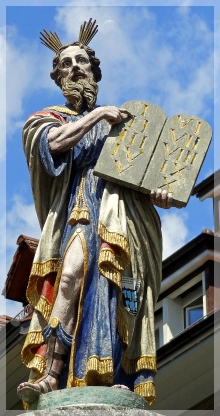 Although three places in Scripture tell us that the Lord proclaimed ten commandments and wrote them on stone tablets, those tablets weren’t numbered (especially not with Roman numerals)! The original languages of the Bible (Hebrew, Aramaic, and Greek) didn’t contain punctuation and the earliest manuscripts didn’t even have spaces between the words. While the words in Scripture are God-breathed, the punctuation was at the discretion of later copyists and translators. Without numbering, punctuation, or paragraphs, we can’t know for sure where one commandment ends and the other begins. As a result, while Jews, Roman Catholics, Protestants, and Orthodox Christians all observe the Ten Commandments, their commandments are not all the same!
For a Jew, rather than ten commandments, there are 613 throughout the Hebrew Scriptures. The first ten are called the Decalogue. While most Christians consider Exodus 20:2, “I am the Lord your God, who rescued you from the land of Egypt, the place of your slavery,” a preface to the Ten Commandments, it is the first one for a Jew and considered the most important because it establishes God’s authority for all that follows. Until that first commandment is accepted—that Adonai is one’s God—the rest wouldn’t be obeyed. The Jewish second commandment spans Exodus 20:3-6 and combines three prohibitions regarding idolatry: (1) no other gods, (2) no making of idols, and (3) no worship of idols. Commandments three through ten are the same as those recognized by most Protestants and Orthodox Christians.
Around 220 AD, the Christian Biblical scholar Origen of Alexandria numbered the commandments in the way familiar to most Protestant and Orthodox Christians. Skipping Exodus 20:2, He began with the prohibition of false gods “You shall have no other gods before me,” and continued with the second commandment prohibiting idols. The 10th commandment prohibited all coveting.
In the fifth century, however, Saint Augustine re-numbered the commandments so that the prohibitions about other gods and idols were combined into the first commandment. Making him short one commandment, Augustine then split Exodus 20:17 into two with coveting a neighbor’s wife the 9th commandment and coveting anything else of the neighbor’s the 10th. Although this required rearranging Scripture’s words, perhaps he reasoned that coveting your neighbor’s wife was vastly different than coveting his house or team of oxen. In any case, Augustine’s system was adopted by the church.
In 1054, the Christian church split into the Eastern Orthodox and the Roman. Orthodox Christians follow Origen’s numbering but include Exodus 20:2, “I am the Lord your God who rescued you from Egypt….,” in the first commandment. The Protestant Reformation of the 16th century further divided the church. Except for Lutherans, the Protestant church returned to Origen’s original numbering system. Perhaps because Luther was an Augustine monk for fourteen years, his version of the Commandments follows that of the Roman Catholic church with one notable exception. Returning to the original order found in Scripture, Luther’s 9th commandment prohibits coveting your neighbor’s house and the 10th prohibits coveting his wife, servant, animals, or anything else. In this way, Luther distinguished coveting the inanimate (house) from coveting the animate (wife, servant, etc.).
Who’s right? Only God know! Far more important than how the commandments are numbered, however, is what those commandments meant to the Israelites and what they mean to us today. The first three or four (depending on your denomination) have to do with mankind’s relationship to God and lay out our obligation to honor our Creator. The next seven or six (again depending on your denomination) have to do with the obligations we have to one another in family and society and lay out the foundation for building a community. Rather than disagreeing about how to number the Ten Commandments, we should make a greater effort to live the two spoken by Jesus!
 On June 19, Louisiana’s Governor Jeff Landry signed legislation requiring all public K-12 classrooms and state-funded universities to display a poster-sized version of the Ten Commandments in “large, easily readable font” in every classroom next year. As expected, a lawsuit has been filed to block what some say is an unconstitutional requirement. I’ll leave the arguments about civil liberties and constitutional law to the lawyers and courts; Louisiana’s law is troubling for other reasons.
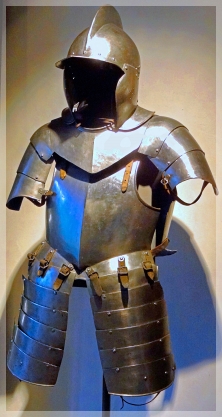 Back in in 1586, during the Eighty Years’ War, Sir Philip Sidney was fighting for the Protestant cause against the Spanish when he noticed another soldier was without leg armor. Believing that he shouldn’t be better protected than his men, Sidney gave the man his cuisses (armor that covered the thigh). During the Battle of Zutphen, Sidney was fatally wounded in his thigh during the final charge and, three weeks later, he died of gangrene from the injury. While heroic, his death was avoidable if the man had worn his complete set of armor!
 Described as a “preaching genius…like no other preacher you have ever heard,” the late Rev. Fred Craddock was well-known for including stories in his sermons. He told one that took place during the early 60s in a diner in the deep South. Although the white Craddock sat in a booth and was served with courtesy and consideration, he silently watched the diner’s manager treat a Black man at the counter with rudeness, disdain, and open contempt. Although offended by the man’s racist behavior, Craddock remained silent. It was when he walked out of the diner after finishing his meal that the preacher heard a rooster crow. A signal of his betrayal, the crowing told the preacher that, by ignoring one of the “least of these”, he’d ignored Jesus! His silence was as much a betrayal of the Lord as were Peter’s denials!
 When I learned about people like Abraham, David, Moses, and Samson as a girl, they were the Bible’s version of super-heroes like Batman or Superman. The Bible’s heroes were larger than life, obedient, invincible, and seemed to overcome their obstacles effortlessly. Appearing perfect in their faith and actions, they weren’t people to whom I could relate. In reality, they were as flawed as the rest of us but, for the most part, their imperfections and failures were redacted from the stories we learned in Sunday school.
 The email from my dentist asked, “Would you recommend us?” When I answered in the affirmative, I was hyperlinked to a site that added my five-star rating to that of other patients. The following day, I received a longer survey regarding my recent visit. Once done, it again asked if I would recommend his services and requested use of my name in an on-line testimonial. It’s clear that my dentist wants more than feedback; he wants the public approval of his patients. Although I like him, I like my privacy more, so I declined!
 Devotions of the Heart