MORE THAN THESE

sunrise - Cancun MexicoWhen they had finished breakfast, Jesus said to Simon Peter, “Simon, son of John, do you love me more than these?” [John 21:15 (ESV)]

Following His resurrection, Jesus remained on earth for forty days during which He was seen by His family, disciples, and followers (more than 500 of them at one time). The time frame of Jesus’ appearances, however, is unclear. Some time after He appeared to the disciples Resurrection Sunday and again eight days later when Thomas was present, Peter told the others he was going fishing. The disciple wasn’t referring to an afternoon of sport fishing—Peter was going back to fishing for species like tilapia and sardines rather than men. The kingdom had not arrived and, unsure of what was next, the disciples were at loose ends. Leaving Jerusalem, Peter and at least six others went to back to their homes and livelihoods in Galilee.

Fishing on the Sea of Galilee was done at night so the fish wouldn’t see the nets. Although the disciples cast their nets several times that night, nothing was caught. As dawn approached and the men again pulled in an empty net, a man on shore called out and told them to cast the net from the other side. Whether it was the morning mist, low light, or sweat in their eyes, the men didn’t recognize the stranger. Nevertheless, after a fruitless night on the water, the discouraged disciples did as instructed. When their net got so full they couldn’t haul it in, John realized the man was Jesus! After all, this wasn’t the first time He’d filled their nets. That first time, the men left everything to follow Jesus to become “fishers of men” and this miracle repeated Jesus’ call to them.

Upon recognizing Jesus, Peter immediately jumped out of the boat to greet Him while the others brought their enormous catch into shore. After enjoying breakfast on the beach, Jesus asked Peter if the disciple loved Him “more than these.” He asked Peter that question three times and scholars and theologians have written hundreds of treatises about His questions and Peter’s answers. They discuss the relationship of Jesus’ three questions to the disciple’s three denials and ponder the significance of Jesus calling the disciple by his old name of Simon rather than Peter. They analyze the use of agape (sacrificial love) and phileo (brotherly love) in both questions and answers while some even try to find hidden meaning in the number of fish caught (153). I’ll leave those issues to them.

My attention was caught by Jesus’ first question to the man who would be the foundational “rock” of the new church: “Simon, son of John, do you love me more than these?” Although Peter asserts that he loves Jesus after each question, who or what are the “these” to which Jesus referred?

Was Jesus asking Peter if the disciple loved Jesus more than any of the other men did? That last night, when Jesus predicted He’d be betrayed and deserted before night’s end, Peter seemed to think he loved Jesus the most. The cocky man even boasted that, “Even if everyone else deserts you, I never will.” Was the one who denied the Lord three times that night still so sure of himself?

Could “these” have been the other disciples? Was Jesus asking Peter whether he loved Him more than he loved his brother Andrew and the rest of the men gathered on the beach? Could his love for those men ever draw him away from following Jesus? If he had to decide between Jesus and family or friends like James and John, who would he choose?

Or, could “these” have referred to the boat, nets, and amazing catch of fish on the beach that morning? In Jesus’ day, the fishing industry was quite profitable and the day’s catch represented a great deal of money. Did the disciple love Jesus more than his life as a Galilean fisherman? Was Jesus asking Peter if he loved the Lord more than the world in which he lived?

It was after Peter’s third affirmation of his love for Jesus that the Lord predicted Peter’s violent death. By describing Peter with his hands stretched out while others girded or bound him and took him where he didn’t want to go, the Lord was describing a martyr’s death, likely crucifixion. After making clear the true price Peter would pay, Jesus repeated the words He’d spoken to Simon the fisherman three years prior: “Follow me!”

Indeed, for Simon the fisherman to become Peter the apostle and leader of the twelve, he had to love Jesus more than any of the other disciples did, had to love Jesus more than he loved his friends and family, and had to love Jesus more than his life as a Galilean fisherman. In fact, since he knew how it would end, Peter had to love Jesus more than his own life!

Repeating the call He made to Peter, Jesus tells us, “Follow me.” Peter did; will we? Do we love Him more than these?

Whoever loves his life loses it, and whoever hates his life in this world will keep it for eternal life. If anyone serves me, he must follow me; and where I am, there will my servant be also. If anyone serves me, the Father will honor him. [John 12:25-26 (ESV)]

Copyright ©2024 jsjdevotions. All rights reserved.

THE DRAGNET

Again, the kingdom of heaven is like a net that was thrown into the sea and gathered fish of every kind. When it was full, men drew it ashore and sat down and sorted the good into containers but threw away the bad. So it will be at the end of the age. The angels will come out and separate the evil from the righteous and throw them into the fiery furnace. In that place there will be weeping and gnashing of teeth. [Matthew 13:47-50 (ESV)]

Because most of the disciples hailed from Galilee where fishing was fundamental to the area’s economy, Jesus’ parable comparing the Kingdom of Heaven to a fishing net gave them a beautiful visual image of the Kingdom when the final judgment occurs. Since we’re not Galilean fishermen, however, our picture of a fishing net might be like the hand-held ones used for trout or bass fishing. Jesus, however, used the word sagéné, meaning dragnet; its English equivalent is seine.

Unlike the trammel and cast nets the disciples used when Jesus provided them with miraculous catches, the fine meshed dragnet could be as long as 1,000 feet, as tall as 25-feet at the middle point, and required a team of fishermen. One end of the net would be firmly secured on shore while the other was attached to the boat. The boat would make a large circle out in the water before returning further down the shore. Because cork floats were attached to the net’s top while lead weights were attached to its bottom, the dragnet formed a net wall parallel to the shore from the top of the water to the bottom of the lake. Once the net was set, a team of up to 16 men (half on each side) would man the ropes attached to the net’s upper and lower corners and start pulling them in as they walked further inland and toward each other. Any fish between the net and shore would be trapped and hundreds of pounds of fish could be caught this way.

Because the net allowed nothing to escape, more than the desired fish were caught. Jewish law considered the musht (tilapia), biny/barbels, and sardines fit to eat because they had scales and fins. The dragnet, however, trapped everything in its path including weeds, trash, and all kinds of undesirable sea life like catfish, eels, shellfish, mollusks, frogs, snails, and turtles. The fishermen had to sort through the catch. While the fish worth keeping were collected in baskets, the worthless were tossed back or thrown away. After sorting the fish on shore, the net would be reordered and the fishing team would begin again in a different spot.

In this parable, the fishing net that is put into the sea is like the gospel message that is to be broadcast into the world. Just as the good fish can’t be distinguished from the bad ones until the net is pulled ashore and the fish are sorted, the true believers can’t be recognized from the false until the last judgment when, like the trash and worthless fish, the wicked will be thrown away. The parable repeats the lesson of the parable of the wheat and tares—that the righteous will have to coexist with evil until God’s final judgment when only the righteous will remain.

While the parable is about the last judgment, it also is about evangelism. Jesus called the disciples to be “fishers of men” and He calls us to the same task. As Christ followers, we are called to cast our nets and share the Gospel message. Dragnet fishing required a team and each person had to pull the weight; the same goes when we fish for men. Spreading the word isn’t the pastor’s job; it’s ours and each of us is responsible for our part of the net! Moreover, a Galilean fishing team didn’t stop after the first catch and neither should we!

Spreading the gospel is not like sport fishing with a rod and tackle designed to catch a specific type of fish. Spreading the gospel is casting a dragnet far and wide and drawing in all that it touches. The dragnet doesn’t decide which fish are worth catching and neither should we! Just as the Galilean fishermen didn’t know whether they were catching biny or turtles, musht or eels, we can’t possibly know what’s in the hearts of the people with whom we share the good news. Our job is to do the fishing while knowing that God will do the sorting at the right time.

Cast in the net and gather them in,
Out of the depths of sorrow and sin;
Out of the gloom and darkness of night,
Gather the lost to gladness and light. [Mrs. C. L. Shacklock]

Passing alongside the Sea of Galilee, he saw Simon and Andrew the brother of Simon casting a net into the sea, for they were fishermen. And Jesus said to them, “Follow me, and I will make you become fishers of men.” And immediately they left their nets and followed him. [Mark 1:16-18 (ESV)]

Copyright ©2024 jsjdevotions. All rights reserved.

TRUST AND OBEY 

Trust in the Lord with all your heart; do not depend on your own understanding. Seek his will in all you do, and he will show you which path to take. [Proverbs 3:5-6 (NLT)]

Great egretAfter using Peter’s boat as a preaching platform, Jesus told him to take the boat out to deeper water and let down his nets. Fishing was a way of life in Galilee and Peter, Andrew, James, and John probably started fishing with their fathers when they were just youngsters. Can you imagine their reaction to this inexperienced carpenter’s son from Nazareth telling them how to fish? Didn’t the rabbi know that net fishing was done at night when the fish were more active and less likely to see the linen nets? Having fished all night, the men were tired. By that time, they’d cleaned their nets and hung them to dry; they were ready to go home, eat, and get some sleep. Experience told them that if they’d caught nothing that night, they certainly weren’t going to catch anything in the light of day! Nevertheless, even though Peter balked at Jesus’ unusual command, he and his partners reloaded their gear, took out their boats, and let down their nets.

Fishing in deep water was done with a rectangular 3-layered, 500-foot, five-sectioned trammel net and two boats were used. After the first boat stealthily dropped the nets, the second would cause such a commotion with noise and splashing that the frightened fish would flee into the nets and get trapped in the inner mesh. The previous night, the men probably dropped and raised the trammel fifteen times to no avail but, that morning, their nets became so full of fish that they began to tear. The second boat was needed to hold the overflowing nets and both boats were on the verge of sinking from the weight. It seems that Jesus rewarded Peter and his partners quite handsomely for the use of Peter’s boat and their obedience to his instructions!

The second time Jesus told these experienced fishermen how to fish occurred after His resurrection. The men had spent an entire night casting their net with nothing to show for it when Jesus called from the shore and told them to cast it from the right side of the boat. Again, Jesus’ directions made no sense. Any fisherman knows that changing a net’s location by only a few feet won’t change the outcome—if the fish aren’t on the left side of the boat, they’re not on the right. Moreover, a net never was cast from the starboard side where the rudder mechanism was located. When pulling it up, the net could get tangled in the steering board, damage the boat, and tear. Nevertheless, the disciples did as Jesus directed, dropped it on the right side, and had another miraculous catch—one so heavy that, unable to haul the net into the boat, they had to drag it into shore!

These two stories demonstrate the obedience of faith along with the blessings that accompany obedience. Jesus’ fishing instructions weren’t just unconventional to the seasoned fishermen, they seemed unreasonable and imprudent. Nevertheless, the disciples trusted in the Lord rather than their own wisdom, left the results to Him, and were blessed with more than they could have imagined or hoped for.

We don’t have to understand the why of God’s directions, we must simply trust and obey Him! These stories tell us that faith-fueled obedience yields blessings. Rather than a boatload of fish, however, it will be a boatload of blessings beyond our wildest expectations both in this world and the next! As the old hymn says: “Trust and obey, For there’s no other way, To be happy in Jesus, But to trust and obey.” [John Henry Sammis]

The Bible recognizes no faith that does not lead to obedience, nor does it recognize any obedience that does not spring from faith. The two are at opposite sides of the same coin.[A.W. Tozer]

And it is impossible to please God without faith. Anyone who wants to come to him must believe that God exists and that he rewards those who sincerely seek him. [Hebrews 11:6 (NLT)]

Copyright ©2024 jsjdevotions. All rights reserved.

HINENI

Then I heard the voice of Adonai saying: “Whom should I send, and who will go for Us?” So I said, “Hineni. Send me.” [Isaiah 6:8 (TLV)]

black-crowned night heronIn Sharon Garlough Brown’s novel, Two Steps Forward, a character choses to pray the Hebrew word hineni during Advent. When another character calls it a beautiful but “costly” prayer, I grew curious about this word. Hineni is composed of two little words, hineh and ani. By itself, hineh is usually translated as “behold” but, when combined with ani (meaning “I”), it usually is translated as “Here I am,” “I’m here,” or “Yes.” However, like shalom, the Hebrew hineni loses the depth of its meaning in translation.
Poh is the Hebrew word used to simply affirm one’s physical presence. We’d respond “Poh,” if the teacher were calling roll or someone asked where we were. Although it’s translated the same as poh, hineni goes beyond a casual “Here I am” or “Yes.” More than a statement of one’s presence, hineni is a declaration of readiness and intent. An offer of total availability, it is blindly agreeing to whatever is asked before the request is made. Like the answer of a servant to his master, hineni is saying (and meaning), “Your wish is my command!” It is emphatic, unquestioning, and unequivocal. Like signing on the dotted line without seeing the contract, hineni can be a costly prayer!

We first find this word in Genesis 22:1. When Abraham responded to God’s call with “Hineni,” he was told to sacrifice Isaac. Without questioning the command, the man took his son to Mt. Moriah, bound him, and laid him on the altar. His knife was at the boy’s throat when an angel of the Lord called to him. Not knowing what more might be asked of him, Abraham again fully committed himself to the Lord’s will with “Hineni.”

Answering hineni often means a change of circumstances with major consequences. Jacob answered “Hineni” twice—when the angel called out and told him to leave Paddan-Aram for Canaan and again when God called and told him to leave Canaan for Egypt. When God called to Moses from a burning bush, the old man answered, “Hineni!”  As a result, the eighty-year-old man ended up with a forty-year commitment while leading Jacob’s descendants back to the Promised Land! When God asked Isaiah who He should send as His messenger, the man immediately signaled his availability with “Hineni.” Rather than being coerced into service, these men willingly answered yes without knowing the ask!

Do we have courage enough to pray a word of total surrender like hineni? When God speaks, do we give the humble steadfast response of a servant to master? Do we respond with the trusting faith of a child to his loving father? Do we unequivocally say “I am ready, willing, and able”? When God calls, it takes faith and courage to answer “Hineni!“  How will you answer?

When God calls, He does not do so by way of universal imperatives. Instead, He whispers our name – and the greatest reply, the reply of Abraham, is simply hineni: “Here I am,” ready to heed Your call, to mend a fragment of Your all-too-broken world. [Rabbi Jonathan Sacks]

Therefore My people will know My Name. Therefore in that day, I am the One who will be saying, “Hineni!” [Isaiah 52:6 (TLV)]

Copyright ©2024 jsjdevotions. All rights reserved.

WHY THE DIFFERENCE?

Moses remained there on the mountain with the Lord forty days and forty nights. In all that time he ate no bread and drank no water. And the Lord wrote the terms of the covenant—the Ten Commandments—on the stone tablets. [Exodus 34:28 (NLT)]

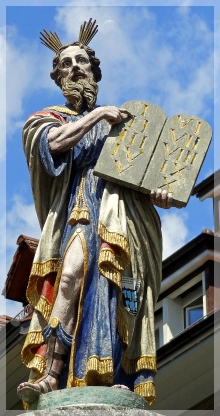
Moses Fountain - Bern  Although three places in Scripture tell us that the Lord proclaimed ten commandments and wrote them on stone tablets, those tablets weren’t numbered (especially not with Roman numerals)! The original languages of the Bible (Hebrew, Aramaic, and Greek) didn’t contain punctuation and the earliest manuscripts didn’t even have spaces between the words. While the words in Scripture are God-breathed, the punctuation was at the discretion of later copyists and translators. Without numbering, punctuation, or paragraphs, we can’t know for sure where one commandment ends and the other begins. As a result, while Jews, Roman Catholics, Protestants, and Orthodox Christians all observe the Ten Commandments, their commandments are not all the same!

For a Jew, rather than ten commandments, there are 613 throughout the Hebrew Scriptures. The first ten are called the Decalogue. While most Christians consider Exodus 20:2, “I am the Lord your God, who rescued you from the land of Egypt, the place of your slavery,” a preface to the Ten Commandments, it is the first one for a Jew and considered the most important because it establishes God’s authority for all that follows. Until that first commandment is accepted—that Adonai is one’s God—the rest wouldn’t be obeyed. The Jewish second commandment spans Exodus 20:3-6 and combines three prohibitions regarding idolatry: (1) no other gods, (2) no making of idols, and (3) no worship of idols. Commandments three through ten are the same as those recognized by most Protestants and Orthodox Christians.

Around 220 AD, the Christian Biblical scholar Origen of Alexandria numbered the commandments in the way familiar to most Protestant and Orthodox Christians. Skipping Exodus 20:2, He began with the prohibition of false gods “You shall have no other gods before me,” and continued with the second commandment prohibiting idols. The 10th commandment prohibited all coveting.

In the fifth century, however, Saint Augustine re-numbered the commandments so that the prohibitions about other gods and idols were combined into the first commandment. Making him short one commandment, Augustine then split Exodus 20:17 into two with coveting a neighbor’s wife the 9th commandment and coveting anything else of the neighbor’s the 10th. Although this required rearranging Scripture’s words, perhaps he reasoned that coveting your neighbor’s wife was vastly different than coveting his house or team of oxen. In any case, Augustine’s system was adopted by the church.

In 1054, the Christian church split into the Eastern Orthodox and the Roman. Orthodox Christians follow Origen’s numbering but include Exodus 20:2, “I am the Lord your God who rescued you from Egypt….,” in the first commandment. The Protestant Reformation of the 16th century further divided the church. Except for Lutherans, the Protestant church returned to Origen’s original numbering system. Perhaps because Luther was an Augustine monk for fourteen years, his version of the Commandments follows that of the Roman Catholic church with one notable exception. Returning to the original order found in Scripture, Luther’s 9th commandment prohibits coveting your neighbor’s house and the 10th prohibits coveting his wife, servant, animals, or anything else. In this way, Luther distinguished coveting the inanimate (house) from coveting the animate (wife, servant, etc.).

Who’s right? Only God know! Far more important than how the commandments are numbered, however, is what those commandments meant to the Israelites and what they mean to us today. The first three or four (depending on your denomination) have to do with mankind’s relationship to God and lay out our obligation to honor our Creator. The next seven or six (again depending on your denomination) have to do with the obligations we have to one another in family and society and lay out the foundation for building a community. Rather than disagreeing about how to number the Ten Commandments, we should make a greater effort to live the two spoken by Jesus!

Jesus replied, “‘You must love the Lord your God with all your heart, all your soul, and all your mind.’ This is the first and greatest commandment. A second is equally important: ‘Love your neighbor as yourself.’ The entire law and all the demands of the prophets are based on these two commandments.” [Matthew 22:37-40 (NLT)]

Copyright ©2024 jsjdevotions. All rights reserved.

POSTING THE COMMANDMENTS

Then God gave the people all these instructions: “I am the Lord your God, who rescued you from the land of Egypt, the place of your slavery. You must not have any other god but me.” Exodus 20:2-3 (NLT)]

Moses - Meiringen - MichaelskircheOn June 19, Louisiana’s Governor Jeff Landry signed legislation requiring all public K-12 classrooms and state-funded universities to display a poster-sized version of the Ten Commandments in “large, easily readable font” in every classroom next year. As expected, a lawsuit has been filed to block what some say is an unconstitutional requirement. I’ll leave the arguments about civil liberties and constitutional law to the lawyers and courts; Louisiana’s law is troubling for other reasons.

For the poster’s required wording, Louisiana’s legislators didn’t look to the original Hebrew or any of the more than 60 accepted Christian Bible translations. Instead, they canonized their own version of the commandments by using the same words placed on a Texas monument the U.S. Supreme Court found to be “on the permissible side of the constitutional line.”

Although the “approved” commandments appear to be from the King James, they are more like a Reader’s Digest version than the real thing. While the prohibition about graven images (Ex. 20:4) is included, verses 5 and 6 with the rest of that commandment along with its warning for disobedience are omitted. The 3rd commandment’s warning of punishment if the Lord’s name is taken in vain also is omitted. Although the commandment to remember the sabbath and keep it holy is included, its prohibitions of work and the reason for the commandment (Ex. 20:9-11) are not. Governments are designed for writing laws, not re-writing Scripture, and God made it clear that His words were not to be edited or abridged in any way!

While Jews, Roman Catholics, Protestants, and Orthodox Christians observe the Ten Commandments, their commandments are not all the same! Disregarding the 16% of their population who are not Christian and the 26% of Louisiana Christians who are Roman Catholic, the required poster uses the Protestant version of the commandments.

In the Texas case, because the monument in question was one of 38 monuments or historical markers on 22-acres of the Texas Capitol grounds and had been there for more than 40 years without objection, the court considered it “historical.” Latching onto the word “historical,” Louisiana’s law doesn’t put the commandments in the Biblical context of who gave them, when and why they were given, and where they are written. Instead, they put the commandments in the context of an historical document. The poster must be accompanied by a four-paragraph “context statement” describing how the Ten Commandments “were a prominent part of American public education for almost three centuries.” Along with the Ten Commandments’ poster, the law also requires the posting of the Mayflower Compact, the Declaration of Independence, and the Northwest Ordinance.

The Ten Commandments do not get their authority because they’ve been printed in schoolbooks since the 17th century nor do they get their significance because they were written thousands of years ago! While they have existed longer than the New England Primer  or the Mayflower Compact, Scripture is no more an “historical document” than the Declaration of Independence or Webster’s The American Spelling Book are sacred ones! Treating the God-breathed Ten Commandments as an historical document diminishes them by placing them on equal footing with McGuffey’s Readers  and a 1787 ordinance laying the basis for the government of the Northwest Territory. As well-written as they may be, theirs are secular words written by men; the words of the Ten Commandments, however, are sacred words spoken by God! Moreover, placing God’s law alongside the teacher’s rules about raising your hand or working quietly further diminishes them.

We could post the Ten Commandments on the walls of every building but that would make no difference in our world today because we can’t legislate God. We can, however, display Him. If we’re to make the world a better place, we won’t do it by posting the Ten Commandments in schools, courtrooms, billboards, or anyplace else. We will do it by posting God’s commandments in our hearts and obediently living God’s way every day!

No one lights a lamp and then puts it under a basket. Instead, a lamp is placed on a stand, where it gives light to everyone in the house. In the same way, let your good deeds shine out for all to see, so that everyone will praise your heavenly Father. [Matthew 5:15-16 (NLT)]

Imitate God, therefore, in everything you do, because you are his dear children. Live a life filled with love, following the example of Christ. [Ephesians 5:1-2a (NLT)]

Copyright ©2024 jsjdevotions. All rights reserved.