
Men know about God. He has made it plain to them. Men cannot say they do not know about God. From the beginning of the world, men could see what God is like through the things He has made. This shows His power that lasts forever. It shows that He is God. [Romans 1:19-20 (NLV)]
 In one of his four-minute essays, Dr. Frank Crane posited that that the Seven Wonders of the World weren’t the most wonderful things in the world; the wonders of everyday life were! I have to agree. The seven wonders are man-made and, of the original seven, only the great pyramid in Giza remains. On the other hand, the night sky has been there since God created it when time began. Within our galaxy there are some 300 billion stars. The Milky Way, however, is just one of some 2 trillion galaxies (making for a total stellar population of roughly 70 billion trillion.) Since that’s just in the observable universe, there probably are plenty more that haven’t yet been detected. That those trillions of stars are orbiting around an ever expanding universe boggles the mind! Nothing made by man even comes close.
I look over at the Alstroemeria (Peruvian lilies) my husband brings me each week. How is it possible that no two of those flowers are exactly alike? Yet, there’s no duplication in them or in snowflakes, zebras, fingerprints, butterflies, and those 70 billion trillion stars either!
As wondrous as God’s creation is, I wonder if we appreciate it. In 2007, a young man exited the metro station in Washington, DC, took out his violin, and began to play. The violinist was virtuoso Joshua Bell and his instrument, made by Antonio Stradivari in 1713, was worth $3.5 million. Bell played for three minutes before anyone even turned a head, another half-minute before someone dropped a dollar into his open violin case, and six minutes before anyone stopped for a moment. Sure that people would notice and recognize Bell, crowd control had been the initial concern for this experiment. There was no need to worry. Although 1,097 people passed by Bell during his 43-minute concert, only seven stopped for at least a minute to listen to a man who easily commands $1000 a minute to play a concert and for whom standing ovations are the norm.
Later, when viewing a video of the experiment, Bell said he understood why a crowd didn’t gather—after all, it was rush hour and people had to get to work. What mystified the violinist was that people didn’t even notice him; it was if he were invisible. There was no applause or acknowledgement of his music until near the end when one woman passed by him. Having been to one of Bell’s concerts, she recognized the violinist and stopped to listen. When he’d played his last note, she thanked him before continuing on her way to work.
Those commuters in DC have become so accustomed to the noisy busy world around them that they totally missed seeing and hearing Joshua Bell. Like them, has the noise and busyness of our lives dulled our senses so much that we no longer see or hear the wonders around us? We don’t need to leave our homes to see the wonders of the world. The Great Wall of China doesn’t hold a candle to the sky on a clear night. As impressive as is Brazil’s Christ the Redeemer statue, it’s really no match for a field of summer wildflowers and the marble structure of the Taj Mahal pales in comparison to the structure of the human genome.
Because God hasn’t hidden His glory from our senses, the Apostle Paul says there is no excuse for not knowing of His existence. Yet, just as people were deaf and blind to Joshua Bell, even those who know God are often as deaf and blind to His glory. We have eyes and ears but, in our rush, we neither see nor hear. Like Bell, God is an artist whose handiwork is worthy of a standing ovation yet, like those commuters, we frequently fail to acknowledge His presence in the everyday wonders of the world. The next time you hear a bird sing, smell a flower, see a rainbow, or bite into a juicy piece of fruit, thank God for the intricacy, beauty, and wonder of His creation. He’s a virtuoso!
 He came as a baby! God Himself humbly came into the world as a helpless infant. Our nativity scenes and Christmas cards portray a serene Mary holding her peacefully sleeping child but babies are anything but calm and peaceful. They are messy and incredibly noisy little creatures who, when not sleeping, are crying, eating, drooling, peeing, or pooping (often all at the same time). That was God sleeping in the feed trough and nursing at Mary’s breast but He didn’t have a gold halo around his head. Looking the same as every other newborn, he was doing and feeling the same things every human baby feels. On the eighth day of His life, He was circumcised just like every other little Jewish boy and I’m sure He cried in pain! That crying baby was God!
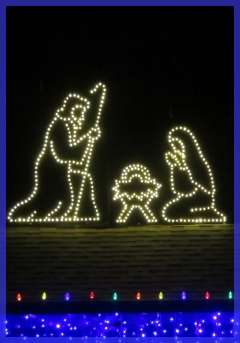 Two nights ago, we joined a long line of vehicles slowly wending their way through a nearby neighborhood famed for its over-the-top holiday light display. Each street follows a theme and over 300 homes are brightly decorated. The streets were aglow with meteor shower, icicle, garland, fairy, net, star, blinking, ball and laser lights along with illuminated blow molds, inflatables, and cut-outs of everything from Santa exiting an outhouse to the Grinch, igloos to elves, and candy canes to Olaf and the Minions. As bright as that neighborhood’s display was, it pales in comparison to one done by the Gay family in Lagrangeville, NY. Holders of the Guinness world record for holiday lights on a residential property, their 2020 display uses more than 670,000 lights that are choreographed to 256 songs.
 Thinking of Jesus’ first miracle caused me to consider His other miracles. Along with general accounts of Him healing people in Capernaum, Gennesaret, and Jerusalem, the gospels mention 35 specific miracles He performed. When we consider the way Jesus healed the blind, His miracles seem almost tailor-made for the people blessed by them. John tells us that Jesus healed one blind man by mixing His spittle with dirt, rubbing the resulting mud over the man’s eyes, and telling the man to wash in the pool of Siloam. Mark tells of another occasion when Jesus took a blind man by the hand and led him out of the village. Surely, they talked but we don’t know about what. Jesus then spit on the man’s eyes and laid His hands on him. Although the man regained his sight, he didn’t understand what he saw so Jesus did it again. Was that one miracle done in two parts or could it have been two miracles: one to restore the man’s sight and the second so he could comprehend what he saw? Another time, Jesus skipped the spit and merely touched two blind men to restore their sight. Then we have the healing of Bartimaeus: Jesus immediately restored His sight without spit, mud, washing, or touch.
 In spite of the theological reasons I gave for the miracle at Cana, providing wine for a wedding still seems an odd choice for Jesus’ debut miracle. Compared to the rest of His miracles, it almost seems frivolous. While the situation was embarrassing for the host, it wasn’t as grave as a demon-possessed child, thousands of hungry people, a crippled woman, a paralyzed man, or a dead friend. When considering Jesus’ reason for performing this miracle, Max Lucado had a simpler explanation than mine. He suggests that Jesus was concerned about the dearth of wine at the wedding simply because it concerned Mary; He cared because she cared! Pointing out that God is there for both the great and small, Lucado asked, “If Jesus was willing to use divine clout to solve a social faux pas, how much more willing would He be to intervene on the weightier matters of life?” Lucado certainly has a point; since it mattered to Mary, it mattered to Jesus.
 Devotions of the Heart