
If any of you wants to be great, he must be your servant. If any of you wants to be first, he must be the slave of all. That’s how it is with the son of man: he didn’t come to have servants obey him, but to be a servant – and to give his life as “a ransom for many.” [Matthew 20:26b-28 (NTE)]
 While the accounts of the anointing of Jesus’ feet in Luke 7:36-50 and John 12:1-8 are similar, they are different events and different people were involved. Luke tells of an unnamed woman and John tells of Mary of Bethany. Although both women wiped Jesus’ feet with their hair, the unnamed woman, a notorious sinner, was an uninvited and unwelcome guest in the Pharisee’s home. Mary was a well-respected and devout friend of Jesus and welcome in her sister’s house. Pharisees were present at one and Christ’s disciples at the other. Where the Pharisees saw a sinful woman’s bad character, Jesus only saw a repentant sinner. Where the disciples saw an extravagant waste of money, Jesus saw a woman who offered a gift of love. He defended one woman’s actions by pointing out that she’d done what His host had failed to do. He defended the other woman’s extravagance by reminding his disciples that she was preparing Him for burial.
They were different times and different places but both women humbled themselves at Jesus’ feet. Both women took on a job that belonged to servants and, while most people chased after Jesus because they wanted something from him, neither woman asked anything of Him. Instead, they offered all they had. One woman’s old life died as she washed His feet and the other woman’s brother, who died, now lived. Their generous acts declared the women’s faith in Jesus as the Messiah. We may come to Jesus as a repentant sinner or we may come to him with praise and thanksgiving but, like both of these women, we must always come with a humble heart that is ready to serve.
The most radical act of humility and service, however, occurred shortly after the disciples argued over who among them was the greatest. That night, in the room where they’d gathered for their Passover meal, Jesus (the greatest of them all) knelt at the feet of His disciples. Knowing full well that soon one of them would betray Him, another would deny him, and all would desert him, Jesus humbly washed their feet. That was God incarnate kneeling in front of them and washing their feet but we don’t read of any of the disciples offering to wash His!
Today is Maundy Thursday and several Christian denominations will have communion services in remembrance of that last supper. As a visual reminder that loving Christ means service and there is dignity in serving others, some churches also will observe a religious rite called Washing of the Feet. As members of the Body of Christ, we are to follow His example by serving one another in humility and love. Like the unnamed woman, Mary of Bethany, and Jesus, we must have the heart of a servant.
One of the principal rules of religion is, to lose no occasion of serving God. And, since he is invisible to our eyes, we are to serve him in our neighbour; which he receives as if done to himself in person, standing visibly before us. [John Wesley]
 In Jesus’ Parable of the Wedding Dinner, after the initial guests refused to come, the king’s servants invited everyone they could find. Since it was a royal wedding, you’d expect the new guests to be dignitaries but everyone was to be called—regardless of social standing, race, nationality, wealth, or even moral character.
 A few miles from our Illinois home, a giant ski jump towered over the treetops. Originally erected in 1905 by Carl Howelsen and a group of Norwegian skiers living in Chicago, it’s been rebuilt over the years and is still used today. In a curious coincidence, in 1913, the man who loved the mountains and deep snow found his way to the Colorado mountain town we once called our winter home. Although Howelsen returned to Norway in 1922, he left an indelible mark on the town by introducing it to recreational skiing and ski jumping. Not far from the hill named for him, stands a statue of the man known as Flying Norseman.
 In ancient times, when an iron tool became dull, another iron implement was used to give it a finer polish and sharper edge. It’s not just tools that can become dulled—so can minds and spirits. Good Christian friends who act as whetstones can make us accountable, keener, stronger, and more enthusiastic and valuable. Rather than allowing us to grow dull and settled in our comfort zones, they sharpen us with challenges that make us better disciples for Christ.
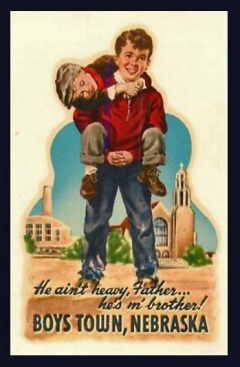 After saying we must carry each other’s burdens, the Apostle Paul seems to reverse himself three sentences later when he tells us we each must carry our own loads. It’s confusing; if we’re all supposed to carry our own loads, then nobody should need help carrying their burdens!
 Since we tend to think of burdens as demanding and often unwelcome duties or responsibilities, we’re certainly not anxious to take on a burden, especially one that actually belongs to someone else! Yet, that is exactly what we’re told we must do if we are going to fulfill Christ’s mandate. And what is that command? To love one another in the way God loves us.
 Devotions of the Heart