ON A NEED TO KNOW BASIS

I also saw something else here on earth: The fastest runner does not always win the race, the strongest soldier does not always win the battle, the wisest does not always have food, the smartest does not always become wealthy, and the talented one does not always receive praise. Time and chance happen to everyone. [Ecclesiastes 9:11 (NCV)]

purple coneflower - MHSP087webSometimes, in the hope of protecting the integrity of secret or sensitive information, access to information is limited to a “need to know” basis. Of course, WikiLeaks and a variety of journalists have proven that there’s little that is ever truly confidential. The HIPA Act and all of those forms we sign when visiting a doctor are supposed to keep our medical information private and on a “need to know” basis. Having just learned that my medical insurance records have been hacked, it seems that a “need to know” status isn’t much of a safeguard to one’s privacy. In spite of all sorts of precautions, hackers, whistle blowers, and informants manage to access and leak information whether we need to know it or not!

There are times we think God is keeping certain information from us that we have a need to know. We want to know the answers to “Why?” Why did he get Alzheimer’s? Why did she go into a coma? Why did this child get leukemia? Why does my child have Down’s syndrome? Why the tornado? Why didn’t the driver stop? Why can’t I have children? Why was he at the wrong place at the wrong time? Why is her child in the gifted class when mine struggles to keep up? Why didn’t she listen? Why did he kill himself? Why is there so much hate and hurt? Why did so many die in such a senseless act of terrorism? Why couldn’t you save them? Why do bad things happen to good people? Why?

I freely admit that any sermons I’ve heard that tried to answer those questions failed miserably; they left me dissatisfied and empty. The short answer, of course, is readily available in Genesis: bad things happen because man sinned. That answer, however, is anything but satisfactory. The only sermons that ever made sense were the ones conceding that, while we’re in this world, there never will be an acceptable explanation for why bad things happen.

The answers to the cries of “Why?” are on a “need to know” basis. We’ll only know the facts we need to know at the time we need to know them. If we truly needed to know, God would tell us; but we don’t, so He won’t. It’s in God’s job description to know the answers to those questions; it’s not in ours. Our job description simply requires us to trust in Him and in His plan. It appears that the angels are all rather content with their positions so we shouldn’t count on them leaking any privileged information our way. We just have to accept that when, and if, we ever need to know why, God will supply a satisfactory answer. We don’t need to know why; we just need to know Him!

You are only human, and human beings have no right to question God. An object should not ask the person who made it, “Why did you make me like this?” The potter can make anything he wants to make. He can use the same clay to make one thing for special use and another thing for daily use. [Romans 9:20-21 (NCV)]

We know that in everything God works for the good of those who love him. [Romans 8:28a (NCV)]

SMOOTH PATHS – LESSONS FROM THE TRAIL (1)

But for those who are righteous, the way is not steep and rough. You are a god who does what is right, and you smooth out the path ahead of them. [Isaiah 26:7 (NLT)]

Tears of joy will stream down their faces, and I will lead them home with great care. They will walk beside quiet streams and on smooth paths where they will not stumble. [Jeremiah 31:9a (NLT)]

9-2-15_9047web
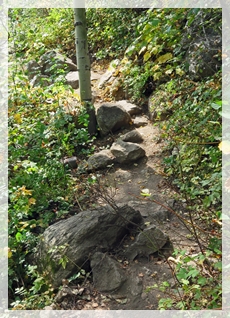
While hiking on one of our favorite mountain trails last month, my husband noted how much easier it was to hike it during the winter. As I stumbled over an exposed root and then tripped on a rock, I had to agree. When covered with snow, I hadn’t realized how uneven its terrain and how rough the trail actually was. Even while wearing our rather cumbersome snowshoes, the winter hike was much easier because several feet of packed-down snow had filled in all of the irregular and rutted parts. The uneven and rocky trail was still there—the rocks, stumps and roots don’t miraculously disappear in the winter—but the snow smoothed out the path. The ruts and other hazards were still there, but we were far less affected by them.

Walking with Jesus is like a trek on a snow-packed trail. Life’s obstacles are still there but Jesus makes the way smoother and easier to traverse. Like the rocks on the path, our troubles won’t miraculously disappear, but we will be less aware, less affected, and less troubled by them. Instead of blindly stumbling along, we will walk confidently because the Lord is smoothing the path ahead and holding us steady with His hand.

The Lord directs the steps of the godly. He delights in every detail of their lives. Though they stumble, they will never fall, for the lord holds them by the hand. [Psalm 37:23-24 (NLT)]

I will lead blind Israel down a new path, guiding them along an unfamiliar way. I will brighten the darkness before them and smooth out the road ahead of them. Yes, I will indeed do these things; I will not forsake them. [Isaiah 42:16 (NLT)]

INVITATIONS

The Angel said to me, “Write this: ‘Blessed are those invited to the Wedding Supper of the Lamb.’” He added, “These are the true words of God!” [Revelation 19:9 (MSG)]

IMGa_8372webI love seeing those thick envelopes in my mail that signify a special invitation. Usually included with the invitation is a request to RSVP. In spite of providing the invitees with a stamped pre-addressed envelope and a response card that requires only a name and check mark, most hosts spend several frantic days shortly before the event trying to track down the people who rudely haven’t bothered to reply. Worse manners, however, are exhibited by the guests who accept an invitation and then fail to attend. Justifiably, the host becomes annoyed; he probably has to pay for the absentee guests whether present or not. Moreover, those people may well have taken the place of others who might have truly appreciated the invitation.

Jesus was dining at the home of a Pharisee. When a dinner companion commented that it will be a blessing to feast in the Messianic kingdom to come, Jesus responded with a parable about a man who hosted a great banquet. Although the initial invitation to his feast had already been accepted, when the host sent his servants to tell the guests the banquet was prepared and ready to be served, the invitees used flimsy excuses about being too preoccupied with their everyday lives to attend. This was a major breach of etiquette; they’d already accepted, animals had been butchered, food was prepared and now the guests rejected the invitation! To add insult to injury, that all of the guests declined at the last minute implies some collusion among them to insult the host. Angry at their rejection, the master of the house, determined not to have an empty table, sent his servants out to bring in the poor, blind and lame—the people who normally would never be invited to such a feast. When that was done, since there was still room at the large table, the master sent his servants beyond the city gates to summon everyone else to his banquet. The host also vowed that not one of those who had been invited and rejected him would ever be invited again; they would never be allowed to dine at his table!

This story was Jesus’ way of warning the Jews that, since they didn’t accept His invitation of salvation, everyone else who came to him by faith would be welcome at His table. Anyone who chose to reject His offer, however, would never dine in God’s Kingdom. This parable, while specifically aimed at the Pharisees attending the banquet, still has meaning to us over 2,000 years later. Jesus reassures us that, while we are totally unworthy to eat at God’s banquet, He will welcome us. All we have to do is accept his invitation and show up when we’re called. The parable also serves as a warning if we don’t accept. God has given us an invitation and, being a gracious host, He’s prepared a heavenly banquet for us. How will He feel and what will He do if we reject his generous offer? I’m not planning on being a “no-show,” how about you?

“All things are ready,” come to the feast! Come, for the table now is spread;
Ye famishing, ye weary, come, and thou shalt be richly fed.
“All things are ready,” come to the feast! Come, for the door is open wide;
A place of honor is reserved For you at the Master’s side.
“All things are ready,” come to the feast! Come, while He waits to welcome thee;
Delay not while this day is thine,Tomorrow may never be.
“All things are ready,” come to the feast! Leave ev’ry care and worldly strife;
Come, feast upon the love of God, And drink everlasting life.
[“Come to the Feast” by Charles H. Gabriel]

Taken aback, Jesus said, “I’ve yet to come across this kind of simple trust in Israel, the very people who are supposed to know all about God and how he works. This man is the vanguard of many outsiders who will soon be coming from all directions—streaming in from the east, pouring in from the west, sitting down at God’s kingdom banquet alongside Abraham, Isaac, and Jacob. Then those who grew up ‘in the faith’ but had no faith will find themselves out in the cold, outsiders to grace and wondering what happened.” [Matthew 8:10-12 (MSG)]

THE FIRST MUST BE LAST

He sat down, called the twelve disciples over to him, and said, “Whoever wants to be first must take last place and be the servant of everyone else.” [Mark 9:35 (NLT)]

Jesus’ disciples believed him to be the long-awaited and promised Messiah. Like most of the Jews, they originally believed that the Messiah would bring a new kingdom into this world: a new government for Israel that was not under the rule of Rome. The disciples began to think about their status in this future kingdom, much like close supporters of a presidential candidate start thinking about an ambassadorship or even a place in the presidential cabinet. The gospels tell us that they argued over which of them was the greatest and who deserved the best position in this new realm. The mother of James and John even had the nerve to ask Jesus to give her sons special status in his coming kingdom. She was like a presidential candidate’s financial backer who requests that a family member be given a cushy or high profile job in the new government. It seemed that everyone around Jesus was jockeying for a choice position in his kingdom.

It took a great deal of time and teaching, however, before the disciples truly grasped that the Kingdom of God of which Jesus spoke was not going to be here on earth. Jesus told his disciples that leadership would not be determined by power and influence but by service. The good leader is not the most prominent, ruthless or esteemed person, said Jesus; the good leader is the servant. This was a new concept of leadership: attending to the needs of people instead of using them for your own purposes, caring for others instead of having them care for you. Instead of looking for ways to earn honors and privileges, Jesus tells us that we should be looking for ways to serve others and minister to their needs.

Just because you’re in the driver’s seat … doesn’t mean you have to run people over. [From “The Last Lecture” by Randy Pausch with Jeffrey Zaslow]

But Jesus called them together and said, “You know that the rulers in this world lord it over their people, and officials flaunt their authority over those under them. But among you it will be different. Whoever wants to be a leader among you must be your servant, and whoever wants to be first among you must become your slave. For even the Son of Man came not to be served but to serve others and to give his life as ransom of many.” [Matthew 20:26-28 (NLT)]

THE REAL THING

The Life-Light was the real thing: Every person entering Life he brings into Light. He was in the world, the world was there through him, and yet the world didn’t even notice. He came to his own people, but they didn’t want him. [John 1:9-11 (MSG)]

7-27-15 CARDINAL6991weLast fall, I wrote about false prophets (“The Fraud”) after mistaking a fake bird for a real one. Yesterday, I almost missed the real thing! Wandering through the Botanic Gardens, what I initially thought was a red scarf or a fallen blossom fluttering in the breeze turned out to be a fledgling cardinal. Perhaps he was too young to be frightened by the many people walking past him as he boldly remained perched on a small sign close to the ground. I seemed to be the only one who noticed this beautiful creature, as exquisite as any of the blooms in the gardens. Never expecting a real bird to perch that close to the pathway, it wasn’t until I came within a few inches of him that I knew him to be real! Ignored by everyone but me, he remained there, chirping away, for several minutes and God blessed me with another one of His “Aha!” moments.

Was that what it was like when Jesus walked the Holy Land? Did people just pass Him by, hurrying to their destination, too busy to notice this itinerant preacher? Had they forgotten the promise of a Messiah? Were they so sure they knew what to expect that they didn’t see what was right in front of them? After generations of ignoring God and His messengers, were they so set in their ways they wouldn’t even stop to listen to Jesus’ words? Were they blind and deaf to His message of truth? Those who didn’t notice the bird merely missed an “Aha!” moment; failing to see Jesus, however, has tragic consequences.

When it comes to our relationship with Jesus, are we like those people who missed seeing the bird. How will we know if He is real if we don’t stop, look and listen? Prayer and God’s word will draw us close enough to hear and see Him. Yet, do we use our mouths more than our ears when we pray? Are we so intent on our needs that we don’t hear God’s message to us? When we read the Bible, do we look for what we want to read, cherry-picking our favorite verses, or do we examine what is actually there? Do we ever skim through a chapter and miss the beauty that is hidden in God’s words? Do we fail to experience glory moments with Him simply because we’re neither looking nor listening?

Eyes that see and ears that hear are blessed by God. He made himself known to man through Jesus Christ but it is up to us to see and hear Him. Father in Heaven, let us never pass by the truth; open our hearts and minds to the real presence of Jesus in our lives.

But you have God-blessed eyes—eyes that see! And God-blessed ears—ears that hear! A lot of people, prophets and humble believers among them, would have given anything to see what you are seeing, to hear what you are hearing, but never had the chance. [Matthew 13:16-17 (MSG)]

Jesus said, “I am the Road, also the Truth, also the Life. No one gets to the Father apart from me. If you really knew me, you would know my Father as well. From now on, you do know him. You’ve even seen him!” [John 14:6-7 (MSG)]


EXPECT TO SEE HIM

“Don’t be afraid,” he said. “Take courage! I am here!” [Mark 6:50 (NLT)]

Faith expects God to be there and isn’t surprised by His presence or what He can do for us.

6-19-155andelier10-10 037webAfter Jesus had miraculously fed the 5,000, He went up to the hills to pray while the disciples headed across the lake to Bethsaida. A sudden windstorm occurred and gale force winds and rough seas pummeled their boat. The frightened disciples were rowing hard, struggling against the wind and waves, when they saw Jesus walking on the water toward them. Instead of being comforted by this sight, however, they became terrified and thought they were seeing a ghost.

We can understand the disciples not expecting Jesus to be walking on the water, but it’s difficult to understand why they didn’t even pray during their frightening voyage. They just kept struggling on by themselves, trusting in their own power instead of putting their faith in God. After the all of the miracles Jesus had performed and the messages he’d preached, one would think the disciples would have known that He would be there when they needed him. Unfortunately, they still didn’t recognize Jesus for who He was.

Our God is an awesome God, capable of more than we can possibly imagine. He is with us always so we should never be surprised when we find him standing right at our side. After all, he told us, “Don’t be afraid. Take courage! I am here!”

As you walk through the valley of the unknown, you will find the footprints of Jesus both in front of you and beside you. [Charles Stanley]

Look! The virgin will conceive a child! She will give birth to a son, and they will call him Immanuel, which means “God is with us.” [Matthew 1:23 (NLT)]