
Men know about God. He has made it plain to them. Men cannot say they do not know about God. From the beginning of the world, men could see what God is like through the things He has made. This shows His power that lasts forever. It shows that He is God. [Romans 1:19-20 (NLV)]
 In one of his four-minute essays, Dr. Frank Crane posited that that the Seven Wonders of the World weren’t the most wonderful things in the world; the wonders of everyday life were! I have to agree. The seven wonders are man-made and, of the original seven, only the great pyramid in Giza remains. On the other hand, the night sky has been there since God created it when time began. Within our galaxy there are some 300 billion stars. The Milky Way, however, is just one of some 2 trillion galaxies (making for a total stellar population of roughly 70 billion trillion.) Since that’s just in the observable universe, there probably are plenty more that haven’t yet been detected. That those trillions of stars are orbiting around an ever expanding universe boggles the mind! Nothing made by man even comes close.
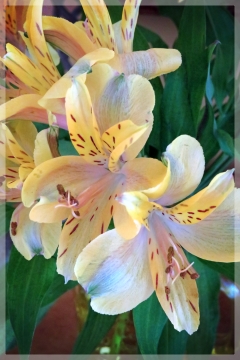
I look over at the Alstroemeria (Peruvian lilies) my husband brings me each week. How is it possible that no two of those flowers are exactly alike? Yet, there’s no duplication in them or in snowflakes, zebras, fingerprints, butterflies, and those 70 billion trillion stars either!
As wondrous as God’s creation is, I wonder if we appreciate it. In 2007, a young man exited the metro station in Washington, DC, took out his violin, and began to play. The violinist was virtuoso Joshua Bell and his instrument, made by Antonio Stradivari in 1713, was worth $3.5 million. Bell played for three minutes before anyone even turned a head, another half-minute before someone dropped a dollar into his open violin case, and six minutes before anyone stopped for a moment. Sure that people would notice and recognize Bell, crowd control had been the initial concern for this experiment. There was no need to worry. Although 1,097 people passed by Bell during his 43-minute concert, only seven stopped for at least a minute to listen to a man who easily commands $1000 a minute to play a concert and for whom standing ovations are the norm.
Later, when viewing a video of the experiment, Bell said he understood why a crowd didn’t gather—after all, it was rush hour and people had to get to work. What mystified the violinist was that people didn’t even notice him; it was if he were invisible. There was no applause or acknowledgement of his music until near the end when one woman passed by him. Having been to one of Bell’s concerts, she recognized the violinist and stopped to listen. When he’d played his last note, she thanked him before continuing on her way to work.
Those commuters in DC have become so accustomed to the noisy busy world around them that they totally missed seeing and hearing Joshua Bell. Like them, has the noise and busyness of our lives dulled our senses so much that we no longer see or hear the wonders around us? We don’t need to leave our homes to see the wonders of the world. The Great Wall of China doesn’t hold a candle to the sky on a clear night. As impressive as is Brazil’s Christ the Redeemer statue, it’s really no match for a field of summer wildflowers and the marble structure of the Taj Mahal pales in comparison to the structure of the human genome.
Because God hasn’t hidden His glory from our senses, the Apostle Paul says there is no excuse for not knowing of His existence. Yet, just as people were deaf and blind to Joshua Bell, even those who know God are often as deaf and blind to His glory. We have eyes and ears but, in our rush, we neither see nor hear. Like Bell, God is an artist whose handiwork is worthy of a standing ovation yet, like those commuters, we frequently fail to acknowledge His presence in the everyday wonders of the world. The next time you hear a bird sing, smell a flower, see a rainbow, or bite into a juicy piece of fruit, thank God for the intricacy, beauty, and wonder of His creation. He’s a virtuoso!
 The Word gave life to everything that was created, and his life brought light to everyone. The light shines in the darkness, and the darkness can never extinguish it. [John 1:4-5 (NLT)
 My day’s reading brought me to 2 Samuel 6 when David, accompanied by the blowing of ram’s horn trumpets and shouts of joy, brought the Ark back to Jerusalem. Having stripped himself of his kingly robes, he wore a linen ephod and unabashedly spun, leapt, and danced his way into the city. After observing her husband’s uninhibited dancing, Michal chided him for his un-kingly attire and undignified behavior. David replied that he was dancing for God, not her and his goal was not to please people. He was dancing to please God.
 When we moved to southwest Florida several years ago, everything was new and strange—we didn’t know which farmer’s market had the finest produce, the best routes to avoid traffic, the amenities of each beach, the fun activities available, or where to hike or bike. Rather than be confused and discouraged, we got out the guidebooks and maps and enthusiastically started exploring—churches, parks, theaters, markets, beaches, and museums. Every day became an adventure and, as we got to know our community, we came to love it.
 Colors have been used to differentiate liturgical seasons since the 4th century and, by the 12th century, Pope Innocent systemized their use in the church. Originally Advent was about penance, prayer and fasting in preparation for baptism so purple (the color associated with sacrifice and repentance from sin) was its liturgical color. Like the Advent wreath, however, liturgical colors are merely traditions and have no basis in Scripture. Most denominations have added more colors to the original five.
 The story was told of a devout Christian woman who, after moving to a new town, visited the local church: the Church of Holier than Thou. When the children’s choir sang the prelude, she was so happy to hear their angelic voices that she applauded at the end of their song. An usher came up and whispered in her ear, “Ma’am, we don’t applaud in this church.” She apologized for the disturbance and the service continued. When the pastor gave his sermon, she was so moved by his words that she shouted out an “Amen!” in response. The usher returned to her side and again sternly instructed her, “You’ll have to restrain yourself here in the Church of Holier than Thou.” Chagrined, the woman promised to behave and the service continued. The choir rose and sang a beautiful medley that included God of our Fathers and How Great Thou Art. Overcome by the words of praise, the woman shouted out “Hallelujah” and “Praise God!” at the song’s conclusion. The usher strode up to her and said, “Lady, you’re causing a disturbance. You’ll have to leave!” The poor woman responded, “I just couldn’t help myself; I was overcome by the joy of the Lord!” In a huff, the usher responded, ‘Well, you sure didn’t get it here!”
 Devotions of the Heart