HAPPILY EVER AFTER

That night God appeared to Solomon and said, “What do you want? Ask, and I will give it to you! [2 Chronicles 1:7 (NLT)]

No one is really happy merely because he has what he wants, but only if he wants things he ought to want. [St. Augustine]

Mountain Bluebird In the many television tributes to the recently deceased actor Gene Wilder, a scene from the movie Willy Wonka & the Chocolate Factory frequently has been aired. In it, Willy tells Charlie not to forget what happened to the man who suddenly got everything he wanted. When the boy asks what that was, Wonka replies, “He lived happily ever after!”

While that exchange made for a nice ending to a children’s film, getting everything we want is hardly the way to guarantee living happily ever after—unless, of course, we only want the right things! Yet, even wanting the right things is no guarantee of happiness. Look at Solomon; when God asked what he wanted, the young king requested the right thing—wisdom. God rewarded him not just with wisdom but also with riches, possessions, honor and fame. Here was a king who truly got all that he wanted plus more. Surely, with everything that Solomon received, he should have lived happily ever after.

Nevertheless, all the wisdom and wealth in the world could not give meaning to Solomon’s life. Although gifted with wisdom, he failed to use it when he broke God’s rules for kings by amassing horses, collecting a harem of 1000, accumulating riches by excessive taxation, sealing alliances by marrying foreign women and worshiping pagan gods. Although he got everything he wanted, Solomon did not find happiness. His words in Ecclesiastes show us how disillusioned, bitter and disappointed this wealthy sage was when he realized how empty his life had been without God at its center.

Getting what we want will only lead to a happily ever after if we want what God wants for us and if we use His blessings with a wisdom far greater than Solomon’s. Let us never forget that God’s answers to our prayers often are not what we think will make us happy. They are, however, always what we need. Moreover, God has already given us all that we need for our happily ever after: His beloved Son, forgiveness, salvation, and eternal life.

God cannot give us a happiness and peace apart from Himself, because it is not there. There is no such thing. [C.S. Lewis]

I tell you the truth, anyone who believes has eternal life. [John 6:47 (NLT)]

I heard a loud shout from the throne, saying, “Look, God’s home is now among his people! He will live with them, and they will be his people. God himself will be with them. He will wipe every tear from their eyes, and there will be no more death or sorrow or crying or pain. All these things are gone forever.” [Revelation 21:3-4 (NLT)]

Copyright ©2016 jsjdevotions. All rights reserved.

THE ZINNIA MAN

zinnia - ACL20-horzweb

You’ll not likely go wrong here if you keep remembering that our Master said, “You’re far happier giving than getting.” [Acts 20:35b (MSG)]

“Wait a minute,” I called to the rest of the group as I paused at a house to take photos of some butterflies. The entire front yard was a palette of brightly colored blooms and I could see why the insects found it a delightful place to stop. Later that afternoon, we again passed by the same house. A man was in the yard tending his precious garden. I paused to thank him for the brilliantly colored flowers everyone enjoys as they walk through town. He replied that the rainbow of blossoms were zinnias and assured me these brilliantly colored flowers are among the easiest of plants to grow. “Let me give you one,” he said as he bent over to snip off a bright yellow bloom. I tried to stop him, telling him it would be wilted long before I reached home. Handing the stem to me, he told me just to enjoy it while it lasted.  “For every one of these I give away, I get another two flowers!” he joyfully added. He then cut a bright pink blossom and handed it to another passerby.

When this man gives away a flower, he not only gets a smile and a “thank you,” but he also gets two more blossoms! What a perfect illustration of the words, “It is more blessed to give than to receive!”

The most obvious lesson in Christ’s teaching is that there is no happiness in having or getting anything, but only in giving. [Henry Drummond]

Give away your life; you’ll find life given back, but not merely given back—given back with bonus and blessing. Giving, not getting, is the way. Generosity begets generosity. [Luke 6:38 (MSG)]

Copyright ©2016 jsjdevotions. All rights reserved.


FIREFLIES

You are the light of the world—like a city on a hilltop that cannot be hidden. No one lights a lamp and then puts it under a basket. Instead, a lamp is placed on a stand, where it gives light to everyone in the house. In the same way, let your good deeds shine out for all to see, so that everyone will praise your heavenly Father. [Matthew 5:14-16 (NLT)]

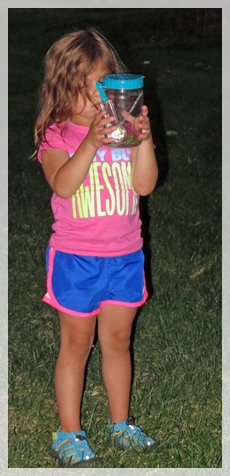
catching firefliesWarm summer nights at the lake mean campfires, s’mores and fireflies. As the darkness descends, bug jars appear and the children start chasing these fascinating insects. How odd that the same child who will shirk away from any insect during the day will give chase to and capture these flashing winged beetles at night. By the end of the evening, the children have collected a jarful of tiny flying stars (that will be released as soon as the little ones are tucked into bed).
Officially, they are Lampyridae—unofficially, they are the lightning bugs that bring magic to our yards and smiles to our faces. They have little light factories in their abdomens that take in oxygen and combine it with luciferin and other harder-to-spell chemicals to produce light with no heat. Actually, these bioluminescent creatures are just highly efficient flying light bulbs!

Unfortunately, many scientists believe Lampyridae are disappearing from the landscape because the grassy meadows and ponds that were their home are now parking lots and housing developments. The bugs’ biggest threat, however, comes not from urban sprawl or pesticides but from the lights that accompany civilization. Fireflies light up so they can communicate with one another and each of the 200 species has its own unique flash pattern. What we see on a summer’s night is actually a firefly’s version of a singles’ bar. As they flit around flashing their lights, they’re looking for a mate. The glow from parking lots, street lamps and car headlights can interrupt a firefly’s signals for several minutes meaning these tiny guys can’t find one another to do what fireflies must do to survive.

While watching my yard light up with these flying light factories, I think of how Jesus calls us to be the light of the world. Like fireflies, we are to shine in its darkness. Just as children are drawn to the firefly’s light, people should be drawn to ours. As Christians, we should sparkle and shine and be a welcome sight to all who encounter us. That glow of love should help others recognize us for what we are—followers of Christ. There’s no need to chase and capture us since we’ll joyfully share the source of our light with others. But, like the firefly, the world around us threatens our survival. While it’s light that endangers the firefly, it’s the world’s darkness that endangers ours. We must never let it keep us from shining brightly.

Heavenly Father, thank you for the blessings of summer nights and for the fireflies that remind us to shine our lights brightly in the darkness of this troubled world.

 All the darkness in the world cannot extinguish the light of a single candle. [Francis of Assisi]

The light shines in the darkness, and the darkness can never extinguish it. [John 1:5 (NLT)]

Feed the hungry, and help those in trouble. Then your light will shine out from the darkness, and the darkness around you will be as bright as noon. [Isaiah 58:10 (NLT)]

Copyright ©2016 jsjdevotions. All rights reserved.

THE “WE” MARRIAGE

Mallards
Love each other with genuine affection, and take delight in honoring each other. [Romans 12:10 (NLT)]

Today is my 49th wedding anniversary and, as I was looking for material for a message about marriage, I came across a 2010 article from the New York Times. Titled “The Happy Marriage is the ‘Me’ Marriage,” it asserted that marriage is no longer about putting the relationship first. People in what the author calls a “sustainable marriage” have spouses who “make their lives more interesting.” In something called “self-expansion,” partners “sculpt” each other “in ways that help each of them attain valued goals.” As for sculpting my partner, I may have sanded off a few of his rough edges in all these years but no relationship is sustainable when we’re trying to change our partner instead of ourselves!

I then linked to “The Sustainable Marriage Quiz” where questions were to be answered on a scale of one (not very much) to seven (very much). According to the author, the higher the score, the happier and “more sustainable” the marriage would be. It asked questions about how much our partner increased our ability to accomplish new things, increased our knowledge, resulted in our having new experiences, or was seen as a way to expand our own capabilities.

The article and quiz seemed to put the burden of our growth on our spouse. Granted, our spouses should motivate and encourage us—that’s what love does. Nevertheless, it remains our task to improve ourselves and become more accomplished, knowledgeable, interesting, and capable. The responsibility for our happiness and growth falls squarely on our shoulders, not those of our spouse. I think of the character in Jerry McGuire who said, “You complete me.” Becoming complete is not someone else’s task; it is ours!

No relationship lasts if it becomes stagnant but I wonder how long anyone can sustain an effort to keep giving one’s spouse new experiences, skills, or knowledge. As much as I love adventure, there is something delightful about doing some of the same things again and again with the person I love! The article cited research done at universities and I suspect the subjects were younger. Their concept of a “long-lasting relationship” was probably quite different than mine. When I think of a relationship as “sustained,” I think in terms of several decades not just a few months or years.

Although I believe the happy marriage is the “we” (rather than “me”) marriage, the truly sustainable marriage has a third party in it—God. As my husband and I have grown in our faith, we have grown in our love for one another. The more God-centered our marriage has been, the richer our relationship and the happier we have become. At close to half a century together, ours is not just a long-lasting relationship, but also one that is truly satisfying and sustainable. It is sustained by the grace of God through prayer and hard work. It is sustained by the effort we each make every day to love one another in a way that both meets our needs and honors God. It is sustained by thinking “we” and not “me.” It is sustained by a commitment to make the marriage work and by remembering that “love never gives up.”

Love never gives up, never loses faith, is always hopeful, and endures through every circumstance. [1 Corinthians 13:7 (NLT)]

The question is asked, “Is there anything more beautiful in life than a boy and girl clasping clean hands and pure hearts in the path of marriage? Can there be anything more beautiful than young love?” And the answer is given. “Yes, there is a more beautiful thing. It is the spectacle of an old man and an old woman finishing their journey together on that path. Their hands are gnarled, but still clasped, their faces are seamed, but still radiant; their hearts are physically bowed and tired, but still strong with love and devotion for one another. Yes, there is a more beautiful thing than young love. Old love.”  [author unknown, found in “Stories for a Faithful Heart” compiled by Alice Gray]

Copyright ©2016 jsjdevotions. All rights reserved.

BE MINDFUL

So then, as occasion and opportunity open up to us, let us do good [morally] to all people [not only being useful or profitable to them, but also doing what is for their spiritual good and advantage]. Be mindful to be a blessing, especially to those of the household of faith [those who belong to God’s family with you, the believers]. [Galatians 6:10b (AMPC)]

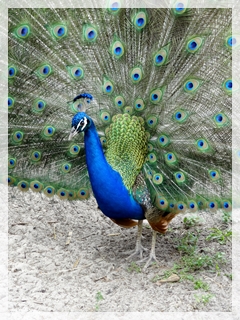
peacock“Be mindful to be a blessing…” After reading Paul’s words as translated in the Classic Amplified Bible, I thought of a comic I recently saw in the newspaper. (Oddly, I get lots of inspiration from the comics and I’m not sure what that says about my intellect.) Nevertheless, in “Nancy,” written by Guy Gilchrist, it’s Nancy who is reading the comics page. The speech balloon says, “Today’s Motivation: Let your presence be a gift to all you meet!” The next panel shows her walking down the street. Instead of her typical hair ribbon, she is wearing an enormous bow and a gift tag that says, “To you!”

Although the Amplified version speaks of being “mindful to be a blessing”, most other translations of Galatians 6:10 say to help or do good when the opportunity arises. Being mindful implies a conscious and deliberate action—an effort to discover or even create those opportunities. Nancy’s attempt to make her presence a present seems the perfect example of Paul’s words. We certainly don’t need to decorate ourselves or wear ribbons and gift tags, but we do need to thoughtfully set out to be a blessing each and every day. Of course, we should seize every opportunity there is to do good but, perhaps, we should make more of an effort to initiate ways of being a blessing to others.

Father, keep us mindful of ways in which we can truly be a blessing to everyone we encounter today. Make us alert to ways that our demeanor, words, and actions can lighten people’s burdens, bring joy to their hearts and put smiles on their faces. May our presence never be a source of strife, irritation or annoyance—rather, let it always be a gift and a blessing.

Let no foul or polluting language, nor evil word nor unwholesome or worthless talk [ever] come out of your mouth, but only such [speech] as is good and beneficial to the spiritual progress of others, as is fitting to the need and the occasion, that it may be a blessing and give grace (God’s favor) to those who hear it. [Ephesians 4:29 (AMPC)]

Copyright ©2016 jsjdevotions. All rights reserved.

STAMP OF APPROVAL

What sorrow awaits those who argue with their Creator. Does a clay pot argue with its maker? Does the clay dispute with the one who shapes it, saying, “Stop, you’re doing it wrong!” Does the pot exclaim, “How clumsy can you be?” How terrible it would be if a newborn baby said to its father, “Why was I born?” or if it said to its mother, “Why did you make me this way?” [Isaiah 45:9-12 (NLT)]

feet -ints 2awebWriting about my granddaughter yesterday made me think about birth defects. In actuality, all of us have what could be called birth defects—it’s just that some are more obvious than others. While all of God’s children have defects, none are defective. I consider a young man at our Florida church. Cerebral palsy keeps him strapped into a wheel chair and his physical limitations are immense. There is, however, nothing defective about this bright young man. I ponder the enthusiastic grocery worker with Down’s syndrome. She may have an extra chromosome, but there is nothing defective about her. I think of a fellow at church who has no ears. He may be deaf but there is nothing defective about him, nor is there anything defective about a friend’s grand born with only a partial arm and hand or my grand, with her heart defects and learning issues. They are all marvelously made—different from others, but no less wonderful.

Have you ever given any thought to how you were made? From biology 101, we know that a sperm and an egg met. That egg, however, was one of about 1 million your mom had at birth, one of some 300,000 she had at puberty, and one of the 300 to 400 eggs that she’d ever ovulate. So on your mom’s side, you were one in a million. As to that tiny sperm that won the race to the egg—there were about 150 million (or more) other sperm that could have fertilized it if they’d been stronger swimmers. If your conception had occurred in another month, it would have been a totally different egg and another one of 150 million or more sperm and you wouldn’t be you—you’d be someone entirely different! Apparently, the odds of you existing as you are about one in 400 trillion…and I don’t think that takes in the probability of your parents ever meeting let alone loving one another enough to make a baby! There is nothing haphazard about the way we got put together. We are, indeed, marvelously made.

I had a friend who called her son “Oops!” because he wasn’t planned. My mother-in-law responded that in her day, before effective birth control, most babies were “Oops!” While pregnancies may not be planned, there is nothing accidental about the way we are made. When I was little, I asked my mother why I had a belly button. She told me that babies were assembled in heaven and, as they moved along the assembly line, God inspected them before sending them to their earthly mothers. After carefully looking over each baby, He gave a poke to its tummy and said “You’re perfect!” Our belly buttons were His stamp of approval. Her explanation, while neither biologically nor theologically correct, reminds me that God makes no mistakes—there are no “oops!” on His heavenly assembly line.

You made all the delicate, inner parts of my body and knit me together in my mother’s womb. Thank you for making me so wonderfully complex! Your workmanship is marvelous—how well I know it. You watched me as I was being formed in utter seclusion, as I was woven together in the dark of the womb. You saw me before I was born. Every day of my life was recorded in your book. Every moment was laid out before a single day had passed. [Psalm 139:13-16 (NLT)]

Copyright ©2016 jsjdevotions. All rights reserved.