
‘We have fasted before you!’ they say. ‘Why aren’t you impressed? We have been very hard on ourselves, and you don’t even notice it!’ “I will tell you why!” I respond. “It’s because you are fasting to please yourselves. Even while you fast, you keep oppressing your workers. What good is fasting when you keep on fighting and quarreling? This kind of fasting will never get you anywhere with me. You humble yourselves by going through the motions of penance, bowing your heads like reeds bending in the wind. You dress in burlap and cover yourselves with ashes. Is this what you call fasting? Do you really think this will please the Lord?” [Isaiah 58:3-5 (NLT)]
 Every evening, a man went to the local pub and ordered three beers. When asked why three, he explained that he ordered the two extra beers in honor of his two dear brothers who lived far away. One evening, when the man ordered only two beers, the bartender assumed the worst and extended sympathy for the loss of a brother. Correcting the bartender, the man said his brothers were both fit as fiddles and the beers were for them. “It’s me that’s not drinking tonight,” he explained. “You see, I’ve given up beer for Lent!”
Yesterday was Ash Wednesday, the first day of Lent, a period of forty days (not counting Sundays) that commemorate Jesus’ forty days of fasting and temptation in the desert. Originally, Lent was a time of fasting, penitence, and reflection in preparation for an Easter baptism. Today, many people continue to observe this tradition with some sort of fast or spiritual discipline before Easter. While they tend to “give up” something in the way of food, entertainment, or pleasure, the most common fasts usually have to do with desserts, alcohol, chocolate, social media, television, or coffee from Starbucks or Dunkin’. Since Lent’s observation isn’t founded in Scripture, the choice to observe this season in some way is a personal one.
What we must never do is err in thinking that God will love us more for our Lenten sacrifice or that giving up something like gum, candy, beer, eating out, or YouTube has any bearing on our salvation. Jesus took care of our salvation on the cross and God’s love could never be greater than it is right now. No amount of sacrifice can earn God’s free gift of grace.
If we do choose to give up something for Lent, we make a mistake if we focus only on our sacrifice. After all, fasting from carbs or alcohol without prayer and Scripture are nothing more than a diet or “dry January.” Rather than focusing on ourselves, Lent is a time to focus on Christ and the sacrifice He made to give us the gift of salvation.
Although Jesus fasted, He never commanded us to do so. His words on fasting tend to focus on people’s hypocrisy when fasting—they often fasted to impress people with their holiness rather than grow closer to God. Self-sacrifice is not to be done ostentatiously but humbly, quietly, and privately. Regardless of how we choose to observe Lent, unlike the man at the bar, it should be done sincerely. God sees into our hearts and knows when we’re repentant and genuinely seeking Him or just going through the motions!
The purpose of Lent is not to force on us a few formal obligations, but to ‘soften’ our heart so it may open itself to the realities of the spirit, to experience the hidden ‘thirst and hunger’ for communion with God. [Alexander Schmemann]
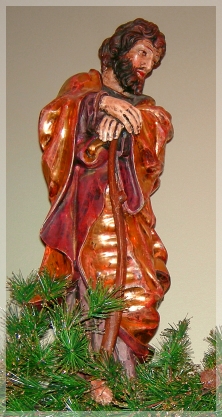 While putting away our nativity, I looked at the figure of Joseph. For the man who played a pivotal role in the Christmas story, once Christmas is packed away, Mary’s husband rarely gets a second thought until the next December. Neither Mark nor John mention the man who served as step-father to Jesus and the author of Hebrews didn’t even list him in its “Hall of Faith.”
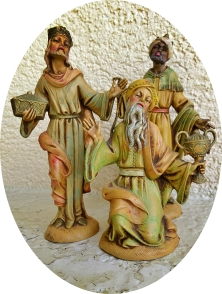 For centuries, access to the written Word of God was limited to just a few. The printing press wasn’t invented until 1439 and, at the time, only about 20% of the population could read. As a result, churches were decorated with paintings, stained glass windows, statues, carvings, and mosaics depicting biblical stories or illustrating theological concepts. For people who couldn’t read the book, religious art told the story. Consider how the Stations of the Cross in Roman Catholic churches illustrate the events of Good Friday. Sometimes, a picture really is worth a thousand words! While most nativity scenes are inaccurate, our depictions of the nativity don’t have to be historically exact to be meaningful.
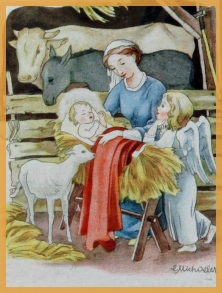 The earliest known portrayal of Jesus’ birth is a bas relief on a Roman sarcophagus from around 385. It depicts the swaddled Christ child in the manger flanked by an ox at His head and an ass at His feet. Why are they present instead of Joseph and Mary? In 1223, Francis of Assisi brought some hay and a manger to a cave and celebrated Mass there on Christmas Eve. Even though Mary and Joseph weren’t present, an ass and an ox were! In 1291, Pope Nicholas IV commissioned Arnolfo di Cambio to create a permanent nativity. While there are statues of Mary and Jesus, Joseph, and three Magi, the sixth statue shows the heads of an ox and an ass rather than shepherd or angel. Besides the baby Jesus, the ass and the ox are the most ancient and consistent elements in depictions of the nativity. Why do these two animals, neither of which is mentioned in the gospels, have such a prominent place in our nativity scenes, Christmas cards, and carols?
 It was a web day at the park and I don’t mean the world-wide kind. It was one of those days when the morning dew, mist, and light cooperated in such a way that we saw beautiful intricate spider webs hanging everywhere. Looking as if they were made of strands of silver rather than proteinaceous silk extruded from a spider’s spinnerets, it seemed like the spiders had decorated all the trees in celebration of Christmas.
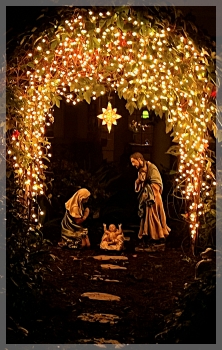 Unfortunately, much of our Advent season is not spent joyfully looking forward to celebrating the birth of the Christ child. In hope of finding the perfect gift for everyone on our list, we pore over catalogues and search for sales and coupons. Either we fight for parking spots at the mall and spend hours standing in line or spend those hours sitting at the computer while shopping on line! We then fret and fuss over wrapping those gifts, mailing packages and Christmas cards, hosting and attending parties, baking cookies, making travel arrangements, decorating the house, preparing holiday dinners, and paying the ever-mounting bills. When we say, “Merry Christmas!” we might find ourselves mumbling a Scrooge-like “Bah! Humbug” under our breath! Instead of looking forward to Christmas with anticipation, there are times we can’t wait until it’s all over and done.
 Devotions of the Heart