
Again Jesus spoke to them, saying, “I am the light of the world. Whoever follows me will not walk in darkness, but will have the light of life.” [John 8:12 (ESV)]
I have come into the world as light, so that whoever believes in me may not remain in darkness. [John 12:46 (ESV)]
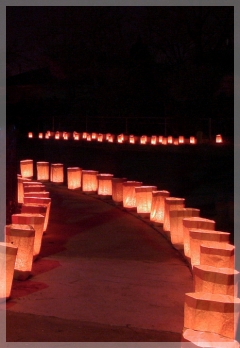 Hundreds of years ago, when Las Posadas was first celebrated, people gathered piñon pine branches into square piles to burn small vigil fires called luminaria to light the way for the Peregrinos as they searched for lodging. On Christmas Eve, bonfires were lit along the roads and in the church yard to guide people to midnight mass. Just as Las Posadas moved into the southwestern states as the Spanish and Mexicans came northward, so did the luminaria. When inexpensive flat-bottom paper bags appeared on the Santa Fe Trail in the 1870s, people started folding down the bag tops, anchoring the bag with a few handfuls of sand, and setting a small candle inside. Better than using precious fire wood, these luminaria (also called farolitos) became the popular tradition that continues in the southwest today.
While I probably won’t be part of any Las Posadas celebrations when I’m in New Mexico next week, I will see plenty of luminaria, even though many of those who set them out know nothing of Las Posadas. Although some of those lanterns will be made of hard plastic and powered by electricity rather than candles, the warm glow of their flickering lights illuminate the walkways, sidewalks, driveways and flat roof tops throughout the state each December.
For those who celebrate Las Posadas, the luminaria serve to light Joseph and Mary’s way as they seek lodging. For others, luminaria guide the way to Christmas Eve worship, are a way of welcoming the Christ child into their homes, or remind them of the star of Bethlehem. Sadly, for many more, their luminaria are lit simply to guide Santa’s gift-laden sleigh to their houses.
Wherever we are this Christmas season, we’re sure to encounter holiday light displays. Whether they’re luminaria, projection spotlights, mini-string or large colored bulb lights, let their brightness remind us that Jesus is the Light of the World. When Christ’s light came into the world, it did more than illuminate our sins. It brought us salvation by guiding mankind out of the darkness of sin and death and into the light of Christ! Jesus called us to lead others into His light but we mustn’t stop at merely pointing the way to Christ. Jesus calls us to be the light—to be His luminaria and provide light for others.
The light of Christ shines brightest in dark and troubled times—and these are dark and troubled times. On a dark night, one individual paper bag holding a flickering candle in it isn’t very impressive and it certainly doesn’t shed much light. Collectively, however, hundreds of luminaria are an impressive sight. Darkness can never overpower God’s light but His light can overpower the world’s darkness. Let us be the world’s luminaria, not just at Christmas, but all year long!
Darkness cannot drive out darkness; only light can do that. Hate cannot drive out hate; only love can do that. [Martin Luther King, Jr.]
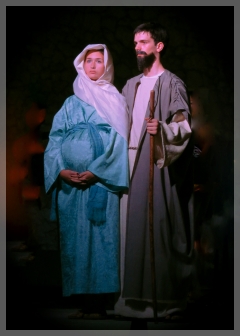 Until learning about Las Posadas, I hadn’t given much thought to the difficulty of Joseph and Mary’s journey to Bethlehem or to how frightened and desperate the couple must have been that night so long ago. As the crow flies, it’s only a 70-mile trip from Nazareth to Bethlehem but Joseph and Mary weren’t crows and the route was not a straight one. Because of the hilly terrain, the most direct route south was the most physically challenging and, because it led right through Samaria, it also was the most dangerous. Wanting nothing to do with Samaritans, Jews typically detoured to the east before going south along the flatlands of the Jordan River, turning west at Jericho, going over the hills surrounding Jerusalem, and on south into Bethlehem—a trip of 90 to 100 miles. The trek from Jericho to Bethlehem would have been the hardest since it was an uphill hike with an elevation change of 3,500 feet! In good circumstances, people could walk about 20 miles a day so Mary and Joseph feasibly could have made Bethlehem in five 8-hour days. Mary, however, was about ready to give birth so a trip of seven to ten days is more likely.
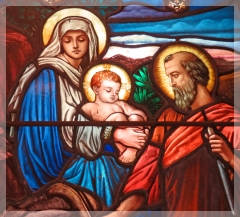 Tomorrow (December 16) is the first day of Las Posadas. Originally a solemn Christmas novena, it was brought to Mexico in 1587 by Spanish priests. Perhaps, because it occurred during the Aztec celebration of the birthday of their pagan god Huitzilopochtli, what began as formal nine-day prayer vigil eventually moved out of the church and into the community where it became a nine-day religious pageant.
 Although it sounds like something Satan might say to his demons, it was Alex Dumas, CEO of Hermès, who said “Our business is about creating desire.” It’s not just Hermès (with their $8,500 Della Cavalleria “magical bag”) that is in the business of creating desire; that seems to be the goal of many businesses. The LA Times has a “Coveted” column in their Image magazine featuring a curated list of luxury items (like $950 Gucci sneakers) they claim to be “mandatory” or “must-haves.” The October Vogue featured “coveted street style trends,” (like $1,364 velvet trousers and $600 Levi jeans) while urging its readers to purchase them “before it’s too late.” There’s even an on-line game called “Covet Fashion” in which you build your virtual dream wardrobe and then follow links to purchase the desired items.
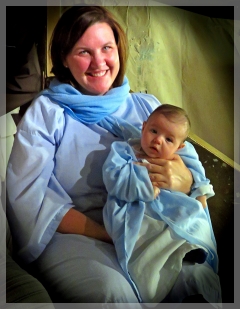 One December evening several years ago, we walked the streets of Bethlehem. Instead of travelling to the Holy Land, however, we traveled back in time at a local church. Our journey began with a stroll through the Christmas story. We walked past Gabriel meeting with Mary, an angel visiting the sleeping Joseph, the shepherds and sheep, Joseph and a very pregnant Mary in a stable, and met the Magi with their camels and gifts. We then went inside the parish hall to the bustling city of Bethlehem. As required by the emperor, we stopped to register for the census and pay our taxes before moving through the crowded marketplace to the shops of the wine merchant, carpenter, leather worker, and oil and spice dealers. After pausing to watch mud bricks being made and fabric being dyed, a young boy took us on a tour through his 1st century Jewish home.
 While we’re busy decorating our homes, planning holiday menus, finding the perfect gift for everyone on our list, and stressed about supply chain issues and shipping delays affecting the receipt of those gifts, let’s not forget that we’re in the season of Advent. This is a time for us to prepare for the second coming of Christ and to ponder the gifts of hope, love, peace, and joy we received with His first coming.
 Devotions of the Heart