
Jesus was born in Bethlehem in Judea, during the reign of King Herod. About that time some wise men from eastern lands arrived in Jerusalem, asking, “Where is the newborn king of the Jews? We saw his star as it rose, and we have come to worship him.” [Matthew 2:1-2 (NLT)]
 Although we try to keep Christ in Christmas, many of our ideas about Christmas aren’t Bible based. In spite of the delightful carols, the gospels make no mention of a little drummer boy, cattle lowing, Jeanette or Isabella, a partridge in a pear tree, and, rather than mid-winter, it’s more likely that Jesus was born in early fall.
Perhaps the most glaring example of misinformation found in the season’s songs has to do with the wise men. We can blame John Henry Hopkins, the Pennsylvania clergyman who wrote the song “We Three Kings” for much of our confusion. He wrote the carol in 1857 for his nieces and nephews and used it in a Christmas pageant that year. Published in a collection of hymns and carols in 1863, it’s been sung around the world ever since and most people are now convinced that these three kings visited the baby Jesus shortly after his birth.
The magi or wise men, however, weren’t kings. If they had been, it’s likely that the Gospel writers would have included such an important detail. Renaissance artworks depicting king-like figures in flowing robes and elaborate crowns at Jesus’s birth probably contributed to Hopkins’ misrepresentation. While they may have been envoys from a king, these wise men probably were priests, court advisors, or even astrologers from a land or lands to the east such as present day Iran or Iraq.
Ancient astrologers interpreted major astronomical events as signaling the birth of a king. Whether a conjunction of the planets Jupiter, Saturn, and Mars or a supernova, these wise men recognized the phenomenon as a special sign. Familiar enough with the ancient prophecies to quote from Micah to Herod, they knew a star would herald the Jewish king’s birth. It was typical for kings to send emissaries from their court with gifts to another king and a king (or kings) may have sent these men with their extravagant gifts to pay tribute to this newborn king. Moreover, while the gospel mentions three gifts, it never says how many men brought them and there may have been as few as two or more than twelve of them.
Even though the gospel account of the wise men’s visit follows closely after the birth of Jesus, logic tells us a couple of years had to pass before their arrival. Having traveled over 800 miles and stopping to see Herod in Jerusalem, the magi couldn’t have arrived immediately following Jesus’ birth. Jesus probably was a toddler when they finally arrived and found Him in a house with Mary. While these visitors sought to worship the new king, Herod wanted to kill him and his decision to kill all boys two years and younger ties in with this timeline.
The Magi may not belong in our nativity scenes, but they are an important part of the Christmas story. Today (January 6), many Christians observe Epiphany or Three Kings Day—a day that celebrates Jesus’ outward and visible expression of love for us and the wise men’s recognition of the one who was born “king of the Jews.” Although Jesus’ birth announcement was made to lowly Jewish shepherds, His first worshipers were these wise Gentiles. Although a messiah had been promised to the Jews, it was foreigners who sought Him, recognized His value, presented Him with precious gifts and worshipped Him. They may have been Gentiles, but they recognized the promised king of the Jews. Moreover, instead of returning to Herod as ordered, they were obedient to God’s direction and returned home another way.
While they weren’t actually there at the time, the presence of the wise men in our nativity sets is a reminder that Jesus, the promised Messiah, came to save all of mankind. They remind us to seek Jesus and recognize Him as our savior, to present Him with our gifts and worship him, and to obey God even when He sends us in a different direction.
We three kings of Orient are Bearing gifts we traverse afar.
Field and fountain, moor and mountain, Following yonder star.
O star of wonder, star of night, Star of royal beauty bright,
Westward leading, still proceeding, Guide us to thy perfect light. [John Henry Hopkins]
 I was listening to Randy Travis sing, “I’m diggin’ up bones, exhuming things that’s better left alone.” It seemed an appropriate song for this time of year when we tend to dwell on the past—not just past loves, but past losses, mistakes, oversights, misunderstandings, injuries and pain. As one year ends and another begins, we often dig up all the grievances, regrets, and ”if onlys” of our yesterdays.
 When prophesying about Jesus, Isaiah called Him a “man of sorrows.” Indeed, Jesus carried a tremendous weight of sorrow upon his shoulders—the heaviest of which was the weight of the world’s sins, a weight totally undeserved by this man who was without sin. A compassionate man, Jesus also carried the burden of the world’s heartache. He knew the anguish of Jarius, the despair of the bleeding woman, the grief of Martha and Mary at Lazarus’ death, the self-reproach of the woman at the well, the centurion’s concern for his servant, the torment of the possessed man, and the distress of the lepers. He also knew the weight of the world’s rejection. He was scoffed at by people in his own hometown, many of his early disciples deserted him, and Judas betrayed him. Wanting none to perish, He wept upon his entry into Jerusalem because of the Israelites’ lost opportunity at salvation. The night of His betrayal, Jesus was filled with grief—indeed, He was a man of sorrows. But, He also was a man of peace, love, purity, holiness, eloquence and love.
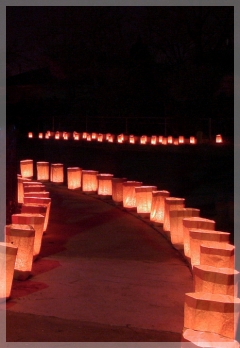 Hundreds of years ago, when Las Posadas was first celebrated, people gathered piñon pine branches into square piles to burn small vigil fires called luminaria to light the way for the Peregrinos as they searched for lodging. On Christmas Eve, bonfires were lit along the roads and in the church yard to guide people to midnight mass. Just as Las Posadas moved into the southwestern states as the Spanish and Mexicans came northward, so did the luminaria. When inexpensive flat-bottom paper bags appeared on the Santa Fe Trail in the 1870s, people started folding down the bag tops, anchoring the bag with a few handfuls of sand, and setting a small candle inside. Better than using precious fire wood, these luminaria (also called farolitos) became the popular tradition that continues in the southwest today.
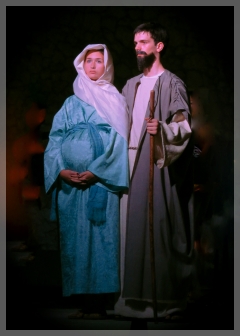 Until learning about Las Posadas, I hadn’t given much thought to the difficulty of Joseph and Mary’s journey to Bethlehem or to how frightened and desperate the couple must have been that night so long ago. As the crow flies, it’s only a 70-mile trip from Nazareth to Bethlehem but Joseph and Mary weren’t crows and the route was not a straight one. Because of the hilly terrain, the most direct route south was the most physically challenging and, because it led right through Samaria, it also was the most dangerous. Wanting nothing to do with Samaritans, Jews typically detoured to the east before going south along the flatlands of the Jordan River, turning west at Jericho, going over the hills surrounding Jerusalem, and on south into Bethlehem—a trip of 90 to 100 miles. The trek from Jericho to Bethlehem would have been the hardest since it was an uphill hike with an elevation change of 3,500 feet! In good circumstances, people could walk about 20 miles a day so Mary and Joseph feasibly could have made Bethlehem in five 8-hour days. Mary, however, was about ready to give birth so a trip of seven to ten days is more likely.
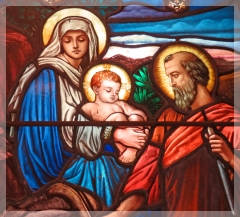 Tomorrow (December 16) is the first day of Las Posadas. Originally a solemn Christmas novena, it was brought to Mexico in 1587 by Spanish priests. Perhaps, because it occurred during the Aztec celebration of the birthday of their pagan god Huitzilopochtli, what began as formal nine-day prayer vigil eventually moved out of the church and into the community where it became a nine-day religious pageant.
