
Everyone who hears my teaching and applies it to his life can be compared to a wise man who built his house on an unshakable foundation. When the rains fell and the flood came, with fierce winds beating upon his house, it stood firm because of its strong foundation. [Matthew 7:24-25 (TPT)]
 While summer is hurricane season here in Florida, early spring is “sinkhole season.” For most property owners, a sinkhole is little more than a headache but, for some, it means the loss of their homes and possibly their lives. Seven weeks ago, two families north of here lost their homes and belongings as the earth collapsed beneath them, leaving a chasm at least 40-feet wide and 60-feet long. Back in 2013, a man went to sleep and literally disappeared as he, his bed and then his entire bedroom vanished into the earth; his body was never recovered.
Here in the “Sunshine State,” our homes are built on limestone that dissolves easily in rainwater; as a result, the underground becomes honeycombed with cavities. Sometimes, a cavity becomes too big to support its ceiling and collapses, leaving a gaping hole at the surface. Too much or too little water can trigger these sinkholes. Although cavities filled with rainwater can support their ceiling, when drought causes them to empty out, they can’t. On the other hand, in a heavy rain, the sudden flood of groundwater rushing into a cavity combined with the weight of pooled water on the surface also can lead to the ground’s collapse.
When purchasing our house of poured concrete, I knew it was hurricane resistant but I never gave any thought to the strength of the ground beneath it. Many of us build our lives in much the same way. Attention is given to looking good on the surface but our lives are not built on God’s bedrock. Instead of a drought or torrential rains jeopardizing our stability, it’s things like job loss, illness, miscarriage, divorce, addiction, mental illness, teenage rebellion, betrayal, depression, boredom, and loss that threaten our weak foundation.
As a carpenter, Jesus knew all about the building of houses when He spoke about foundations at the end of His Sermon on the Mount. Two houses experience the same challenges but only the house built on rock can endure life’s storms. In case his listeners didn’t understand His point, Jesus clearly explained it: a life built upon His teaching was built on a foundation of bedrock and wouldn’t fail.
Since most sinkholes occur in the central part of our state and only a few small ones have occurred near us, I’m not worried about them. Nevertheless, we do look for signs of trouble such as leaks or structural cracks in our floors or walls. Sinkholes can be prevented if geotechnical experts are called in time and the necessary repairs or remediation are done. Those houses I mentioned didn’t have to disappear into an abyss and neither do our lives. Lives built on shaky foundations can be saved. The salvage expert to be consulted is Jesus who will shore up our lives with His living word. Moreover, unlike that man who disappeared into the ground, nobody can fall so far into the abyss that Jesus can’t lift them out. Let us all build our lives on the bedrock of Jesus Christ!
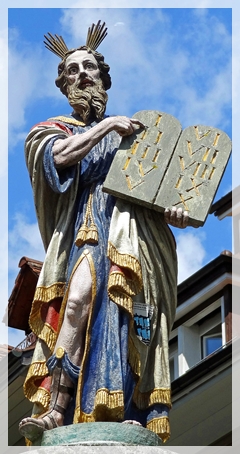 In Scripture, the number forty often appeared in the context of preparation, judgment, or testing. The rain poured down upon Noah for forty days and nights. After spending forty years in Egypt and another forty as a shepherd, Moses twice spent forty days with the Lord on Mt. Sinai. The Israelite scouts spent forty days exploring the land of Canaan and, because the people lost heart and rebelled at their report, they spent an extra forty years wandering the wilderness (one year for each day the men explored). Jonah warned Nineveh their destruction would take place in forty days, Ezekiel lay on his right side for forty days because of Judah’s sins and, before being slain by David, Goliath taunted Saul’s army for forty days.
 You may have celebrated the Feast of the Presentation of Christ in the Temple (or Purification of Mary) at church yesterday. Also known as Candlemas, this day commemorates an incident found in Luke 2 when, forty days after the birth of Jesus, three important events occurred: the ceremonial purification of Mary, Joseph and Mary’s dedication of their firstborn son to God, and Jesus’ first entrance into the Temple. It was then that Simeon and Anna recognized Jesus as the Messiah for whom they’d patiently waited. The association of candles with this event in Jesus’ life is understandable; upon seeing Jesus, Simeon declared him to be the light that would reveal God to the nations. Traditionally, a candle-lit procession preceded the Mass and all of the candles that would be used in the church that year were blessed. Candlemas night, people would place lit candles in their windows.
 After his wife complained about the roaches that had invaded their garden and begged him to destroy their underground nest, a Brazilian man poured gasoline into the hole he believed to be the source of the infestation and then tossed in lit matches! Within seconds, a massive explosion destroyed his yard while his home security camera captured the entire thing. “I had no idea that this could happen!” he said. Although the man did destroy the roaches, he destroyed his yard in the process! I’m not sure where he got his bright idea but I would guess that his Smartphone was involved. A quick search with mine told me that pouring gasoline on a roach colony is an effective way to eliminate the pests. Assuming a certain amount of common sense among its readers, however, the site had no warning about the explosive nature of gasoline vapors!
 Every Tuesday, we begin our afternoon Bible study with prayer and by saying the Pledge of Allegiance to the Bible. The words we use are attributed to Homer Grice, a Southern Baptist minister, who wrote them for Baptist Vacation Bible Schools in 1925. He combined two verses from Psalm 119 into this simple vow and versions of it continue to be used by Vacation Bible and Sunday Schools, Christian homeschoolers, and even adult Bible studies. Because it reminded me of elementary school and standing by my desk with my hand across my heart, starting class with this pledge seemed rather childish at first. Once I carefully considered the words, however, I realized that saying this pledge always reminds me that the Bible is at the center of a Christian’s devotion to Jesus Christ. It was in Him that the Word became flesh and, through Scripture, God continues to speak to us today.
 Broken people were drawn to Jesus but Mary Magdalene was not as broken as many people think. Magdalene was not her last name; it simply means “from Magdala” and the Gospels’ writers added it to distinguish her from the many others Marys: Jesus’ mother, Martha’s sister, the wife of Clopas, and the mother of James and Joseph.
 Devotions of the Heart