
God replied to Moses, “I AM WHO I AM. Say this to the people of Israel: I AM has sent me to you.” [Exodus 3:14 (NLT)]
“I am the Alpha and the Omega—the beginning and the end,” says the Lord God. “I am the one who is, who always was, and who is still to come—the Almighty One.” [Revelation 1:8 (NLT)]

As Christianity Today aptly points out, “Changing gender norms, new social media platforms, and deepening class divisions have led to a renewed conflict over language.” As a writer, I have more than enough opportunities to intentionally or unintentionally offend with my words and, as a reader, you have plenty of opportunities to criticize my choice of words. As a Christian, I want to speak with love and in such a way that doesn’t isolate any race, gender, religion, sexuality or ethnic background so I try to use inclusive language and avoid words that might be thought of as exclusionary of any group. Nevertheless, I’m not always successful. While I understand using “police officer” instead of “policeman,” other words are more problematic and not so easily changed.
Moreover, eventually we need a pronoun and most pronouns are gender specific. In 2012, the Swedes started using hen, a gender neutral pronoun that can replace the gender specific hon (she) and han (he). We don’t have that option in English. Our pronouns take the gender of the noun they replace and substituting every “his” and “her” with “his or her” or “his/her” is cumbersome at best. Using “they,” “them” or “their” for a singular person when gender is unknown can be misleading and goes against rules of grammar I learned as a girl!
When referring to Jesus, it’s easy to know the correct pronoun because Scripture makes it clear—the Savior presented Himself on earth as a man. With God and the Holy Spirit, it’s not so clear cut. Regardless of who is referring to God or if it’s written in Hebrew, Aramaic, or Greek, male pronouns are used for God in Scripture. Since God chose to reveal Himself to us as a man when He clothed Himself in flesh and Jesus made about 160 references to God as father (not parent), does that make God male? What about the Holy Spirit? Although the Greek word for spirit (pneuma) was gender neutral, the Holy Spirit is referred to as masculine throughout the New Testament. Is the Spirit male, as well?
God is God: the great I AM—the Alpha and Omega—the beginning and the end! Although God is a person—with intellect, emotion, motivation, insight and a will—a person who can communicate, create, and have relationships—God is spirit. Without flesh, bones, and the limitations of a physical body, God has no gender—neither male nor female. Like God, the Holy Spirit is both a person and a spirit and, as such, is genderless, as well. Without a gender, there are no perfect pronouns for either God or the Holy Spirit. The Lord is not an “it” nor is the Holy Spirit a “they.”
Although some women writers refer to God as “she,” lacking a better solution and, in deference to Scripture’s original writers, I will continue to refer to God and the Holy Spirit as “He.” I understand that being referred to by the right pronoun can be pivotal to a person’s identity, but I doubt it is crucial for God. Something tells me that God is far more interested in having us talk about Him (or Her) and pray to Him (or Her) than what pronouns we use when doing it.
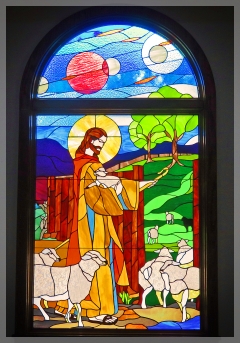


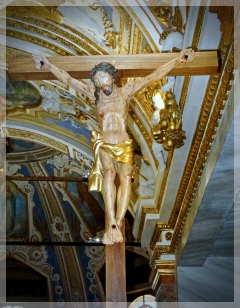 In any cathedral or art museum, we’ll find many pictures of Jesus and even rather graphic depictions of Him on the cross. None of them, however, tell us anything about His appearance because they were created long after His time. Still, in a world where we seem to memorialize everything with pictures, you’d think one of Jesus’ followers would have sketched Him while blessing the children, giving the Sermon on the Mount, or feeding the multitude! 1st century rabbis in Judah, however, vehemently objected to the depiction of human figures because the second commandment prohibited making a “graven image.” With its Jewish roots, this prohibition carried into the early church and inhibited early Christian art.
 After the rich young ruler departed, Jesus compared the difficulty of a rich man entering heaven to a camel trying to squeeze through the eye of a needle. Because of its impossibility, people find this metaphor troubling. To rationalize it, some scholars speculate that a narrow gate called “The Needle” was located in the wall surrounding Jerusalem. Supposedly used after dark when the main gates were closed, it was so small that a camel had to be unburdened of rider and cargo before getting down on its knees to pass through the gate. They interpret the metaphor as meaning that people must leave behind their baggage, repent, and humble themselves to get through the gate to God’s kingdom. While that’s correct and their explanation makes an excellent Sunday school lesson, no historical or archeological evidence exists that such a gate existed.
 Devotions of the Heart