
And we know that God causes everything to work together for the good of those who love God and are called according to his purpose for them. [Romans 8:28 (NLT)]
 Used primarily in soccer and hockey, the term “own goal” or “OG” describes the moment a player accidentally (or deliberately) puts the ball or puck into their own net, resulting in the opposing team getting credited with the goal. OGs can arise from a player’s misjudgment or simply bad luck, as might happen when he’s the victim of a wicked deflection or freak incident. An “own goal” is probably one of the lowest moments for a player and the term has now become a metaphor for any action that backfires on a person. When I think of the way Paul’s imprisonment helped rather than hindered the growth of the early church, I can’t help but think that Satan made an own goal with that one and the point went to God’s team, not his.
The enemy scored another “own goal’ some 57 years ago when I was a freshman at Northwestern University. Although I’d been raised in a church-going family and considered myself a Christian, I was a troubled and confused young woman when I entered college. First quarter freshman year, I took a course in Methods of Discussion in which we studied group communication. On our first day, the class was divided into small groups for a major assignment. We were to select a campus organization that had discussions and observe several meetings. Our purpose was not to scrutinize the topic discussed but to analyze and evaluate the way in which it was considered—how decisions were made, conflicts resolved, understanding built, questions answered, and voices heard. Having been on campus for less than a week, we freshmen knew nothing about any campus organizations and when Dave, the group’s lone upper classman, assured us that Campus Crusade for Christ would make for a great term paper, we deferred to his wisdom. The fact they met Sunday nights and served supper when the dorms didn’t was the selling point for most of us.
What we didn’t know until after starting the project was that Dave’s purpose in choosing Campus Crusade had nothing to do with observing discussion methods or eating a free dinner. An angry atheist, his sole reason for choosing the group was to write a paper that denigrated and ridiculed Christians and this group in particular. The rest of us, however, insisted on sticking to the task and focusing on the method of communication rather than the topic discussed. When it became clear that our paper wouldn’t accomplish his purpose, Dave dropped the class.
While I remember getting an A on the paper, I remember nothing about the mode of discussion at the Campus Crusade get-togethers except that it was spirited and friendly. What I do remember is their message of God’s grace and salvation through Jesus Christ. This wasn’t the God of judgment and condemnation with whom I was familiar; this was a God of unconditional love and forgiveness, a God of relationship rather than religion. Jesus became real to me and I learned more about Him in a few Sunday evenings than I had in years of Sunday school and church. Even though I’d been baptized as an infant and confirmed as a young teen, it wasn’t until I knelt in the university chapel and asked Jesus into my life that I truly became His disciple. After our paper was submitted, I continued attending those Sunday meetings (and not just for the dinner) until I left university life.
Our Heavenly Father works in strange and wonderful ways and has no problem allowing evil people to accomplish His purposes. There’s a certain amount of poetic justice when Satan’s plans backfire as they did with the Apostle Paul and as they even did with me! Thank you, Jesus, for the atheist who brought me into your arms!
 We reject all shameful deeds and underhanded methods. We don’t try to trick anyone or distort the word of God. We tell the truth before God, and all who are honest know this. If the Good News we preach is hidden behind a veil, it is hidden only from people who are perishing. Satan, who is the god of this world, has blinded the minds of those who don’t believe. They are unable to see the glorious light of the Good News. They don’t understand this message about the glory of Christ, who is the exact likeness of God. [2 Corinthians 4:2-4 (NLT)]
 When the angel promised John’s birth to Zechariah, it was ordained that the child would be named John, that he would be a Nazarite, and that he would prepare the people for the coming of the Lord. After that, other than his circumcision, the only thing we know about John’s youth is that he “grew up and became strong in spirit. And he lived in the wilderness until he began his public ministry to Israel.” [Luke 1:80] We know that Zechariah lived in the hill country of Judea and church tradition places his home in Ein Karem near Jerusalem. Considering Zechariah’s and Elizabeth’s advanced ages, they probably didn’t live to see their boy become a man. Nevertheless, they would have been sure their son knew of his divine calling and made provisions for his care.
 Since it was Easter, along with the oatmeal raisin cookies I made for Sunday treats, I brought a bowl of pastel-wrapped Hershey candy for the little ones. As I placed the candy on the hospitality table, I recalled the last time I had chocolates at church. It was several years ago at our Colorado mountain church. Even though it wasn’t Easter or Valentine’s Day, along with Bibles, the pew book racks were filled with chocolate kisses that morning.
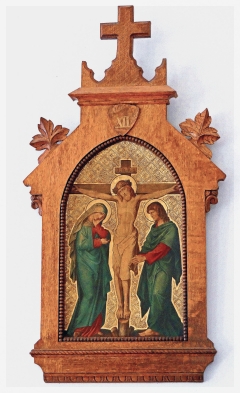 Jesus knew that one would betray Him, another deny Him, and all desert Him. He knew the people He’d fed, healed, taught, and loved—the people who just a few days earlier had greeted him like a king with palm branches and shouts of “Hosanna”—soon would prefer a thief over Him. Because of His anguished prayers later that evening in Gethsemane, we know that He knew the suffering and torment that lay ahead for him. Nevertheless, he sang with the disciples during their Passover meal that last night and it wasn’t a sorrow-filled psalm of lament.
 We always knelt for prayer in the church I attended as a girl so I used to think the only way to pray was on my knees with head bowed and hands tightly clasped. While I now pray in a variety of postures, I wondered if Scripture tells us exactly how we should pray.
 Devotions of the Heart