JOHN THE BAPTIST – Part 1

And he [John] will turn many Israelites to the Lord their God. He will be a man with the spirit and power of Elijah. He will prepare the people for the coming of the Lord. He will turn the hearts of the fathers to their children, and he will cause those who are rebellious to accept the wisdom of the godly. [Luke 1:16-17 (NLT)]

blue flag irisWhen the angel promised John’s birth to Zechariah, it was ordained that the child would be named John, that he would be a Nazarite, and that he would prepare the people for the coming of the Lord. After that, other than his circumcision, the only thing we know about John’s youth is that he “grew up and became strong in spirit. And he lived in the wilderness until he began his public ministry to Israel.” [Luke 1:80] We know that Zechariah lived in the hill country of Judea and church tradition places his home in Ein Karem near Jerusalem. Considering Zechariah’s and Elizabeth’s advanced ages, they probably didn’t live to see their boy become a man. Nevertheless, they would have been sure their son knew of his divine calling and made provisions for his care.

The word translated as wilderness or desert is erémos, meaning a barren place, it typically was used to describe the desert to the east and south of Palestine. It is speculated that John may have resided in the erémos with a community of Essenes who lived in the Judean desert near Qumran. This Jewish sect studied and copied Hebrew scripture and practiced various forms of asceticism like fasting, prayer, and celibacy. 1st century historian Josephus tells us they often took in children who were dedicated by their parents to such a lifestyle and the Dead Sea scrolls tell us they often recruited members from priestly families.

There are similarities between John and the Essenes. They both strived for holiness through a demanding ascetic lifestyle, practiced a baptism ritual requiring a change in heart, and described themselves as voices in the wilderness. Like John, Essenes had a special diet and members vowed never to eat food prepared outside the community. There was, however, a loophole and anything eatable found in nature that didn’t require preparation was allowed so John’s strange diet of wild honey and locusts would have been acceptable for an Essene.

There are, however, significant differences between the Essenes and John. Essenes interpreted Isaiah’s words, “Clear the way through the wilderness for the Lord! Make a straight highway through the wasteland” to mean they should separate themselves from Judah and civilization and live in the wilderness to await redemption. The Essenes lived in almost total isolation but John did just the opposite and became a very public voice by the banks of the Jordan as he called the nation to repent. The Essenes’ doctrine expected two Messianic figures along with a prophetic figure. The Dead Sea scrolls make it clear they did not believe Jesus to be a messianic figure but John recognized Jesus as the one and only Messiah.

With his call for the nation’s repentance, John is far more like an Old Testament prophet than an Essene. Just as Elijah confronted King Ahab about his sins, John confronted Herod. Like Elijah, he wore clothing of camel’s hair with a leather belt and his attire, while seeming strange to us, would have made perfect sense to a 1st century Jew. Jesus made the connection when he told John’s disciples that John was the fulfillment of Malachi’s prophecy that a prophet would come in the spirit and power of Elijah to prepare the way for the Lord.

John the Baptist is the connection between the Old and New Testaments—between the old covenant of the law and the new covenant of grace. We may not know much about John before his thirtieth year but we do know that he fulfilled the task God set before him: “to prepare the way for the Lord. …to give light to those who sit in darkness and in the shadow of death, and to guide us to the path of peace.”

And you, my little son, will be called the prophet of the Most High, because you will prepare the way for the Lord. You will tell his people how to find salvation through forgiveness of their sins. Because of God’s tender mercy, the morning light from heaven is about to break upon us, to give light to those who sit in darkness and in the shadow of death, and to guide us to the path of peace.” [Luke 1:76-79 (NLT)]

Copyright ©2022 jsjdevotions. All rights reserved.

TEND THE GARDEN – EARTH DAY 2022

Then God blessed them and said, “Be fruitful and multiply. Fill the earth and govern it. Reign over the fish in the sea, the birds in the sky, and all the animals that scurry along the ground.” … The Lord God placed the man in the Garden of Eden to tend and watch over it. [Genesis 1:28,2:15 (NLT)]

It is terrible to hear the young birds calling for food after the old ones have been killed to get the feathers for rich women to wear. I am not going to have my birds sacrificed that way. [Rhett Green (Corkscrew Swamp Audubon Warden from 1912 – 1917)]

great egret - snowy egret - corkscrew sanctuaryThe wading birds of southwest Florida are absolutely beautiful, especially this time of year when they’re wearing their mating plumage. We’ve lived here eleven years and I still haven’t tired of their beauty as I encounter them daily in our ponds. 115 years ago, however, I would have been hard put to see any of these beautiful creatures anywhere. In the late 1800s, bird feathers became the fashion craze in women’s hats. Along with a plethora of plumes, some hats even featured an entire exotic bird! By 1900, more than five million birds were being killed every year and plume hunters had nearly wiped out the entire egret population. It wasn’t just the egrets with their white mating plumes—herons, roseate spoonbills, flamingoes, and peacocks were among the fifty North American species being killed for their plumage. No bird was safe.
After killing the birds and stripping them of their plumage, poachers would leave their carcasses to rot. They also left abandoned nests with eggs that would never hatch or baby birds unable to fend for themselves. For the hunters, poaching was profitable; they could easily bag 100 birds on a good day and the plumes sold for as much as $32 dollars an ounce. Merely for the sake of fashion, the bird population in rookeries was decimated throughout Florida and the southeast U.S. Fortunately, because of a grass roots campaign by two Boston socialites, organizations like the Audubon Society, and both state and national legislation, the carnage of these beautiful creatures has stopped.

We were called to be good stewards of the earth, but we still show little regard for God’s creation. Last fall, U.S. Fish and Wildlife Service delisted 11 species of birds from the endangered species list—not because they no longer were at risk but because they had become extinct! In 2021, Birdlife International reported that nearly 1,500 of the 11,000 species of birds face the threat of extinction with another 1,000 species considered “vulnerable.” We’re not wearing fancy feathered hats but loss of habitat, climate change, wind farms, cell towers, pesticides, cats, and even windows pose threats to them. It’s not just birds that are in danger; our local papers are filled with reports of blue-green algae, red tide, fish kills, Florida panther loss, starving manatees, diminishing wetlands, and endangered sea turtles! Worldwide, we face plenty of other pressing environmental issues including oil spills, water pollution, global warming, fossil fuel dependency, a diminishing rain forest, and the loss of open land (to name just a few).

When I look at the birds with their beautiful plumage, I thank God for their creation and for the people who took action to save them. Although God did the creating, it is up to us to do the maintaining. In Genesis, we read that God gave mankind permission to govern the earth and reign over all the animals along with the responsibility of tending and watching over His garden. The Hebrew word used for “tend” was shamar and it means more than keeping the land cultivated and free of weeds. It means keeping watch, preserving, guarding, and protecting. Have we tended God’s beautiful garden and made it thrive or have we run roughshod over it without regard for His creation?

Today is Earth Day. Observed by over a billion people every year, it has become the largest secular observance in the world. Concern for our environment, however, is not a secular concern—it is a sacred responsibility given to us by God. Let us remember that every day is Earth Day!

Lord, grant us the wisdom to care for the earth and till it. Help us to act now for the good of future generations and all your creatures. Help us to become instruments of a new creation, Founded on the covenant of your love. [The Cry of the Earth]

The earth is the Lord’s, and everything in it. The world and all its people belong to him. [Psalm 24:1 (NLT)]

Copyright ©2022 jsjdevotions. All rights reserved.

WHAT HAPPENED TO THEM?

He said to them, “The Son of Man is going to be betrayed into the hands of his enemies. He will be killed, but three days later he will rise from the dead.” They didn’t understand what he was saying, however, and they were afraid to ask him what he meant. [Mark 9:31-32 (NLT)]

Although crucifixion probably began with the Assyrians and Babylonians, the first historical record is of Persia’s King Darius I crucifying 3,000 political opponents in 519 BC. Alexander the Great adopted the practice when he crucified 2,000 survivors of the siege of Tyre in 332 BC. In 88 BC, the Hasmonean king of Judea, Alexander Jannaeus, crucified 800 Jewish rebels after killing the rebels’ wives and children in front of them. Following a massive slave revolt against Rome in 71 BC, 6,000 rebels were crucified along the Appian Way. The crosses stretched for miles and the bodies were left there as a clear message that any rebellion would end in a violent death. After the death of Herod the Great in 4 B.C., a failed rebellion in Judea led to the crucifixion of 2,000 rebellious Jews.

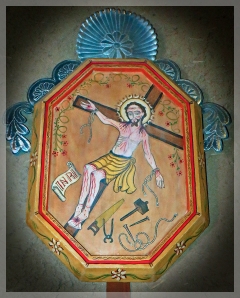
While the Romans didn’t invent crucifixion, they had perfected it by the time of Jesus and the torture began long before the cross. The condemned were stripped naked, tied to a post, and flogged across the back, legs, and buttocks by Roman soldiers using whips called flagrums consisting of small pieces of bone and metal attached to a number of leather strands. The scourging left the victims’ skin ripped to the bone. If they survived the scourging, they were taunted and forced to carry the crossbar of their death instrument to the place of execution. According to Josephus, sometimes Roman soldiers further tortured the condemned by blinding them or cutting off a body part (like the tongue). Arms were nailed or strapped to the cross beam and feet to the upright. Once upright, a massive strain was put on the wrists, arms and shoulders often resulting in dislocated shoulder and elbow joints. The rib cage was constrained in a fixed position making it extremely difficult to exhale and impossible to take a full breath. While death came from suffocation, loss of body fluids, and multiple organ failure, it did not come quickly.

According to Josephus, crucifixion in Palestine was a common sight so Jesus’ disciples knew all too well what carrying a cross meant. They heard stories of Roman cruelty, saw the bloodied and battered condemned carrying their crosses, and passed by the dead bodies left decaying on crosses as a warning to those who dared challenge Rome. But, for all of their lives, these same men had been waiting for the promised Messiah to come and deliver them from Roman oppression.

Perhaps, when Jesus spoke of the cross, they thought He was referring to the many Jewish rebels who had carried their crosses for defying Rome. But, unlike those times, this time they had Jesus—the promised Messiah who finally would bring victory to the Jewish nation. Even though they believed Jesus was the Messiah, they didn’t fully understand what that meant. They thought He came to defeat Rome, rather than death, and to save a nation, not the world. Even after Jesus spoke of His death on the way to Jerusalem, we have James and John ignoring that prediction and asking Jesus for positions in His kingdom. They still pictured a political victory!

The disciples abandoned Him at His arrest and, in spite of His repeated warnings, were not prepared for His death. Surely, the man who raised Lazarus from the dead wasn’t going to die a criminal’s death, but He did and there was no doubt that He was dead. When the Sabbath was over, two disappointed followers returned to Emmaus, the women went to the tomb to anoint a dead body, and the frightened disciples were gathered in a locked room. They weren’t proclaiming Jesus that morning and didn’t even believe the women when told the tomb was empty. They were a defeated, disappointed, and frightened group of men.

So, what happened to change this group of disheartened disciples? What turned them into enthusiastic evangelists? What turned them into men who willingly followed Jesus to their own equally horrific deaths? It was seeing the risen Christ! May we always remember the truth of this message: Christ has died, Christ is risen, Christ will come again!

God raised Jesus from the dead, and we are all witnesses of this. Now he is exalted to the place of highest honor in heaven, at God’s right hand. And the Father, as he had promised, gave him the Holy Spirit to pour out upon us, just as you see and hear today. [Acts 2:32-33 (NLT)]

Copyright ©2022 jsjdevotions. All rights reserved.

FLYING AWAY

Oh, that I had wings like a dove; then I would fly away and rest! I would fly far away to the quiet of the wilderness. [Psalm 55:6-7 (NLT)]

mourning doveEaster is over and “season” here in southwest Florida is winding down. More people are departing than arriving as our seasonal visitors return north, transport trucks laden with cars are moving up the interstate, and we finally can get a table at our favorite restaurant! It’s been said that there is no escape from death or taxes but we usually try to flee from just about every other unpleasant thing. Thinking their lives would be better here, our snowbirds came south to escape sub-zero temps, heating bills, and shoveling snow. While the climate here is nicer, our tropical paradise doesn’t come with a guarantee and none of us can flee from life’s uncertainties and problems.

Rather than escaping from winter weather, Naomi and Elimelech fled from Bethlehem to escape a famine. Instead of trusting God, they ran away to Moab, a pagan nation hostile to Israel. They intended staying briefly but remained for ten years during which time their sons broke Jewish law by marrying Moabite women. Moab, however, didn’t turn out to be the sort of get-away for which they hoped; sadly, Elimelech and both sons died. A widow with no sons in a hostile and pagan land was in worse straits than a family in their homeland during a famine. Having literally fallen out of the frying pan into the fire, Naomi decided to flee from Moab. At least this time, she went in the right direction—back to Bethlehem and the God of Israel!

We’re not much different from Naomi and some of our snowbirds; we want to escape to a place where life will be better, simpler, happier, easier, less costly, or more fun. Like Naomi, however, we’re likely to be disappointed because the baggage we’ve packed contains more than our clothes. Tucked in with the sunglasses and beach attire are things like problems at work, disappointments, worries, responsibilities, lack of faith, ill health, guilt, unmet deadlines, family strife, or financial problems. If we can’t physically flee from our troubles, some people try escaping through things like procrastination, alcohol, shopping, drugs, busyness, codependency, or denial. Disregarding the bills doesn’t get them paid, ignoring the lump won’t make it disappear, and taking a vacation, moving to a new house, or having another baby won’t fix a broken marriage. There is no way to escape from life’s problems, obligations, or consequences. We carry that baggage with us wherever we go.

In Naomi and Elimelech’s day (the time of the judges), famine was a test of faith but the couple missed what God planned for them by fleeing from their challenge. If we simply suffer through our troubles and allow them to be our master, we lose hope and become bitter, as did Naomi. Having resigned herself to being an embittered penniless widow with no grandchildren, upon her return to Bethlehem the woman whose name meant pleasant called herself Mara, meaning bitter. Rather than running from or resigning ourselves to our troubles, we can endeavor to change them by trusting God—exactly what Naomi and Elimelech failed to do. Instead, it was the Moabite woman Ruth who showed more faith in Israel’s God than did her in-laws. Trusting in Him, she bravely faced the challenges of widowhood by gleaning in the fields of Boaz. Ruth, however, wasn’t alone in those fields; God was at her side! No matter how bleak the situation may seem, there’s no need to flee when we remember that God is with us in our troubles.

Good people must never expect to escape troubles; if they do, they will be disappointed, for none of their predecessors have been without them. [Charles Spurgeon]

The Lord hears his people when they call to him for help. He rescues them from all their troubles. The Lord is close to the brokenhearted; he rescues those whose spirits are crushed. The righteous person faces many troubles, but the Lord comes to the rescue each time. [Psalm 34:17-19 (ESV)]

Don’t be afraid, for I am with you. Don’t be discouraged, for I am your God. I will strengthen you and help you. I will hold you up with my victorious right hand. [Isaiah 41:10 (NLT)]

Copyright ©2022 jsjdevotions. All rights reserved.

THE REASON FOR THE SEASON – Easter 2022

So you see, just as death came into the world through a man, now the resurrection from the dead has begun through another man. Just as everyone dies because we all belong to Adam, everyone who belongs to Christ will be given new life. [1 Corinthians 15:21-22 (NLT)]

For this is how God loved the world: He gave his one and only Son, so that everyone who believes in him will not perish but have eternal life. God sent his Son into the world not to judge the world, but to save the world through him. [John 3:16 (NLT)]

rabbitIn less than five minutes the house was ready for Easter. I’d hung out the spring wreath with its silk tulips, placed the resin Easter rabbit with his cart and eggs on the hall table, and put the three ceramic bunnies around the flowers on the table. With no grands visiting this year, I didn’t even have eggs to boil or baskets to fill! Since it took me days to ready the house for Christmas, I wondered why Easter doesn’t get the same amount of decoration and celebration. Granted, most of the holiday traditions for both holy days have pagan beginnings. Nevertheless, those customs have become part of our culture and Christmas seems to overshadow Easter by a mile.

Christmas has its own color scheme, its own genre of music, and its own beloved fictional characters, including a Grinch, a snowman, an elf on a shelf, and a red-nosed reindeer. We spend weeks decorating our homes, purchasing gifts, and preparing food. We have special Christmas attire ranging from Santa hats to candy cane jewelry and ugly holiday sweaters. People decorate trees, hang garlands and lights, dress up their dogs, and adorn their cars with reindeer horns. Every year sees at least one Christmas-themed movie release and we get a plethora of holiday-themed television shows throughout December. Christmas music is played from the first of November to New Year’s and our calendars are filled with dates for holiday parties and concerts. Easter traditions pale in comparison to Christmas. Even with Easter baskets and egg hunts, the Easter Bunny can’t hold a candle to Santa. The few Easter hymns are sung only a couple of Sundays and hard-boiled eggs and Peeps are second-rate when compared to the plethora of holiday treats, Christmas cookies, and peppermint bark! As far as celebrations go, Easter is sort of like the neglected step-child of holy days. Of course, it’s difficult to generate a festive spirit when Easter is preceded by a season of penitence and fasting and follows the darkest day in Christendom.

As much as I enjoy the traditions of Christmas (in spite of their pagan origins), Christmas really has nothing to do with decorating houses, baking cookies, hanging stockings, gift exchanges, sending cards, singing carols, or holiday parties. Although our sacred Christmas traditions emphasize Jesus’ birth with nativity scenes and pageants, that night in Bethlehem was just the beginning of a far greater story—the story of who Jesus was and what He did for us.

Granted, we usually consider a person’s arrival more reason to celebrate that his departure and we celebrate birthdays rather than dates of death but, in Christ’s case, it is just the opposite. The meaning of Christmas is actually found in the Easter story. Without Jesus’ death, resurrection, and ascension there would be no forgiveness, redemption, and salvation. Without Easter, the Christmas story would be no more than just a story. For me, the purpose of Christmas can be summed up in one word: Easter!

So, Merry Christmas and Happy Easter on this upcoming Resurrection Sunday!

Somehow we just don’t make the same boisterous fun of Holy Week that we do of Christmas. No one plans to have a holly, jolly Easter. … Easter may seem boring to children, and it is blessedly unencumbered by the silly fun that plagues Christmas. Yet it contains the one thing needful for every human life: the good news of Resurrection. [Frederica Mathewes-Green]

All praise to God, the Father of our Lord Jesus Christ. It is by his great mercy that we have been born again, because God raised Jesus Christ from the dead. Now we live with great expectation, and we have a priceless inheritance—an inheritance that is kept in heaven for you, pure and undefiled, beyond the reach of change and decay. [1 Peter 1:3-4 (NLT)]

Jesus told her, “I am the resurrection and the life. Anyone who believes in me will live, even after dying. Everyone who lives in me and believes in me will never ever die. [John 11:25-26a (NLT)]

Copyright ©2022 jsjdevotions. All rights reserved.

THY WILL BE DONE

“My Father! If it is possible, let this cup of suffering be taken away from me. Yet I want your will to be done, not mine.” … Then Jesus left them a second time and prayed, “My Father! If this cup cannot be taken away unless I drink it, your will be done.” … So he went to pray a third time, saying the same things again. [Matthew 26:39,42,44 (NLT)]

water liliesThroughout His ministry, it seems that Jesus knew that the cross awaited Him but we don’t know if the human part of Him knew the exact details. Even so, it’s one thing to know what lays in the future but quite another to know it is about to begin within a matter of minutes. That night in Gethsemane, God showed Jesus the cup from which He would drink and He showed it in gruesome detail. Jesus viewed the betrayal, abandonment, sham trials, mocking, beating, flogging, and suffering torture on the cross along with the jeers of the crowd and the heartbreak and tears of His mother and the other women at the foot of the cross. Had Jesus not known exactly what the next 24-hours held, He would have been no different than the lambs brought to the Temple for sacrifice. They weren’t there of their own volition and had no knowledge of what would happen to them when presented to the priest. Rather than willing sacrifices, they were victims! The Lamb of God, however, needed to know the extraordinary cup—the horrible ordeal—that lay before him because, rather than a victim, He was a willing volunteer! His anguished prayers that night, however, tell us He didn’t look forward to it.

When we look at Jesus’ prayers that last night, there’s a condition to His request to remove the cup: “if it is possible.” If there were an alternative means to accomplish God’s will, Jesus certainly would have preferred it. Knowing exactly what He was facing, the human part of Him prayed for another way and He prayed so intensely that he sweat blood! Judas and the soldiers hadn’t yet arrived and Jesus could have quietly slipped away in the night and disappeared into Jerusalem, but He didn’t! As He prayed for deliverance, He also prayed to do God’s will. Since the Son of God had come to mankind to do His Father’s will, Jesus obediently and willingly stayed in the garden and submitted to all the horror that followed.

Looking at Jesus’ prayers in Gethsemane as a lesson in prayer, we see that since God the Father denied the request of His only Son, we shouldn’t expect God to agree to all we ask. C.S. Lewis says that Jesus’ unanswered prayers that night make it clear that prayer is not to be considered “a sort of infallible gimmick.” There is, however, a greater lesson in Jesus’ prayers in Gethsemane.

He forthrightly asked for the horror of what lay ahead to be removed which is the sort of prayer we typically offer when a loved one lies in a coma, the doctor says “inoperable,” the bank threatens foreclosure, we face 32 more radiation treatments, or a child become addicted. We pray, “Take it away, Lord—make it all right!” That, however, is usually where we stop but Jesus didn’t stop there. After asking for our difficult cup to be removed, do we add “if it is possible,” with the understanding that God’s purpose is more important than our desire? Finally, like Jesus, do we complete our prayer by fully submitting to God’s divine plan (whether we like it or not) with the words, “I want your will to be done, not mine”? Jesus submitted, will we?

If there was not an absolute necessity of his suffering them in order to their salvation, he desired that the cup might pass from him. But if sinners, on whom he had set his love, could not, agreeably to the will of God, be saved without his drinking it, he chose that the will of God should be done. He chose to go on and endure the suffering, awful as it appeared to him. [Matthew Henry]

He walked away, about a stone’s throw, and knelt down and prayed, “Father, if you are willing, please take this cup of suffering away from me. Yet I want your will to be done, not mine.” Then an angel from heaven appeared and strengthened him. He prayed more fervently, and he was in such agony of spirit that his sweat fell to the ground like great drops of blood. [Luke 22:41-44 (NLT)]

Copyright ©2022 jsjdevotions. All rights reserved.