UNFORGIVABLE

And forgive us our sins, as we have forgiven those who sin against us. … If you forgive those who sin against you, your heavenly Father will forgive you. But if you refuse to forgive others, your Father will not forgive your sins. [Matthew 6:12,14-15 (NLT)]

It’s been nearly 50 years, but I’ll never forget that day when, out of anger and fear, I vowed, “I’ll never forgive him!”  My husband and I had taken our three children shopping for school clothes. While I was busy with the eldest, my husband said he’d take the other two for a walk through the mall. Unknown to me, the three-year-old had convinced his father that he’d stay at the store, sit quietly in a little crawl-through hole by the store’s entrance, and wait for his dad’s return. Unfortunately, my husband never told me of that decision. Having the attention span of a gnat, the little guy quickly grew bored watching shoppers. After wandering into the store to hide in the clothes racks, he looked for his brother and me. Not seeing us (since we were in a changing room), the independent guy decided we’d left without him and calmly went looking for us in the mall parking lot. While I was paying for our purchases, my husband returned with only one child in tow. Almost simultaneously, with panic in our voices, we asked one another, “Where’s Scooter?” My imagination went wild with all the horrible things that could have happened to the youngster. In an instant, I decided I’d never forgive my husband for his carelessness and that our marriage would be over!

After the saleswoman made a call to mall security, we learned that a concerned woman had spotted the boy wandering in the parking lot sobbing because he was sure we’d left for home without him. She took him to security where he was enjoying a red lollipop. Through God’s good graces, his misadventure had a happy ending, but what if it hadn’t? While angrily deciding I’d never forgive my husband, it never occurred to me that he’d be hard put to forgive himself if our son was harmed in any way!

I thought of that episode after reading about a 5-year-old severely autistic child who’d wandered out of his house and was found drowned in a nearby pond. A few days later, I learned of a critically injured three-year old who’d fallen out of an industrial mowing tractor and been run over by his father. Unlike our story, those stories had sad endings. Several years ago, a friend’s grandchild died in another tragic accident. Wanting to go on a ride with his dad, the toddler had quietly left the house and was standing in the driveway when his father backed over the youngster. That accident ended up destroying a family through divorce and then the father’s suicide. Apparently, neither parent could forgive the other nor could they forgive themselves. I sometimes think of how my husband and I narrowly escaped a similar ending that day in the mall. Would we have forgiven ourselves and one another? How will the family of the child run over by that lawn mower or the parents of that special-needs child cope? Will they forgive each other? Will they ever forgive themselves? Or, as happened with our friend’s family, will one tragedy lead to others?

C.S. Lewis said, “Everyone says forgiveness is a lovely idea, until they have something to forgive.” Indeed, forgiveness isn’t easy and, sometimes, it seems nearly impossible. Nevertheless, we ask God to forgive us in the way we forgive others. It is hypocritical for us to ask God to forgive our sins if we withhold forgiveness from anyone else. Unless we want God to pick and choose among our sins and failings, we cannot pick and choose among the actions of those who’ve failed us. We don’t get to forgive the little transgressions and withhold forgiveness on the big ones unless we want God to do the same with us.

Instead of a mall cop and a three-year-old with a red lollipop, what if our story hadn’t ended well? I’d like to think that I would have forgiven my husband and our marriage would have survived and thrived. Only God knows—I certainly don’t and I thank Him for not putting me to the test!

To be a Christian means to forgive the inexcusable because God has forgiven the inexcusable in you. [C.S. Lewis]

Do not judge others, and you will not be judged. Do not condemn others, or it will all come back against you. Forgive others, and you will be forgiven. [Luke 6:37 (NLT)]

Copyright ©2025 jsjdevotions. All rights reserved.

THE BLESSING OF WORK

The Lord God took the man and put him in the garden of Eden to work it and keep it. [Genesis 2:15 (ESV)]

Today is Labor Day—the unofficial last day of summer. On a day originally intended to celebrate the accomplishments of workers, it’s somewhat ironic that most of us are doing as little work as possible. Nevertheless, whether it’s just making the bed, grilling the burgers, washing the car, or being called in for an emergency surgery, we’ll all do some work today. We appreciate the day off but we’d much prefer a full-blown vacation—with no chores, deadlines, schedules, or business calls, texts, and emails. On the ideal vacation, all we have to do is relax and enjoy ourselves.

Everyday life, however, requires work of some kind. Some days that work might be stimulating but, other days, it can downright boring. While our labor can be enjoyable, it also can be grueling or hectic. Most of our tasks aren’t what we’d describe as fun. Some are physically demanding, others are tedious, and some are just plain gross! The list of tasks seems never-ending and much of the what we did yesterday, we’ll do again today, and probably tomorrow, as well! Nevertheless, work is a gift from God and, quite likely, the gift we least value.

Surveys show that about 60% of our waking hours are spent working in some way or another. The American Time Use Survey estimates that, out of their 16.2 waking hours, the average employed person spends 8.8 hours working at their job, 1.8 hours on household activities, and 1.2 hours caring for others. No matter how much we love our family, doing the laundry, pulling weeds, grocery shopping, changing diapers, and helping the kids with homework is work. With so much of our life spent in labor, God wants us to enjoy our work and, thankfully, he’s given us the ability to do so.

God worked for six days creating the universe, Jesus accomplished the work God gave him [John 17:4], and the Holy Spirit is working in us right now. Because God is inherently good, anything He does is good, so we know work can’t be bad or evil. It’s simply a fact of life. God didn’t put Adam in the garden to sit in a lounge chair and drink margaritas. He gave him a garden to tend and watch over. Work was a gift not a curse but, because of our sin, God’s curse affected our work! It was only after the fall that work became toil, presented difficulties, and was prone to failure and unintended consequences. Work became more important in our lives simply because it took more labor to yield the desired results!

God wants us to enjoy all aspects of life, not just holidays like Labor Day or those two weeks in the sun while on vacation. Holidays and vacations are just the icing on the cake; He wants us to delight in the cake as well. When we work to the best of our ability with an uncomplaining (and appreciative) heart, work becomes a privilege and a way to honor our Heavenly Father.

Lord, we thank you for the gift of labor. Forgive any grumbling, shoddy workmanship, or lackluster effort on our part. Renew us with your Spirit. Fill us with enthusiasm, competence, and fortitude as we work so that the fruit of our labor brings honor to you and joy and self-respect to us.

Work is a blessing. God has so arranged the world that work is necessary, and He gives us hands and strength to do it. The enjoyment of leisure would be nothing if we had only leisure. It is the joy of work well done that enables us to enjoy rest, just as it is the experiences of hunger and thirst that make food and drink such pleasures. [Elisabeth Elliot]

Commit your work to the Lord, and your plans will be established. [Proverbs 16:3 (ESV)]

Whatever you do, work heartily, as for the Lord and not for men, knowing that from the Lord you will receive the inheritance as your reward. You are serving the Lord Christ. [Colossians 3:23-24 (ESV)]

Copyright ©2025 jsjdevotions. All rights reserved.

MARVELOUS WORKMANSHIP

For ever since the world was created, people have seen the earth and sky. Through everything God made, they can clearly see his invisible qualities—his eternal power and divine nature. So they have no excuse for not knowing God. [Romans 1:20 (NLT)]

We were discussing when and how we came to believe in the existence of God. Those who’d been brought up in families of faith said there never was a time they weren’t aware of God’s presence. Others spoke of believing in God because He is visible in His creation—in flowers, majestic mountains, birds, sunrises and sunsets, the vastness of space, or the miracle of birth. One came to believe in God while attending Vacation Bible School with a neighbor and another met God through a campus ministry. After apologizing in advance for “grossing” us out, one woman shared her experience while in medical school.

Not a believer at the time, she was sure science explained everything that needed explaining until she dissected a human brain. As she cut into the tissue and started labeling parts, she began to wonder. While slicing through the 100 billion neurons of a man’s brain, she questioned where she’d find the part that loved stroking his wife’s hair, knew the sound of his children’s laughter, taught his boys how to play football, or built a dollhouse for his daughter. She wondered which of those billions of neurons learned the alphabet and times tables, struggled to learn Spanish, loved his parents, knew how to play the guitar, told jokes to his friends, called blue his favorite color, or enjoyed both the Beetles and Bach? With each slice she asked things like, “Is this the part that knew sorrow at his child’s death or joy at his daughter’s wedding? Where is the memory of his first bicycle, first kiss, or honeymoon?”

She held the most fascinating and complex organ of the body in her hands and knew the name and function of every part of it but she couldn’t find the answers to her questions. Touching this man’s brain, she knew him more intimately than anyone. Nevertheless, she couldn’t uncover what made him who he was. When she couldn’t find his essence—his very soul—she realized that man is greater than the sum of his parts. Understanding that inside us all there is something unique that cannot be seen, cut into, labeled, or even explained was her “Aha!” moment. It was then that she recognized something or someone far greater is in charge. That moment she finally believed in God—the creator of heaven and earth and all things in between.

When she finished speaking, there was dead silence in the room and she started to apologize again for talking about cadavers and dissections. We reassured her there was no need for apology. Her compelling story had not turned our stomachs; rather, the beauty of it had taken away our breath! We sat in stunned silence as we each reflected on this great and marvelous Creator God who reveals Himself in such wonderful and unique ways.

You made all the delicate, inner parts of my body and knit me together in my mother’s womb. Thank you for making me so wonderfully complex! Your workmanship is marvelous—how well I know it. You watched me as I was being formed in utter seclusion, as I was woven together in the dark of the womb. [Psalm 139:13-15 (NLT)]

Copyright ©2025 jsjdevotions. All rights reserved.

HE’S NOT TAME 

O clap your hands, all ye people; shout unto God with the voice of triumph. For the Lord most high is terrible; he is a great King over all the earth. [Psalm 47:1-2 (KJV)]

The Lord is great in Zion; and he is high above all the people. Let them praise thy great and terrible name; for it is holy. [Psalm 99:2-3 (KJV)]

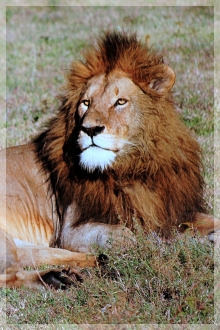
lion - tanzania

“He’s not a tame lion.” Anyone familiar with The Chronicles of Narnia by C.S. Lewis knows to whom this sentence refers. Throughout the seven Narnia books, that same thought is expressed in various ways when describing Aslan (the Christ-like character in the series). When the Pevensie children discover that Aslan is a lion, they ask if he’s safe. “Who said anything about safe?” is the reply. “’Course he isn’t safe,” adds Mr. Beaver, “But he’s good. He’s the King, I tell you.” A safe lion would be a tame lion because a tame lion has been trained. It’s predictable and can be managed, manipulated, controlled, and taught. Aslan, most definitely, is not tame but he is good and, at times, that fact is forgotten. Perhaps it is because, as Lewis explains: “People…sometimes think that a thing cannot be good and terrible at the same time.”

The Hebrew word describing God in the Psalms and translated as “terrible” in the King James, was yare, meaning “to be feared.” Most other modern translations use “awesome” or a similar less terrifying word. Back in the 1600s, when the King James version was first published, the type of “terror” associated with the word was a reverent fear of God. It conveyed both dread and terror as well as solemn awe and reverence—an appropriate response to a Being who is far greater and more powerful than any human could ever hope to be. When describing God (or Lewis’ lion Aslan), “terrible” means tremendous, awe-inspiring, formidable, intense, and fearsome. Our God is all that and more; what He isn’t is tame!

The children eventually understand that Aslan is intrinsically good and, because the lion is good, it doesn’t matter that he isn’t tame. The same goes for God! If we truly believe Him to be good, we can trust that everything He does is for our good. When life takes a bad turn, however, we tend to lose sight of God’s goodness and love. Forgetting that His inherent goodness and terribleness are inseparable, we allow challenging circumstances to steal our confidence in a good God. Like Aslan, God can’t be evil any more than He can be tamed.

Afraid of trusting an unpredictable, fearsome, and awesome God, we would prefer a God who is tame—one we could tell what to do along with when and how to do it. We wouldn’t need to please a tame God; He’d want to please us. He would coddle rather than challenge and beg rather than demand. A tame God would answer to us rather than hold us accountable to Him. Since a tame God would live to please our sinful nature, a tame God could not be good!

In Lewis’ books, the untamed but good lion brings the children into Narnia not to live bland or boring lives but to face foes, trials, and difficulties and become better for it. Nevertheless, they never face those challenges alone; Aslan is always there for them. In the same way, our awesome God does not call us to lead humdrum safe lives. He calls us to live far-reaching, uncompromising, purposeful, profound, and often challenging ones. Jesus told His disciples to take up their crosses and have lives of radical goodness and love; He tells us to do the same thing.

Our God is not tame, but He is good; He is untamed goodness and love!

Ascribe ye strength unto God: his excellency is over Israel, and his strength is in the clouds. O God, thou art terrible out of thy holy places: the God of Israel is he that giveth strength and power unto his people. Blessed be God. [Psalm 68:34-35 (KJV)]

Come and see the works of God: he is terrible in his doing toward the children of men. He turned the sea into dry land: they went through the flood on foot: there did we rejoice in him. [Psalm 66:5-6 (KJV)]

Copyright ©2025 jsjdevotions. All rights reserved.

HE’S BIGGER

Though you have not seen him, you love him; though not seeing him now, you believe in him, and you rejoice with inexpressible and glorious joy, because you are receiving the goal of your faith, the salvation of your souls. [1 Peter 1:8-9 (CSB)]

lion - tanzania

Although C.S. Lewis never intended the seven books in The Chronicles of Narnia series to be allegories, they are filled with Christian imagery and allusions. Having enjoyed reading (and re-reading) the Narnia books, I was pleased when the Pastor opened his sermon on “The Supremacy of Jesus” by quoting from it. In Prince Caspian, after a year’s absence from Narnia, Lucy encounters Aslan the lion (the Christ-like figure in the series) and says, “Aslan, you’re bigger.” The lion replies, “That is because you are older, little one.” When she asks, “Not because you are?” the lion assures her, “I am not.” He then explains, “But every year you grow, you will find me bigger.”

Only a year had passed in Lucy’s world since she last saw Aslan, but 1,300 years had passed in Narnia. Even so, in all that time, Aslan hadn’t gotten larger. As Hebrews 13:8 reminds us, “Jesus Christ is the same yesterday, today, and forever.” Indeed, God is unchangeable in His being, character, will, attributes, power, and promises.

Lucy’s misperception of Aslan’s size is not because she’s another year older or two inches taller. While we tend to think of growing as getting older or larger, growing in the spiritual sense is different. It’s a little like seeing people from a distance. From afar, they seem small but, as we grow closer to them, they seem to enlarge. Once face-to-face, we finally perceive how large they really are! Spiritual growth is coming closer to God so that we perceive how big He is and how small we are. Growth in our spiritual life doesn’t mean there is more of us; if anything, there is less of us and more of God! While God is immutable, our relationship with Him is not.

As we grow and mature spiritually, like Lucy, our perception of God will change proportionally. The more we move toward Him, the larger He becomes! We will come to see both our spiritual brokenness and the greatness of God’s mercy, our sinfulness and His immeasurable holiness, our weakness and His infinite power, our poverty and His limitless grace, our emptiness and His abundant love. As we accept our inadequacy and hopelessness, our small perspective of God changes and we begin to grasp the full extent of God’s wisdom, glory, power, and majesty. Indeed, our God is a big God!

Aslan played a prominent role in the first Narnia book so all four of the children know he exists. Nevertheless, upon their return to Narnia, they don’t see him. But, that doesn’t mean he wasn’t there. Lucy is the only one who finally sees him, perhaps because, unlike her siblings, she was the only one who believed Aslan would help them. For the other three children, Aslan remains invisible until, one by one, like Lucy, they start having faith in him. It’s been said that “seeing is believing.” In this case, it is the believing that allowed for the seeing! I expect that, as their faith increased, like Lucy, each sibling said, “Aslan, you’re bigger!”

And, so it is with Jesus. We must believe in Him to see Him and the more we trust Him, the bigger He gets!

Jesus said to her, “Didn’t I tell you that if you believed you would see the glory of God?” [John 11:40 (CSB)]

Jesus said, “Because you have seen me, you have believed. Blessed are those who have not seen and yet believe.” [John 20:29 (CSB)]

Now without faith it is impossible to please God, since the one who draws near to him must believe that he exists and that he rewards those who seek him. [Hebrews 11:6 (CSB)]

Copyright ©2025 jsjdevotions. All rights reserved.

COUNTING – FORGIVENESS (2)

Then Peter came up and said to him, “Lord, how often shall my brother sin against me, and I forgive him? As many as seven times?” Jesus said to him, “I do not say to you seven times, but seventy times seven.” [Matthew 18:21-22 (RSV)]

dayflowerWhen writing about issumagijoujungnainermik, the Inuit word for forgiveness, I came across a word in the Tshiluba language spoken by the Bantu of the Congo: ilunga. Because isumagijoujungnainermik is made up of several Inuit words, it easily translates as “not-being-able-to-think-about-it-anymore.” Like issumagijoujungnainermik, ilunga has to do with forgiveness but, unlike the Inuit word, it resists an easy translation. In fact, back in 2004, 1,000 linguists gave it the questionable honor of being the world’s “most difficult” word to translate!

Although the official English definition of ilunga is “a person who is ready to forgive any abuse for the first time, to tolerate it a second time, but never a third time” seems straightforward, it misses the cultural nuance. While we might think of it as a “three-strikes-and-you’re-out” kind of person, an ilunga’s tolerance for the offense lessens with the situation and frequency. Worse, ilungas would never practice issumagijoujungnainermik because they need to remember and keep count of every offense! I wonder, do they keep a little scorecard in their back pocket? Do we?

I don’t think Hebrew or Aramaic have a word like ilunga but Jewish tradition held a similar attitude of limits on forgiveness. Although forgiveness was valued, the rabbis taught that it was reasonable to forgive a person only three times for the same offense. By the fourth offense, they believed there was no reason or need to forgive! Considering this Jewish tradition, when Peter asked Jesus how many times he should forgive, I suspect the disciple thought seven times was more than generous. Jesus, however, rejected Peter’s calculations with His answer: “Not seven times…but seventy times seven.” Rather than setting an upper level of 490 on forgiveness, Jesus was using hyperbole. His numbers alluded to Genesis 4 in which God promised a sevenfold punishment on anyone who killed Cain and Lamech later called for a seventy-sevenfold punishment on anyone who harmed him. Jesus’ answer told Peter that our forgiveness is to be as excessive as the vengeance for which Lamech called.

To cement His point, Jesus continued with the Parable of the Unforgiving Servant in which the unforgiving servant owed the King an incalculable amount of money. Even though the servant’s immense debt was forgiven by the King, he refused to forgive a fellow servant a debt just one six-hundred-thousandth of that amount! When the King learned of this, he withdrew his forgiveness and tortured the unforgiving man until the debt was paid.

Since repaying the King the equivalent of billions of dollars was an impossibility, this appears to be a reference to judgment and eternal damnation. On the other hand, it simply may refer to severe discipline from God in this life. Regardless of how this threat is interpreted, it is clear that God will not treat our unforgiveness lightly! Scripture tells us that the way we forgive is how God will forgive us; if we keep count like an ilunga, so will He! Jesus’ parable tells us that no number of offenses against us can compare with our innumerable offenses against God—anything owed to us is but a pittance compared to what we owe to Him.

In light of God’s extravagant and infinite grace to us, we are not to be like an ilunga and our forgiveness of others is not to be limited by the frequency or quantity of the offense. The unlimited forgiveness God extends to us is the kind of forgiveness we must extend to others!

To be a Christian means to forgive the inexcusable because God has forgiven the inexcusable in you. [C.S. Lewis]

For if you forgive men their trespasses, your heavenly Father also will forgive you; but if you do not forgive men their trespasses, neither will your Father forgive your trespasses. [Matthew 6:14-15 (RSV)]

And forgive us our debts, As we also have forgiven our debtors…. [Mark 6:12 (RSV)]

And whenever you stand praying, forgive, if you have anything against any one; so that your Father also who is in heaven may forgive you your trespasses.” [Mark 11:25 (RSV)]

Copyright ©2025 jsjdevotions. All rights reserved.