THE ONLY CONSTANT

I am the Lord, and I do not change. [Malachi 3:6a (NLT)]

rainbowOur fast-paced world is ever-changing and once ordinary items like slide rules, cassette tapes, boom boxes, floppy discs, dial phones, film, and VCRs are relics. My kids don’t use maps, write checks, or have a land line and my grands have never used a library card catalogue, set of encyclopedias, dictionary, carbon paper, or typewriter. We no longer need to get up to change channels, turn the lights on or off, or see who’s at the door. Our camera, maps, calculator, credit cards, compass, note pad, address book, plane tickets, and Bible all fit into our cell phones and everything on our phones (along with a fitness tracker and heart monitor) fits into a watch!

The world is in a constant state of flux! 38 different models of the iPhone have been released since its introduction in 2007 (with a new generation expected in the fall)! Since its introduction in 1985, there have been 49 versions of the Windows operating system. What with chatbots, artificial intelligence, the metaverse and internet of things, chatbots, NFTs, cryptocurrency, 3-D printers, and reality that can be extended, augmented, or virtual, by the time I’ve caught up to the latest technology, I’m already behind the times!

In theory, all those changes are supposed to be for the better but new doesn’t necessarily mean better (as the Coca-Cola company learned when they tried to change their drink formula in 1985). Unfortunately, the updated and improved version can be worse than its predecessor (which is what most tech people would say about Windows ME, Vista, and Windows 8)!

The Greek philosopher Heraclitus said, “The only thing constant is change,” and, despite my previous rant, I disagree. The one unchanging constant in our lives is God and His unchangeability is called immutability. Unlike things that can be modified like iPhones, Windows, and Coke, something immutable cannot change. Regardless of technology, innovative trends, style, or the passage of time, God’s truth, purpose, promises, and character remain the same. God needs no updates because He is the very essence of perfection—He can’t become more or less, greater or smaller, or any better than He already is!

God’s immutability doesn’t mean that He is a static, impersonal, remote, disinterested being. Although He is unchanging, we are not deists who think of God as an indifferent uninvolved clockmaker who made a clock, wound it up, and then ignored it. He is actively involved in all of His creation and regularly interacts with everything and everyone in it.

Rather than impassive and distant, God is enmeshed in our lives. He walked and talked with Adam and cared enough to give him a companion in Eve! He made covenants with Noah and Abraham and revealed Himself to people like Moses, David, Elijah, Paul, Peter, and John. The God who walked in Eden with Adam, hung a rainbow in the sky for Noah, wrestled with Jacob, etched His law onto stone tablets for Moses, sent manna from heaven, and blinded Paul on the road to Damascus is the very same God who walks with us today!

Although God’s interaction with us may change (as it did when He evicted Adam and Eve from Eden, permitted Satan to plague Job, or allowed Judah to be taken into captivity), God’s nature never changes! Timeless and eternal, God was and always will be holy, unlimited, all-powerful, ever-present, all-knowing, all-loving, and divine. Fortunately, the original 1.01 version of God (introduced at the beginning of time) is all we need or want! Thank you, O Lord, for being the one constant in our lives.

It is well for us that, amidst all the variableness of life, there is One whom change cannot affect; One whose heart can never alter, and on whose brow mutability can make no furrows. [Charles Spurgeon]

Jesus Christ is the same yesterday, today, and forever. [Hebrews 13:8 (NLT)]

Whatever is good and perfect is a gift coming down to us from God our Father, who created all the lights in the heavens. He never changes or casts a shifting shadow. [James 1:17 (NLT)]

Copyright ©2023 jsjdevotions. All rights reserved.

 

HALLELUJAH

Praise the Lord, all nations! Extol him, all peoples! For great is his steadfast love toward us, and the faithfulness of the Lord endures forever. Praise the Lord! [Psalm 117 (ESV)]

giant swallowtail vbutterflyAs a way of emphasizing the penitential nature of Lent, hymns with alleluia or hallelujah were not sung at our church during Lent’s forty days.  With the exception of Palm Sunday’s All Glory, Laud, and Honor, the hymns for the last six weeks were rather slow, somber, and introspective and I missed the more joyful upbeat hymns I enjoy. Easter service, however, opened with Christ the Lord is Risen Today and the twenty “Alleluias” we sang in five verses made up for their long absence.

If you’re not familiar with this beautiful hymn, check it out. YouTube has an outstanding rendition done by the Tabernacle Choir accompanied by full orchestra, a trumpet ensemble, and bell choir. This hymn’s alleluias are Easter’s version of the cascading of glorias in Christmas’ Angels We Have Heard on High. Regardless of your musical talent (or lack of it), you can’t help but join in singing them! Without benefit of choir, bells, or orchestra, our congregation’s joyful alleluias (some of which were off key) weren’t on a par with those of the Tabernacle. Nevertheless, because they were heartfelt, they were welcome music to God’s ears!

Having enjoyed singing those alleluias, I wondered what exactly was meant by the word. “Alleluia” comes from an ancient Hebrew word combining hālal, which means to praise or glorify, and yâ, a contraction for God’s name of Yahweh. When the Hebrew Scriptures were translated into Greek, ”hallelujah” was derived from the Hebrew spelling of the word; ”alleluia” simply is the Latin transliteration of the Greek. In Scripture, we usually find the original Hebrew of hālal yâ translated as “Praise the Lord,” which isn’t entirely accurate. In Hebrew, hālal  is an imperative command (rather than a suggestion) and the more accurate translation would be “You must praise the Lord!”

Since we are commanded to praise the Lord, what exactly is praise? While praise and thanks are closely linked, they are not quite the same thing. Thanks is gratitude for what has been done or given while praise exalts the doer or giver. Thanks is when it finally rains after weeks of drought and praise is for a God who holds the incredible power of wind, rain, thunder, and lightning in His almighty hands. Thanks is for the newborn baby and praise is for the God who miraculously packed all the makings of a human being (including a soul) into two small cells! I’m thankful when I see a beautiful sunrise but praise is when I silently sing the old hymn’s words, “When morning gilds the skies, My heart awaking cries: May Jesus Christ be praised!” Praise is an acknowledgement of the excellence, goodness, capability, power, authority, and perfection of God’s character, traits, and works. It is thanking, honoring, exalting, magnifying, applauding, proclaiming, and celebrating Him. We praise God not just by singing alleluias, but in our everyday words, actions, and thoughts.

While praise usually comes from a grateful heart, there are no qualifiers in Scripture’s “hallelujahs.” The call to praise is not dependent upon circumstances. We must praise the Lord, not because He is good to us (or those we love); we are to praise the Lord because He is a good God!

Perhaps, because there isn’t a better word encompassing the meaning of hallelujah in any other language, people from all over the world have borrowed hallelujah/alleluia from the original Hebrew. While it may be spelled differently, “hallelujah” sounds very much the same in almost every language.

“Hallelujah” appears twenty-four times in Psalms and four in Revelation. In Psalms, those hallelujahs come from earth but, in Revelation, they come from heaven. Someday, we will join a heavenly chorus of believers from every nation and the unified sound of our heavenly hallelujahs will be even louder and more beautiful than those of the Tabernacle Choir!

Then I heard what seemed to be the voice of a great multitude, like the roar of many waters and like the sound of mighty peals of thunder, crying out, “Hallelujah! For the Lord our God the Almighty reigns. [Revelation 19:6 (ESV)]

Copyright ©2023 jsjdevotions. All rights reserved.


MISSING EASTER

Then when Judas, his betrayer, saw that Jesus was condemned, he changed his mind and brought back the thirty pieces of silver to the chief priests and the elders, saying, “I have sinned by betraying innocent blood.” They said, “What is that to us? See to it yourself.” And throwing down the pieces of silver into the temple, he departed, and he went and hanged himself. [Matthew 27:3-5 (ESV)]

Do not abandon yourselves to despair. We are the Easter people and hallelujah is our song. [Pope John Paul II]

rabbitJudas wasn’t the only one who betrayed Jesus that Thursday night. With his three denials, Peter also betrayed our Lord. Both men were filled with remorse but neither man could undo what had been done. One never lost faith and hung in there; the other lost faith and hung himself. One stayed around for the resurrection to see the living Christ and to experience Jesus’ forgiveness; the other missed his opportunity for redemption when he gave up all hope. One became the humble willing servant of the Lord and the rock of the church; the other one’s name lives on in ignominy and is synonymous with betrayal and treason.

Judas betrayed the Lord for thirty pieces of silver (the same amount paid to compensate the master of a slave who was gored to death by an ox). Did Judas think that by returning the money he could undo what was done? By no longer profiting from his treachery, did Judas think he’d be free from guilt? I often wonder what would have happened had Judas waited a few more days. Jesus forgave Peter. If Judas had waited and truly repented, would Jesus have forgiven him as He did Peter? While Judas’ sin was great, it was not unforgivable! But Judas missed Easter by killing himself in despair and disgrace.

As for the leading priests and elders—they didn’t care about Jesus’ innocence. Giving no thought to the wrong they committed, they debated what to do with this blood money. By Jesus’ day, Deuteronomy’s law that a temple offering earned from prostitution was detestable to the Lord was applied to any money gained illicitly. Although these “holy” men had no problem orchestrating an innocent man’s murder with money from the Temple treasury, as sticklers for the law, they wouldn’t return the now tainted money to the treasury. Did they think using the silver to purchase a defiled piece of property in the Hinnom Valley would diminish their guilt? Referred to as a garbage dump in Jeremiah 19, this land had been desecrated by idol worship. The field became known as Aceldama (meaning “field of blood”) and was used to bury strangers who died while visiting Jerusalem.

Like Judas, the leading priests and elders missed Easter. Although they were the ones most qualified to recognize Jesus’ fulfillment of the Messianic prophecies, they refused to see what was right before them—both before and after Golgotha. When the tomb was found empty, rather than consider the meaning of such a miracle, they denied its truth and bribed the guards to say the disciples stole Jesus’ body.

Did you miss Easter yesterday? I don’t mean the Easter Bunny or the brightly decorated baskets, colored eggs, chocolate rabbits, elaborate brunch, jelly beans, lilies, ham dinner, or Peeps. Did you miss the significance of Easter—the message of love, forgiveness, hope, and salvation? Judas and Jerusalem’s religious leaders certainly did. They missed the first Easter and all of the possibilities it brought.

If you missed the resurrection message of Easter, there’s still hope. While it’s too late for Judas and Jerusalem’s leaders, it’s not too late for you. There’s no need to wallow in guilt or remorse. Today can be your Easter! Today, the Holy Spirit can bring about your very own resurrection. The redemption of Easter can be experienced any day of the year!

Our old history ends with the cross; our new history begins with the resurrection. [Watchman Nee]

Jesus said to her, “I am the resurrection and the life. Whoever believes in me, though he die, yet shall he live, and everyone who lives and believes in me shall never die. [John 11:25-26 (ESV)]

Copyright ©2023 jsjdevotions. All rights reserved.

TWO IN ONE

Don’t you realize that I could ask my Father for thousands of angels to protect us, and he would send them instantly? But if I did, how would the Scriptures be fulfilled that describe what must happen now? [Matthew 26:52-54 (NLT)]

stations of the cross - loretto - santa feThere is a fancy term for how God the Son, Jesus, took on human form and yet remained God: hypostatic union. Sounding like why my socks cling to my t-shirts in the dryer, knowing the term doesn’t help us understand it. I’m not sure anyone can wholly comprehend how Jesus always existed and yet was conceived by the Holy Spirit, born of Mary, and became man. When pondering Christ’s incarnation, I can’t help but think of an old ad for Certs Mints. Since they were both a breath mint and a candy mint, their commercials ended with the catch phrase: “Certs is two, two, two mints in one!”  Fully man and fully God at the same time, Jesus, like Certs, had two distinct natures in one.
When Jesus walked the earth, He was not a human who once had been God; He was God in a human body. When He put on skin and became a living breathing man, Jesus didn’t cease being God or lose His godly attributes. For the most part, however, He voluntarily limited himself to the restrictions of humanity. As God, He could be everywhere at once but, as a man, Jesus only could be one place at a time. God is eternal and transcends time but the man Jesus had both a beginning and an end and was confined to a twenty-four-hour day. Nevertheless, there were moments when Jesus exercised His omniscience, omnipotence, and authority. For example, He knew the scandalous history of the woman at the well, the thoughts of the Pharisees, and who would betray Him. He used His divine power and authority to cast out demons, walk on water, give sight to the blind, and forgive sins.

Jesus, however, never resorted to His godly attributes to make life easier for Himself. As God, He never experienced weariness, hunger, or thirst but, when living in a man’s body, He grew tired, hungry, and thirsty. When fasting in the wilderness, the man who fed thousands with a few fish easily could have turned stones into loaves of bread, but He deliberately chose not to do so. God doesn’t feel pain, bruise, bleed, or die but, as a man, Jesus chose to do just that. The man who could still storms, change water into wine, and cast demons into swine could have stopped the flogging, mockery, and beating he endured that dark Friday. The man who cured lepers, healed a bleeding woman, and raised the dead certainly had the power to endure crucifixion without agony or to survive it unscathed. But, He didn’t!

After tempting Jesus in the wilderness, Luke tells us Satan left Him “until the next opportunity came.” Without a doubt, an opportunity came at Golgotha when the enemy made a last-ditch effort to stop God’s plan of redemption. He may have tempted Jesus with words like these: “Smite them; they dared to spit on you!” or “They’re beating you cruelly—show no mercy, strike the mortals down!” As Jesus suffered on that cross, Satan may have whispered, “You’re God, you don’t have to suffer like this. Break free and step down!” Being divine, Jesus easily could have come down from the cross unmarked by His ordeal. Instead, our all-powerful God deliberately chose to limit Himself to the indignities, pain, and weaknesses of a mortal human body. Submitting Himself to God the Father, He chose to endure torture, suffer, and die a miserable death as a man. Why? Because He loved us.

Though he was God, he did not think of equality with God as something to cling to. Instead, he gave up his divine privileges; he took the humble position of a slave and was born as a human being. When he appeared in human form, he humbled himself in obedience to God and died a criminal’s death on a cross. [Philippians 2:6-8 (NLT)]

For God loved the world so much that he gave his one and only Son, so that everyone who believes in him will not perish but have eternal life. [John 3:16 (NLT)]

Copyright ©2023 jsjdevotions. All rights reserved.

LAMB SELECTION DAY – Palm Sunday

Rejoice, O people of Zion! Shout in triumph, O people of Jerusalem! Look, your king is coming to you. He is righteous and victorious, yet he is humble, riding on a donkey—riding on a donkey’s colt. I will remove the battle chariots from Israel and the warhorses from Jerusalem. I will destroy all the weapons used in battle, and your king will bring peace to the nations. His realm will stretch from sea to sea and from the Euphrates River to the ends of the earth. [Zechariah 9:9-10 (NLT)]

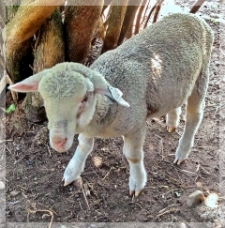
lambAs one of three pilgrimage feasts requiring every Jewish man’s attendance in Jerusalem, Jesus and the disciples joined other pilgrims on their journey toward the city for the Passover celebration. By the time they passed through Jericho (where He healed the blind Bartimaeus and ate dinner with Zacchaeus), a large crowd was following Jesus. It was on a Sunday that He and His disciples left Bethany for the two-mile walk into Jerusalem. The roads would have been crowded as pilgrims streamed into the city in preparation for the festival. Having heard of Jesus’ miracles and the way He brought Lazarus out of the grave, many of those in the streets were anxious to see Him. ”Could this be the long-awaited Messiah?” they wondered.

Although Jesus seemed to have walked everywhere, when He was less than a mile from the city, He sent two disciples to fetch a donkey’s colt that would be waiting for them. When Jesus deliberately rode that colt into Jerusalem, He was presenting Himself as Israel’s promised king. The animal’s significance was not lost on the people and their questions about His identity were answered. Solomon rode a donkey when he was presented to Israel as David’s rightful heir and successor and Zechariah prophesied that the promised Davidic king—the Messiah—would come on a donkey, as well! Thinking this king would save them from Rome, rather than Satan, people called out “Hosanna,” a combination of two Hebrew words, yasha (meaning save) and na (meaning now). Although Jesus brought salvation, it wasn’t from Rome!

Believing Jesus was the promised heir to David’s throne, the people recited from Psalm 118: “Blessings on the one who comes in the name of the Lord! Hail to the King of Israel.” Traditionally, people honored a new king by throwing their coats where he would sit or walk and palm branches were considered symbols of joy, victory, and triumph. The crowd’s reaction to seeing Jesus on the colt was to cut palm branches from the trees and to lay both palms and their coats across the road in Jesus’ path. Others, thinking they were celebrating victory over Rome, waved branches of palms as He passed. They didn’t know the victory they were celebrating was Christ’s victory over sin and death!

While Jesus was entering Jerusalem from the east, it’s likely that Pontius Pilate (governor of Judea) was entering the city from the west and King Herod from the north. In contrast to Jesus’ humble but joyous procession, their entrances would have been solemn and regal. Jesus rode a donkey and was accompanied by twelve disciples. Pilate and Herod would have ridden in chariots and been accompanied by legions of soldiers and warhorses. Jesus and his followers were weaponless but the soldiers wore armor and carried swords. While the procession from the east was led by the Prince of Peace, the processions of Herod and Pilate, men known for their violence and cruelty, would have been a show of force to quell any thoughts of a rebellion during the Passover.

Of course, only Jesus knew that the crowd exclaiming, “Hail to the king!” would soon turn on Him—that the cries of blessings upon Him would become shouts to crucify Him! Only He knew that His royal welcome would end with His dying a criminal’s death on a cross. It wouldn’t be until after His resurrection that His Jewish followers would understand the full significance of His entry into Jerusalem on that Sunday, the 10th day of Nisan.

According to Exodus 12, the 10th of Nisan was the specific day on which people were to select their Passover lamb (a male without any defect or blemish). The family was to keep the lamb until twilight on the 14th day when it would be killed and eaten. Jesus, the Lamb of God, entered Jerusalem on Lamb Selection Day. When He and His disciples ate their Passover meal that Thursday evening, Jesus broke the bread and gave it to His disciples saying, “This is my body.” He then passed the cup saying, “This is my blood.” It wasn’t until later that the disciples understood the full meaning of Christ’s words. While they may have consumed leg of lamb that night as they commemorated Israel’s deliverance from bondage to Egypt, the bread and wine made it clear that the sinless Jesus was the true Passover lamb. He was the perfect sacrifice who would deliver all who believed in Him from their bondage to sin!

On the night when he was betrayed, the Lord Jesus took some bread and gave thanks to God for it. Then he broke it in pieces and said, “This is my body, which is given for you. Do this in remembrance of me.” In the same way, he took the cup of wine after supper, saying, “This cup is the new covenant between God and his people—an agreement confirmed with my blood. Do this in remembrance of me as often as you drink it.” For every time you eat this bread and drink this cup, you are announcing the Lord’s death until he comes again. [1 Corinthians 11:23-26 (NLT)]

Copyright ©2023 jsjdevotions. All rights reserved.

DAILY BREAD (BEGGARS CAN’T BE CHOOSERS)

Give us this day our daily bread… Look at the birds of the air: they neither sow nor reap nor gather into barns, and yet your heavenly Father feeds them. Are you not of more value than they? [Matthew 6:11,26 (RSV)]

A pastor friend told me about returning from a service project with some of his SK8 church youth including Brian, a young man new to the faith. When they stopped for lunch at a taco stand, a street person asked Brian for money. Trying to do what Jesus would want done, the new Christian offered to buy the hard-up man a burrito. It was when Brian ordered two bean burritos that his dining guest loudly complained, “I ain’t eatin’ no $%2#!* bean burrito—I want a steak one!” Brian had little money to spare but, since the man was getting vociferous, he ordered the steak burrito for his guest and a bean one for himself. Apparently, the vagrant wasn’t familiar with the proverbs about beggars not being choosers, half a loaf being better than none, and not looking a gift horse in the mouth!

When I came across a cartoon done by Mark Lynch about Jesus feeding the multitude, I remembered my pastor friend’s story. In Lynch’s cartoon, Jesus is standing in front of a large group. Behind Him are piles of loaves and fish. With the caption “IF IT HAD BEEN TODAY,” the various speech balloons show members of the crowd asking if the fish contains mercury and if there’s a vegan option. Others want to know if the bread is gluten-free, baked locally, or has nuts. Another one complains, “I’m lactose intolerant.” While it is just a comic, I think Lynch isn’t far off. Human nature being what it is, the day Jesus fed a multitude of hungry people, I suspect there were some who grumbled about the lack of things like honey, olives, grapes or figs. Perhaps others asked, “Is this the best He can do?”

Shortly after teaching us to pray, “Give us this day our daily bread,” Jesus reassured us that, since God cares for the birds, He surely will care for us. His miracle of feeding the multitude shows us that God cares for His people. God, however, isn’t like Burger King and never promised us, “Have it your way!” He certainly never told us (as the hamburger chain now does), “You Rule.”

God is concerned about meeting our necessities but, like the homeless man and the comic’s multitude, our vision of a necessity often differs from His. Our daily bread probably isn’t brioche, a gluten-free all-natural blueberry muffin, a $10 loaf of artisanal sourdough from the farmer’s market, or even that $3.79 orange scone from Panera. It definitely isn’t the Gold Leaf Bread from Algatocin, Spain, that’s made with 250 mg of gold dust! It may not even be a whole loaf and it probably won’t include extras like Nutella, honey, fruit preserves, pate or avocado spread. Daily bread is what’s necessary and nothing more—anything else is like frosting on a cake or peanut butter on toast!

“We are beggars; this is true,” was written on a scrap of paper found in Martin Luther’s pocket when he died. How easily we forget that. In truth, we are not that different from the panhandler at the taco stand or Lynch’s multitude gathered on a hillside—more often than not we are unappreciative of the gifts we’re given. Perhaps, after asking God for our daily bread, we might want to add another prayer: “Help me recognize my needs and appreciate your provision.” With thanksgiving, let us reach out and gladly accept God’s love, forgiveness, mercy, Holy Spirit, and daily provision on His terms, not ours. Let us remember that beggars can’t be choosers.

And my God will supply every need of yours according to his riches in glory in Christ Jesus. [Philippians 4:19 (RSV)]

Copyright ©2023 jsjdevotions. All rights reserved.