
But when the Pharisees saw this, they asked his disciples, “Why does your teacher eat with such scum?” When Jesus heard this, he said, “Healthy people don’t need a doctor—sick people do.” Then he added, “Now go and learn the meaning of this Scripture: ‘I want you to show mercy, not offer sacrifices.’ For I have come to call not those who think they are righteous, but those who know they are sinners.” [Matthew 9:11-13 (NLT)]
The Gospel is good news of mercy to the undeserving. The symbol of the religion of Jesus is the cross, not the scales. [John Stott]
 Last week, after posting the second of two devotions mentioning David Bennett, Sr. (who received a pig’s heart in a ground-breaking transplant), I checked news links for an update on his condition. I was surprised to learn that 34 years ago, when Bennett was just 23, he was convicted of stabbing Edward Shumaker seven times, a violent assault that left the 22-year-old paralyzed and in a wheelchair. Bennett was sentenced to 10 years in prison and served 6 of those years before returning to society and moving on with his life. As for Shumaker, after enduring 19 years of staph infections, sepsis, bedsores, a stroke, and moving in and out of nursing homes, he died a week before his 41st birthday.
Understandably, Shumaker’s survivors had difficulty processing the news that the man who caused such heartache and suffering for Edward not only went on to have a normal life complete with children and grands but also received a new lease on that life with his life-saving heart transplant. For Shumaker’s sister, it seems outrageous that someone guilty of such a violent crime could undergo this lifesaving procedure when so many more “deserving” recipients die or become too ill for transplant surgery before a heart becomes available.
Officials at the Baltimore hospital where Bennett received his new heart explained that the decision about Bennett’s transplant eligibility was based solely on his medical records, explaining that they provide, “lifesaving care to every patient who comes through their doors based on their medical needs, not their background or life circumstances.” Arthur Caplan, a bioethics professor at New York University, elaborated, “The key principle in medicine is to treat anyone who is sick, regardless of who they are.…We are not in the business of sorting sinners from saints.”
Caplan’s words made me think of Jesus—the Great Physician who came into this world to heal mankind. There is no record of His assessing the purity or sinfulness of those he restored to determine whether or not they deserved healing. He didn’t evaluate people’s righteousness before making the lame walk, the blind see, or the deaf hear. He didn’t categorize acceptable from unacceptable sins or sort out the honest from the corrupt, the moral from the immoral, or the law-abiding from the criminal before healing leprosy, mental illness, fevers, or hemorrhaging. When He fed the multitude, Jesus didn’t tell the disciples to offer food only to those virtuous people worthy of receiving it and He broke bread with both the respectable and the disreputable. When it comes to God’s healing, mercy, love, provision, or forgiveness, not one of us is more or less deserving than the next; none of us are worthy because we all are sinners!
Just as the medical profession is not in the business of sorting sinners from saints, neither is the Church. Someday, the Lord will separate the sheep from the goats but, until that day comes, let us remember that His Church is a hospital for sinners, not a country club for saints! We don’t scrutinize those who come to us and weed out all of the swearers, liars, ex-cons, crude, self-righteous, alcoholics, doubters, adulterers, divorced, gossipers, or scoundrels before welcoming them through our doors. If we did, both our pews and pulpits would be empty! Our pasts, no matter how soiled or violent, do not bar us from the healing and restoration of the Lord!
Grace is the very opposite of merit… Grace is not only undeserved favor, but it is favor, shown to the one who has deserved the very opposite. [Harry Ironside]
 I was listening to Randy Travis sing, “I’m diggin’ up bones, exhuming things that’s better left alone.” It seemed an appropriate song for this time of year when we tend to dwell on the past—not just past loves, but past losses, mistakes, oversights, misunderstandings, injuries and pain. As one year ends and another begins, we often dig up all the grievances, regrets, and ”if onlys” of our yesterdays.
 Apparently speechless when Jesus washed their feet, John records no one objecting to His doing so until Jesus came to Peter. After protesting that Jesus never would never wash his feet, the Lord warned the disciple that unless he allowed Jesus to wash him, Peter wouldn’t belong to Him. Eager to show his devotion to Jesus, Peter then enthusiastically offered the rest of his body for cleansing. Jesus explained that, because Peter already bathed, only his feet needed washing, while adding that not all of those present were clean. Since we know the rest of the story, we know He was referring to Judas. The reference to Judas not being clean, however, tells us that this exchange is about more than washing the filth of Judah’s roads off the disciple’s feet. Since Jesus wasn’t giving a hygiene lesson, what did He mean?
 While researching 1st century dining habits, I learned how guests traditionally were seated. Although da Vinci’s famous mural places Jesus in the middle of the group at a long rectangular table, the position of Jesus (as the host) would have been second from the left on the left side of a U-shaped table. Customarily, a trusted friend was seated to the host’s immediate right and the guest of honor to the host’s immediate left. The rest of the diners were seated to the left starting with the highest-ranking person and proceeding on down to the least important. If a servant were present during the meal, the last seat was his since it was closest to the door. With no servant, it was given to the youngest or lowest ranking guest.
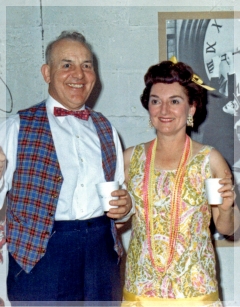 My in-laws were great ones for giving theme parties. When they hosted a “Backwards Party,” guests entered through the back door, wore their clothes backwards (which my mother-in-law admitted made it difficult for the men), and ate dessert before dinner. At another get-together, attendees came dressed as children, received jump ropes and jacks, pulled taffy, and played games like “Mother May I?” and “Pin the Tail on the Donkey.” My introduction to their parties was in 1966 when they turned their house into a Prohibition era speakeasy and guests needed a password to enter. Women dressed as flappers while the men wore fedoras, vests, and spats. Another party had the theme, “Come as You Wish You Had Been.” My mother-in-law, dressed in shorts with a whistle around her neck, came as the PE teacher she once dreamed of becoming and my father-in-law dressed as the train conductor he once aspired to be. Other attendees dressed as ballerinas, weight lifters, princesses, cowboys, or baseball players.
 While visiting my son last summer, I was walking in his neighborhood when a car raced out of a blind driveway and, without even slowing to look for cars or people, sped down the street. If I hadn’t paused briefly by the gate to get a flower photo, I would have had an intimate encounter with the vehicle. After thanking God that I hadn’t become road kill, I continued down the road and turned onto the walking path. I was a little disconcerted when a car approached and stopped but, when the driver lowered his window and called out to me, I realized it was the driver of the speeding car. After offering an earnest apology, he explained he’d been late for a meeting but added that his tardiness was no excuse for his recklessness. Ashamed of his behavior, he’d returned to make sure I was OK. Assuring him I was fine, I wished him well. I was both shocked and touched by the unexpected apology. While unnecessary, it was much appreciated since I knew the driver probably lost another ten minutes by turning around to find me and apologize.
 Devotions of the Heart