
“What do you mean, ‘If I can’?” Jesus asked. “Anything is possible if a person believes.” The father instantly cried out, “I do believe, but help me overcome my disbelief!” [Mark 9:23-24 (NLT)]
 Prayer is calling on God’s power; it’s like calling in the big guns to fight the battle. When doubt in the efficacy of prayer sneaks in, however, it’s more like calling in the big guns but not believing they’re loaded with enough ammunition. I am often like the father in Mark 9 who qualified his request that Jesus heal his son by saying, “If you can.” Like that father, I profess to believe but I need God to help me believe more! Sometimes, the enemy sneaks into my heart and causes me to doubt both the ammunition and God’s aim.
Looking for a feel-good movie to escape from the challenges of the day, we recently streamed the War Room. Not to be confused with the 1993 documentary The War Room, the war room in this 2015 movie is a converted closet with prayer requests covering the walls rather than an Arkansas political campaign headquarters. Focusing on the power of prayer, the story is about a crumbling marriage that is redeemed by prayer.
In one memorable scene, Elizabeth Jordan, the woman in the troubled marriage, and Miss Clara, a prayer warrior extraordinaire, are walking together when they’re confronted by a knife-wielding mugger demanding their money. As Elizabeth starts to get out her wallet, Miss Clara successfully defies him just by saying, “You put that knife down right now in the name of Jesus!” The next scene shows a frazzled Elizabeth reporting the incident to a skeptical policeman while the unruffled Miss Clara enjoys some ice cream.
Even the most positive reviews of this movie were critical of the unreality of those scenes but, as improbable as they were, their inclusion in the movie were necessary because they demonstrate the absolute faith—the total certainty—that is necessary for truly powerful prayer. Facing that mugger, Miss Clara had no doubt that she was in God’s hands and was certain that He would rescue her if she called on Jesus’ name. Later, as she calmly consumed both her and Elizabeth’s ice cream, it is obvious she wasn’t surprised by God’s protection. She expected it, as should we all if we truly believe. After all, nothing is impossible with God!
I’m not sure that God wants us to respond to a weapon-wielding robber the way Miss Clara did but I think He does want us to have the kind of faith demonstrated in that scene. When we come to Him in prayer, we must have faith enough to put our entire lives in His hands. We must believe that our prayers can actually make a difference. Indeed, prayer is the key to winning all those battles we can’t win on our own.
When we pray, do we ask with our lips but doubt in our hearts? When we ask, are we surprised when we receive? Father in heaven, I don’t know why I still doubt when you’ve shown me over and over again that my prayers do not fall on deaf ears. I have faith, dear Lord; please, help me have more!
Faith is not believing that God can. It is knowing that God will. [Ben Stein]
 Although Elijah had just won an amazing victory over Baal and his prophets, we find the prophet running for his life in 1 Kings 19. The journey of over 120 miles left him physically exhausted and, having endured so many setbacks and challenges, the disheartened prophet was emotionally exhausted, as well. Wanting what he saw as a hopeless situation to end, He begged the Lord for death and he’s not the only one of the Bible’s heroes to do so. Overwhelmed by the heavy burdens he carried, Moses cried to God, “If you are going to continue doing this to me, then kill me now. If you care about me, put me to death, and then I won’t have any more troubles.” [Numbers 11:15] A discouraged and frustrated Jonah told God it would be better for him to die than to live. Job, in his despair and agony, and Jeremiah, in his disappointment after decades of prophesying with no appreciable results, were so miserable that they cursed the day they were born! Even the Apostle Paul admitted having been nearly overwhelmed by his troubles. Yet, as hopeless at their situations seemed, none of them died when they wanted to and none took their own lives. God did not abandon them and they did not abandon life.
 The Bible is filled with evidence of God’s goodness and the great (and miraculous) things He’s done for His people. Daniel emerges unscathed from a lion’s den, David defeats Goliath and the shepherd boy becomes a king, wisdom and riches are given to Solomon, and Shadrach, Meshach, and Abednego aren’t even scorched from a fire. Water is parted more than once, the walls of Jericho collapse, jail doors miraculously open, and storms cease at a word. Armies are led to victory, manna falls from heaven, fish and bread multiply, the barren give birth, the sick and lame are healed, and the dead rise. The Bible is full of marvelous accounts of miracles, majesty, and triumphs.
 Paul was speaking metaphorically of his thorn and whether it was a spiritual, emotional, physical affliction, or something else entirely, we don’t know. Since Paul dictated his letters, some speculate that that he had poor eyesight: perhaps cataracts or macular degeneration. Then again, severe arthritis in his hands may have prevented him from holding a stylus. Paul may have had a chronic medical problem such as gout, migraines, severe asthma, or spinal stenosis. It may have been a person: perhaps, Alexander the metalsmith who was harming his ministry. Considering the number of times the apostle was arrested, the thorn may have been an old injury from the many beatings inflicted upon him. Paul even may have suffered from bouts of depression or the 1st century equivalent of Chronic Fatigue Syndrome. The identity of his thorn (or even thorns) is unimportant to us. It is how Paul dealt with his thorn that matters.
 I was listening to Randy Travis sing, “I’m diggin’ up bones, exhuming things that’s better left alone.” It seemed an appropriate song for this time of year when we tend to dwell on the past—not just past loves, but past losses, mistakes, oversights, misunderstandings, injuries and pain. As one year ends and another begins, we often dig up all the grievances, regrets, and ”if onlys” of our yesterdays.
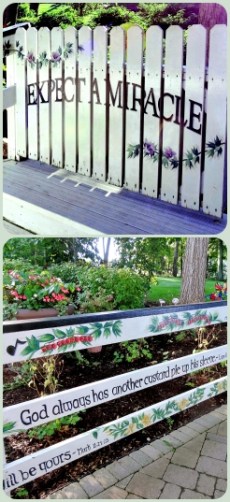 When we lived in the north, we often walked a public path that meandered along the shoreline of a nearby lake. Running through both public and private properties, it crossed the front lawns of historic lakefront estates and stunning homes with beautifully landscaped yards and gardens. One such home placed a lakeside bench for tired walkers that said, “Sit-Pray-Mediate-Enjoy” under a sign that read, “You can trust me. Love, God.” A delightful white fence delineated their private property from the public path. Decorated with whimsey, “Expect a Miracle” was the message on the gate and assorted Bible verses and words of wisdom were painted on the fence’s horizontal slats.
 Devotions of the Heart