HIS PRESENCE

During the forty days after he suffered and died, he appeared to the apostles from time to time, and he proved to them in many ways that he was actually alive. And he talked to them about the Kingdom of God. [Acts 1:3 (NLT)]

COMMUNION CUPBy now, the visiting family has returned home; the jelly beans, Peeps, and chocolate eggs have been eaten; the Easter lily has wilted; the baskets and bunny décor are back in their boxes; and the hardboiled eggs are long gone. While Easter has been put away for another year, its message didn’t end with the resurrection.
The resurrection miracle continued for the next forty days during which Jesus was seen, not just by the disciples, but by hundreds of people. Able to appear in a locked room, the resurrected Jesus seemed less limited by time and space than when He was a man. Although Scripture tells us that He wore the scars of His crucifixion, He talked, walked, ate, drank, and could be touched just like anyone who hadn’t endured crucifixion, death, and burial. Can you imagine what it was like for those fortunate enough to spend time in the presence of the resurrected Jesus? No wonder their faith was so strong that they were willing to endure terrible persecution and horrific torture rather than deny their Lord.

While we can only imagine what it was like when people were in the presence of the risen Christ 2,000 years ago, we can come close to that experience when we share in the Lord’s Supper. Most Communion liturgies include Jesus’ words, “Do this in remembrance of me,” and, upon hearing those words, we recall that last supper in the upper room and Jesus’ sacrifice for our sins. Nevertheless, I think we do the Eucharist a disservice when we think of it as little more than a rite to remember an event long past.

Although most Christians believe that Jesus is present in some way during the Eucharist, there is serious disagreement about how and in what form His presence takes; theologians have argued this point of contention for centuries and will continue to do so until the end of time. Nevertheless, while they disagree on things like transubstantiation and consubstantiation, they do agree that in some mysterious way the Lord is present when we eat the bread, drink the wine, and remember His death and resurrection. About this conundrum John Calvin wrote, “It is a mystery too sublime for me to be able to express, or even to comprehend; and to be still more explicit, I would rather experience it, than understand it.”  C.S. Lewis wisely added, “The command after all, was ‘Take and eat,’ not take and understand.”

One day, we will dine with Jesus in His kingdom but, until then, when we celebrate the Lord’s Supper we are as close to touching the body of the resurrected Jesus as we will be here on earth. When we eat that bread and drink that wine or juice, it’s almost like breaking bread with Jesus in Emmaus, being with the disciples in that locked room Easter morning, or having breakfast with Him beside the Sea of Galilee.

In actuality, the miracle of Jesus’ resurrected presence didn’t end when He ascended into heaven forty days after Easter. In some inexplicable way, He’s with us every time we celebrate the Eucharist.

We should come to the Lord’s table with the confident expectation of meeting Christ there, of receiving there a blessing. [Rev. Chas. A. Savage]

And be sure of this: I am with you always, even to the end of the age. [Matthew 28:20 (NLT)]

Look! I stand at the door and knock. If you hear my voice and open the door, I will come in, and we will share a meal together as friends. [Revelation 3:20 (NLT)]

Copyright ©2023 jsjdevotions. All rights reserved.


HALLELUJAH

Praise the Lord, all nations! Extol him, all peoples! For great is his steadfast love toward us, and the faithfulness of the Lord endures forever. Praise the Lord! [Psalm 117 (ESV)]

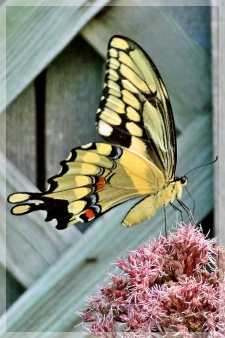
giant swallowtail vbutterflyAs a way of emphasizing the penitential nature of Lent, hymns with alleluia or hallelujah were not sung at our church during Lent’s forty days.  With the exception of Palm Sunday’s All Glory, Laud, and Honor, the hymns for the last six weeks were rather slow, somber, and introspective and I missed the more joyful upbeat hymns I enjoy. Easter service, however, opened with Christ the Lord is Risen Today and the twenty “Alleluias” we sang in five verses made up for their long absence.
If you’re not familiar with this beautiful hymn, check it out. YouTube has an outstanding rendition done by the Tabernacle Choir accompanied by full orchestra, a trumpet ensemble, and bell choir. This hymn’s alleluias are Easter’s version of the cascading of glorias in Christmas’ Angels We Have Heard on High. Regardless of your musical talent (or lack of it), you can’t help but join in singing them! Without benefit of choir, bells, or orchestra, our congregation’s joyful alleluias (some of which were off key) weren’t on a par with those of the Tabernacle. Nevertheless, because they were heartfelt, they were welcome music to God’s ears!

Having enjoyed singing those alleluias, I wondered what exactly was meant by the word. “Alleluia” comes from an ancient Hebrew word combining hālal, which means to praise or glorify, and yâ, a contraction for God’s name of Yahweh. When the Hebrew Scriptures were translated into Greek, ”hallelujah” was derived from the Hebrew spelling of the word; ”alleluia” simply is the Latin transliteration of the Greek. In Scripture, we usually find the original Hebrew of hālal yâ translated as “Praise the Lord,” which isn’t entirely accurate. In Hebrew, hālal  is an imperative command (rather than a suggestion) and the more accurate translation would be “You must praise the Lord!”

Since we are commanded to praise the Lord, what exactly is praise? While praise and thanks are closely linked, they are not quite the same thing. Thanks is gratitude for what has been done or given while praise exalts the doer or giver. Thanks is when it finally rains after weeks of drought and praise is for a God who holds the incredible power of wind, rain, thunder, and lightning in His almighty hands. Thanks is for the newborn baby and praise is for the God who miraculously packed all the makings of a human being (including a soul) into two small cells! I’m thankful when I see a beautiful sunrise but praise is when I silently sing the old hymn’s words, “When morning gilds the skies, My heart awaking cries: May Jesus Christ be praised!” Praise is an acknowledgement of the excellence, goodness, capability, power, authority, and perfection of God’s character, traits, and works. It is thanking, honoring, exalting, magnifying, applauding, proclaiming, and celebrating Him. We praise God not just by singing alleluias, but in our everyday words, actions, and thoughts.

While praise usually comes from a grateful heart, there are no qualifiers in Scripture’s “hallelujahs.” The call to praise is not dependent upon circumstances. We must praise the Lord, not because He is good to us (or those we love); we are to praise the Lord because He is a good God!

Perhaps, because there isn’t a better word encompassing the meaning of hallelujah in any other language, people from all over the world have borrowed hallelujah/alleluia from the original Hebrew. While it may be spelled differently, “hallelujah” sounds very much the same in almost every language.

“Hallelujah” appears twenty-four times in Psalms and four in Revelation. In Psalms, those hallelujahs come from earth but, in Revelation, they come from heaven. Someday, we will join a heavenly chorus of believers from every nation and the unified sound of our heavenly hallelujahs will be even louder and more beautiful than those of the Tabernacle Choir!

Then I heard what seemed to be the voice of a great multitude, like the roar of many waters and like the sound of mighty peals of thunder, crying out, “Hallelujah! For the Lord our God the Almighty reigns. [Revelation 19:6 (ESV)]

Copyright ©2023 jsjdevotions. All rights reserved.


LAMB SELECTION DAY – Palm Sunday

Rejoice, O people of Zion! Shout in triumph, O people of Jerusalem! Look, your king is coming to you. He is righteous and victorious, yet he is humble, riding on a donkey—riding on a donkey’s colt. I will remove the battle chariots from Israel and the warhorses from Jerusalem. I will destroy all the weapons used in battle, and your king will bring peace to the nations. His realm will stretch from sea to sea and from the Euphrates River to the ends of the earth. [Zechariah 9:9-10 (NLT)]

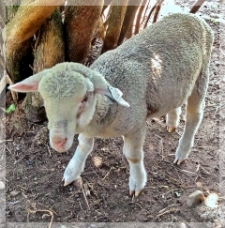
lambAs one of three pilgrimage feasts requiring every Jewish man’s attendance in Jerusalem, Jesus and the disciples joined other pilgrims on their journey toward the city for the Passover celebration. By the time they passed through Jericho (where He healed the blind Bartimaeus and ate dinner with Zacchaeus), a large crowd was following Jesus. It was on a Sunday that He and His disciples left Bethany for the two-mile walk into Jerusalem. The roads would have been crowded as pilgrims streamed into the city in preparation for the festival. Having heard of Jesus’ miracles and the way He brought Lazarus out of the grave, many of those in the streets were anxious to see Him. ”Could this be the long-awaited Messiah?” they wondered.

Although Jesus seemed to have walked everywhere, when He was less than a mile from the city, He sent two disciples to fetch a donkey’s colt that would be waiting for them. When Jesus deliberately rode that colt into Jerusalem, He was presenting Himself as Israel’s promised king. The animal’s significance was not lost on the people and their questions about His identity were answered. Solomon rode a donkey when he was presented to Israel as David’s rightful heir and successor and Zechariah prophesied that the promised Davidic king—the Messiah—would come on a donkey, as well! Thinking this king would save them from Rome, rather than Satan, people called out “Hosanna,” a combination of two Hebrew words, yasha (meaning save) and na (meaning now). Although Jesus brought salvation, it wasn’t from Rome!

Believing Jesus was the promised heir to David’s throne, the people recited from Psalm 118: “Blessings on the one who comes in the name of the Lord! Hail to the King of Israel.” Traditionally, people honored a new king by throwing their coats where he would sit or walk and palm branches were considered symbols of joy, victory, and triumph. The crowd’s reaction to seeing Jesus on the colt was to cut palm branches from the trees and to lay both palms and their coats across the road in Jesus’ path. Others, thinking they were celebrating victory over Rome, waved branches of palms as He passed. They didn’t know the victory they were celebrating was Christ’s victory over sin and death!

While Jesus was entering Jerusalem from the east, it’s likely that Pontius Pilate (governor of Judea) was entering the city from the west and King Herod from the north. In contrast to Jesus’ humble but joyous procession, their entrances would have been solemn and regal. Jesus rode a donkey and was accompanied by twelve disciples. Pilate and Herod would have ridden in chariots and been accompanied by legions of soldiers and warhorses. Jesus and his followers were weaponless but the soldiers wore armor and carried swords. While the procession from the east was led by the Prince of Peace, the processions of Herod and Pilate, men known for their violence and cruelty, would have been a show of force to quell any thoughts of a rebellion during the Passover.

Of course, only Jesus knew that the crowd exclaiming, “Hail to the king!” would soon turn on Him—that the cries of blessings upon Him would become shouts to crucify Him! Only He knew that His royal welcome would end with His dying a criminal’s death on a cross. It wouldn’t be until after His resurrection that His Jewish followers would understand the full significance of His entry into Jerusalem on that Sunday, the 10th day of Nisan.

According to Exodus 12, the 10th of Nisan was the specific day on which people were to select their Passover lamb (a male without any defect or blemish). The family was to keep the lamb until twilight on the 14th day when it would be killed and eaten. Jesus, the Lamb of God, entered Jerusalem on Lamb Selection Day. When He and His disciples ate their Passover meal that Thursday evening, Jesus broke the bread and gave it to His disciples saying, “This is my body.” He then passed the cup saying, “This is my blood.” It wasn’t until later that the disciples understood the full meaning of Christ’s words. While they may have consumed leg of lamb that night as they commemorated Israel’s deliverance from bondage to Egypt, the bread and wine made it clear that the sinless Jesus was the true Passover lamb. He was the perfect sacrifice who would deliver all who believed in Him from their bondage to sin!

On the night when he was betrayed, the Lord Jesus took some bread and gave thanks to God for it. Then he broke it in pieces and said, “This is my body, which is given for you. Do this in remembrance of me.” In the same way, he took the cup of wine after supper, saying, “This cup is the new covenant between God and his people—an agreement confirmed with my blood. Do this in remembrance of me as often as you drink it.” For every time you eat this bread and drink this cup, you are announcing the Lord’s death until he comes again. [1 Corinthians 11:23-26 (NLT)]

Copyright ©2023 jsjdevotions. All rights reserved.

DRIFTING

So we must listen very carefully to the truth we have heard, or we may drift away from it. [Hebrews 2:1 (NLT)]

Lake Brienz-Switzerland
We had an elderly friend who frequently visited us at our lakeside cottage. An avid reader but a poor swimmer, she loved to relax and read in a small rubber raft while floating on the water. Inevitably, she’d drift off and, finding it difficult to paddle against the current and return to the dock, she’d call on the children to swim out and tow her back to safety. Eventually, tiring of their towing job on a breezy day, they took a length of rope and tied it to both raft and dock. The rope was long enough to allow our friend to float around but short enough that she never got too far away from home. I thought of her when I read the caution in Hebrews 2:1 to carefully listen to the truth lest we drift away from it.

Like the Hebrews, many in the church at Colosse were drifting away into dangerous waters. Rather than drifting into apostasy (the abandonment of their belief in Jesus) as were the recipients of the letter to the Hebrews, the Colossians were drifting into the equally dangerous waters of heresy (adhering to a belief contrary to church doctrine). Sitting near the intersection of several major highways, Colosse was exposed to a wide variety of beliefs and philosophies. Rather than waves of persecution, these new Christians were being pushed along by the popular, but false, teachings of the day. Various un-Biblical philosophies and beliefs were being integrated into doctrine and wreaking havoc in the church. Just as my children brought my friend back to the dock, Paul’s letter was his way of returning the church to sound doctrine.

From Paul’s letter, it appears that some teachers were peddling something akin to Gnosticism—a belief that some people possessed secret superior knowledge that was hidden from most other believers. Thinking that all matter (including the body) was evil, they affirmed the deity of Jesus but denied His humanity. Others seemed to embrace a fusion of Christianity and Judaism that included Jewish dietary laws and the observance of Jewish holy days. Some Colossians espoused a spiritualistic teaching requiring them to worship angels before connecting with God. Still others adopted a legalistic version of Christianity with man-made requirements like pious self-denial, special rituals, and possibly circumcision. Calling them “empty philosophies and high-sounding nonsense,” Paul pointed out that those beliefs came from human thinking and demons rather than Christ.

When those false theories and ideologies were merged into the tenets of the new church, there was just enough of Scripture’s truth in them to make them sound right. Even in the 21st century, it’s easy to get caught up in new philosophies or trendy ideas and different “empty philosophies and high-sounding nonsense” continue to be preached today.  As Tim Challies said, “This world is a murky madness of true and false. For every doctrine we know to be true, there seems to be a hundred pretenders.” Like the Colossians, we must be on guard for those pretenders—those who add to, ignore, dismiss, or edit Scripture along with any who are more interested in filling their wallets than saving souls, more intent on pleasing mankind than God, or claim to have been called by God to preach words outside of Scripture.

To avoid drifting away from the truth found in Jesus, rather than tethering ourselves to a dock as did my friend, we must tether ourselves to God; instead of using a rope, we use His word as found in the Bible. Simply put, sound doctrine comes solely from God. Its authority comes only from God’s Word and is consistent with all of Scripture (rather than a verse taken out of context).

Whatever is only almost true is quite false, and among the most dangerous of errors, because being so near truth, it is the more likely to lead astray. [Henry Ward Beecher]

But you must continue to believe this truth and stand firmly in it. Don’t drift away from the assurance you received when you heard the Good News. … Don’t let anyone capture you with empty philosophies and high-sounding nonsense that come from human thinking and from the spiritual powers of this world, rather than from Christ. [Colossians 1:23,2:8 (NLT)]

Copyright ©2023 jsjdevotions. All rights reserved.

IN THE YEAR OF OUR LORD

In the beginning [before all time] was the Word (Christ), and the Word was with God, and the Word was God Himself. [John 1:1 (AMP)]

I am the Alpha and the Omega, the First and the Last, the Beginning and the End [the Eternal One]. [Revelation 22:13 (AMP)]

tri-colored heronVarious events leave an indelible mark on our personal history and we have our “befores” and “afters” with which we mark time. It might be BP for “before Parkinson’s,” AM for “after marriage,” BS for “before sobriety,” or AC for “after cancer.” When we had little ones, our time was marked by BC (before children) and AD (after diapers)! Of course, for most of the world, the designations BC and AD have to do with the calendar and delineate whether the time was before or after Christ.

When just a child, I knew BC meant “before Christ” but mistakenly thought AD meant “after death.” As a result, I wondered where that left the thirty-three years He walked the earth. Was that DC—“during Christ?” AD actually is an abbreviation for anno Domini Nostri Jesu Christi, Latin for “in the year of our Lord Jesus Christ” (“in the year of our Lord,” for short), so those thirty-three years belong on the AD side of the timeline.

The BC/AD system was a byproduct of an attempt by the First Council of Nicaea (AD 325) to unify the church by setting the date of Easter as the first Sunday following the full moon following the spring equinox. Computations determining the date were recorded in documents known as Easter tables. But, with no universally accepted way of dating the years, some calendars were based on the founding of Rome and others on the reign of Roman Emperor Diocletian. As a result, depending on the dating system, Easter’s date varied by as much as five weeks. Wanting to unite the church in their celebration of the most important event in Christianity, a monk named Dionysius Exiguus introduced the concept of AD in 525 when he anchored his Easter table on the year of the Lord’s birth. It was, however, several centuries before his system became commonplace.

In 731, the English monk Bede was the first author to use Dionysius’ AD system in his history of the English people. Bede also was the first person to use BC to designate how many years prior to Christ’s birth an event occurred. In the ninth century, the Roman Emperor Charlemagne adopted the BC/AD system throughout his empire and, by the fourteenth century, most of Christendom had adopted it.

Although Dionysius never explained how he determined Jesus’ birth year, he probably consulted the early church writings of Clement of Alexandria and Eusebius of Caesarea to estimate the date. As it turns out, he miscalculated the year and most historians now believe Jesus actually was born four to six years earlier than Dionysius thought. Nevertheless, error or not, whether we use BC and AD or the more “politically correct” BCE (before the common era) and CE (common era), our calendars are anchored in Christ’s incarnation!

Aside from our calendars, while there was a time before Jesus appeared in Bethlehem, there never really was a time before Christ. Moreover, what I didn’t understand as a girl is that, while time has passed since Jesus walked the earth, there never has been a time “after” Him. Jesus always existed and forever will exist. He was here at the beginning of time, He is here now, and He will be here at the end; He is the Alpha and Omega. In actuality, it always has been AD—anno Domini—the year of our Lord.

For Christians, perhaps the most important dividing line is a very personal BC—before Christ. Different for each of us, it is the moment we accepted Christ as our Lord and Savior. It is our real birth (rather re-birth) day and, from that moment on, we truly live in AD—the year of our Lord.

For just as in Adam all die, so also in Christ all will be made alive. [1 Corinthians 15:22 (AMP)]

Copyright ©2023 jsjdevotions. All rights reserved.

HANUKKAH (2) – FEAST OF DEDICATION

Look at my servant, whom I strengthen. He is my chosen one, who pleases me. I have put my Spirit upon him. He will bring justice to the nations. [Isaiah 42:1 (NLT)]

In the same way, let your light shine before others, that they may see your good deeds and glorify your Father in heaven. [Matthew 5:16 (NLT)]
menorah

Most of us associate Hanukkah with Judaism’s menorah. Although the books of the Maccabees mention the relighting of the Temple’s lampstand/menorah, they make no mention of a miracle of oil. However, the Talmud (a collection of discussion and commentary on Jewish history, customs, law and culture) does. It claims that, while only one small flask of consecrated oil was found to light the menorah that first day, the lamp remained lit the entire eight days of celebration until new oil could be consecrated.

Although the Temple’s menorah had seven branches with wicks that burned fresh olive oil, Hanukkah’s menorah usually has nine branches with nine candles. Eight of those candles represent each day of the feast. The ninth candle, often placed in the center and slightly higher than the rest, is called the shamash, meaning servant. Rather than lighting each candle with a match, only the shamash is lit. It is this “servant” candle’s flame that is used to ignite the rest. Upon learning this, I couldn’t help but think of the Messianic prophecies of a suffering servant found in Isaiah 53. That servant was Jesus—He was the shamash who brought God’s light into the world and, like the shamash candle, He gave His light to our lives. By trusting in Him, Jesus said we become  “children of the light,” and, as His children, we are His servants. The Great Commission tells us that we are to be the shamash candles who continue to bring His light into our troubled world.

Thinking of Hanukkah merely as a festival of lights, however, misses the heart of this story—the rededication of the Temple. When a ragtag group of Jewish rebels retook the Temple from the powerful Seleucid army, the Temple had been desecrated and profaned. Before resuming worship there, the Temple had to be cleaned, the idols removed, the pagan altar dismantled, and a new altar consecrated. Only after they made it a fitting place for Jehovah to live did they re-dedicate the Temple to God.

For the people of Judah, the Temple was where God resided. For the people of Jesus, however, it is our bodies—our hearts, minds, and souls—that serve as a temple for God’s Holy Spirit. As believers, we are God’s temple individually and, as the body or church of Christ, we are His temple collectively. As His temple, we should be as holy and pure as were the Temple’s menorah and altar. Nevertheless, it’s difficult to walk through this sinful world and not have some of its filth contaminate us. Things like hate, anger, prejudice, envy, pride, deception, and greed defile us as much as that pig’s blood and idol of Zeus defiled Jerusalem’s Temple. Worse, as the collective temple of God, we’ve seen His church desecrated with things like corruption, exploitation, abuse, hypocrisy, bigotry, and shoddy, distorted and false doctrine. Like the Maccabees, do we need to do some cleaning of His holy temple?

The season of Hanukkah reminds us that Jesus is the servant whose light overcame the darkness of the world. My prayer for this Christmas season is that we allow Hanukkah’s story and traditions to inspire us so that we rid our lives of all that defiles His temple. Let us rededicate ourselves to the Lord and, as His servants, may we glorify Him in all we do.

He that chooses God, devotes himself to God as the vessels of the sanctuary were consecrated and set apart from common to holy uses, so he that has chosen God to be his God, has dedicated himself to God, and will no more be devoted to profane uses. [Thomas Watson]

Don’t you realize that your body is the temple of the Holy Spirit, who lives in you and was given to you by God? You do not belong to yourself, for God bought you with a high price. So you must honor God with your body. [1 Corinthians 6:19-20 (NLT)]

Copyright ©2022 jsjdevotions. All rights reserved.