BROWSERS, CONSUMERS, & INVESTORS

And all the believers met together in one place and shared everything they had. They sold their property and possessions and shared the money with those in need. They worshiped together at the Temple each day, met in homes for the Lord’s Supper, and shared their meals with great joy and generosity—all the while praising God and enjoying the goodwill of all the people. And each day the Lord added to their fellowship those who were being saved. [Acts 2:44-47 (NLT)]

Galena ILOur cottage was near a charming little town known for its history, architecture, and resorts. A popular summer destination, its Main Street was flooded on weekends with tourists checking out the various stores. Chef I’s shop usually was bursting with browsers enjoying samples of his salsas, hot sauces, mustards, BBQ sauces, seasonings, rubs, marinades, fruit preserves, salad dressings, and dips. Although some tasters purchased a jar or two to take back home, they were just browsers. Having purchased something on a whim, they wouldn’t return unless they happened to come back to town.

Sometimes, we have people who are browsers in our churches. While they may pause for a sample, possibly show up on Easter and Christmas, or return when the mood hits, they are simply passing through. A church can’t count on the browsers to keep its doors open!

A little lunch café in our town was regularly patronized by Ron. Although it offered a wide variety of menu items, Ron went there specifically for their “Pig n’ Pineapple” sandwich (pork cutlet, pineapple slice, bacon, mozzarella, onion, and mayo). When the diner stopped serving it, Ron stopped patronizing them. Although he’d gone there regularly, he wasn’t a loyal regular. He didn’t care about the café—only the sandwich—and Ron never returned.

In our churches, we have people who are consumers like Ron. They find one thing they like but, rather than a sandwich, it may be the choir, music, youth group, vacation Bible school, worship time, food bank, or afternoon Bible study. If, for some reason, that thing changes, stops, or they no longer need or want it, like Ron, they disappear. For example, when our church met at the beach, some people regularly stopped and worshipped with us before taking their place in the sand immediately after service. Of course, we only saw them on good beach days and, when hurricane Ian closed the beach and dislocated us, they disappeared! We haven’t moved far, still meet outside, and have a lovely setting overlooking a lake but, since they were consumers who came more for the location than anything else, they didn’t follow us! Just as Ron abandoned a restaurant for lack of a sandwich, they abandoned our church for lack of a beach! They were no more committed to us than Ron was to that café. They were looking to be served rather than serve and to use rather than develop. A church needs more than consumers, it needs commitment.

My friend Maria started as a browser at a resort-wear shop known for its distinctive prints but, after trying on the clothing, she turned into a consumer. Even though everything wasn’t always to her liking, she became loyal to the brand. In fact, Maria became so committed to the store that she started working there. Taking advantage of her employee discount, she became a walking advertisement for the brand. Better than the discount, however, was discovering her knack for helping customers find the perfect outfit and her joy in doing so. Finding the business true to its core values of things like excellence, integrity, continued improvement, making the world a brighter place, and having fun in the process, Maria even took some of her earnings to purchase stock in it.

A church can’t survive on browsers and consumers—it needs people like Maria—people who become committed—who invest their time, talents, and finances in its success. Rather than mere consumers, they become participants, workers, and shareholders in their church. Like Maria, they may not find everything to be a perfect fit or design; nevertheless, they remain committed. Rather than discovering and employing hidden talents as did Maria, they can discover and use their spiritual gifts! Instead of receiving an employee discount or a dividend, people’s cups will overflow with spiritual blessings when they become shareholders in the church. Rather than being a walking advertisement for a clothing brand, they become walking advertisements for Christ and His church.

We are the “living stones” of God’s spiritual temple but we’re no more than bits of gravel when all we do is browse or occasionally stop and shop! Are you a browser, consumer, or a shareholder in God’s kingdom?

And you are living stones that God is building into his spiritual temple. What’s more, you are his holy priests. Through the mediation of Jesus Christ, you offer spiritual sacrifices that please God. [1 Peter 2:5 (NLT)]

Copyright ©2023 jsjdevotions. All rights reserved.

GOOD INTENTIONS

Then the rest of the people…joined their leaders and bound themselves with an oath. They swore a curse on themselves if they failed to obey the Law of God as issued by his servant Moses. They solemnly promised to carefully follow all the commands, regulations, and decrees of the Lord our Lord. [Nehemiah 10:28-29 (NLT)]

prairie starIn the years following the exiles’ return to Judah and the rebuilding of the Temple, adherence to the Law grew lax. Knowing how to live a Jewish life depended on knowing the commandments of the Torah but the people had drifted away from God and His word and were committing the same sins that got them exiled! More than fifty years after the Temple’s rebuilding, Ezra arrived in Jerusalem. As a priest and teacher of the law, Ezra was shocked to find such disobedience. He tore his clothes and pulled his hair in sorrow before kneeling in prayer. He led the people in prayers of confession and repentance after which they swore a solemn oath to follow the Lord’s commands.

A decade after Ezra’s arrival, Nehemiah arrived and rebuilt the city’s wall. When the wall was completed, all the men, women, and children (old enough to understand) assembled in the square by the Water Gate. Ezra stood on a high platform and read to them from the Torah. After Ezra read, the Levites went among the people to help them understand each passage. The next morning, after further study, they found directions for the Feast of Booths and immediately reinstituted the celebration. Realizing they’d broken their covenant with God, the people assembled again to hear the Book of the Law. After confessing their sins, they again rededicated themselves to following God and keeping His law. They specifically pledged to faithfully observe both the Sabbath and the seventh Sabbath year, to pay their Temple tax and tithes, and not to neglect the Temple or marry pagans. Their vows were recorded and the document was ratified and signed by the leaders, Levites, and priests.

Good intentions aren’t enough and remaining faithful to God’s word requires daily vigilance. Nehemiah was called back to the Persian court for an unknown amount of time and, in the years between signing that covenant and his return to Jerusalem, the people managed to violate every promise they made. It was during this period that the prophet Malachi rebuked the priests and people for their willful disobedience.

Nevertheless, despite Malachi’s warnings and their good intentions, when Nehemiah returned, he found the people blatantly disregarding God’s Law. Tithes and offerings weren’t being made, provision hadn’t been made for the Levites, trade and work were being done on the Sabbath, intermarriage with pagans had resumed, and wood hadn’t been provided for Temple offerings. Many of the children couldn’t even speak Hebrew! Worse, in direct violation of the Torah, an Ammonite was given a room at the Temple. In his anger at finding God’s house despoiled, Nehemiah cleared the Temple (as Jesus would again nearly 400 years later). “Wasn’t it just this sort of thing that your ancestors did that caused our God to bring all this trouble upon us and our city?” asked Nehemiah. [13:18]

The city’s walls may have protected Jerusalem from attack, but they couldn’t prevent sin from entering the people’s lives. They’d done more than neglect bringing wood for the fire at the altar—they’d allowed the fire in their hearts to die! Despite their good intentions, they took their eyes off God and His word. The flame of faith needs more than good intentions; it needs both fuel and tending. Gen. William Booth, founder of the Salvation Army, told his followers “Bear in mind that it is the nature of a fire to go out; you must keep it stirred and fed and the ashes removed.” The exiles had failed to keep the fire going. The book of Nehemiah closes with him making sure there was a supply of wood for the altar. Just as the fire on the altar was never to be allowed to go out, the fire in our hearts must burn continuously, as well!

Take care of giving up your first zeal; beware of cooling in the least degree. Ye were hot and earnest once; be hot and earnest still, and let the fire which once burnt within you still animate you. Be ye still men of might and vigor, men who serve their God with diligence and zeal. [Charles Spurgeon]

This is why I remind you to fan into flames the spiritual gift God gave you when I laid my hands on you. For God has not given us a spirit of fear and timidity, but of power, love, and self-discipline. [2 Timothy 1:6-7 (NLT)]

Copyright ©2023 jsjdevotions. All rights reserved.

THE REST OF THE STORY (THE LORD’S PRAYER – 2)

Praise the Lord, the God of Israel, who lives from everlasting to everlasting. Amen and amen! [Psalm 41:13 (NLT)]

Praise the Lord God, the God of Israel, who alone does such wonderful things. Praise his glorious name forever! Let the whole earth be filled with his glory. Amen and amen! [Psalm 72:18-19 (NLT)]

The version of what we call “The Lord’s Prayer” in Luke 11 and the one we find in Matthew 6 are somewhat different. The shorter version in Luke was given to His disciples (probably on the Mt. of Olives) while the one in Matthew was taught to the crowd gathered on the hill by the Sea of Galilee as part of the Sermon on the Mount. It’s quite likely that Jesus gave this prayer example several times during his three-year ministry, each time with slightly different wording. Both versions, however, are probably shorter than the prayer most Protestants recite today. Missing is the phrase, “For thine is the kingdom, the power, and the glory, for ever and ever, Amen.” Because this phrase was not found in the two earliest Greek manuscripts of Matthew’s gospel, most modern Bible translations do not include it. Although found in later manuscripts, most Biblical scholars believe it to be a later liturgical addition to the original prayer. So, how did we come to pray this prayer in its longer form?
That those additional words were not found in the earliest New Testament manuscripts doesn’t necessarily mean Jesus never said them; after all, the gospels don’t include everything our Lord did or said. If the additional words did not come from Jesus, they probably came from any one of several psalms, 1 Chronicles 29:11, or some other Jewish prayer. Jesus never said this was the only prayer to be said nor did He tell His followers to stop saying the prayers they learned in the temple. The Apostles and early church were Jewish and Jewish prayers often ended with what is called a “doxology.” Meaning to speak glory and praise, a doxology is a short, hymn-like verse exalting the glory of God. It’s understandable that this prayer, taught to Jewish disciples by a Jewish Jesus, took on some of its Hebrew heritage and flavor with the addition of this doxology.

The version of the Lord’s Prayer with which most of us are familiar comes from a Christian manual written before 300 AD. Bearing neither date nor author, some scholars believe it was written as early as 65 to 80 AD. The only complete copy has two titles: The Teaching of the Twelve Apostles and The Teaching of the Lord through the Twelve Apostles to the Gentiles. Known now as the Didache, meaning teaching, it is not part of the Biblical canon because it is not considered God-breathed or divinely inspired. Nevertheless, as a sort of handbook for the early Christians, it gives us valuable insight into the early church. Beginning with a statement of faith, the Didache may be the first Christian catechism. Its second section describes how to perform rituals like Baptism and the Eucharist and gives instructions to recite the Lord’s prayer three times a day. This direction reflects Christianity’s Jewish heritage since Jewish men were supposed to pray the Amidah three times a day. The Didache’s third section covers ministry and dealing with traveling teachers while the fourth includes several passages from the New Testament and reminds believers that Jesus will return.

As famed radio broadcaster Paul Harvey would say, “And now you know the rest of the story.”  As for me, knowing the rest of the story—that the Lord’s Prayer was regularly prayed by the earliest followers of Jesus—makes it an even more meaningful prayer to say.

Neither pray you as the hypocrites, but as the Lord commanded in His Gospel, thus pray you: Our Father, Who are in heaven, hallowed be Your name; Your kingdom come; Your will be done, as in heaven, so also on earth; Give us this day our daily bread; And forgive us our debt, as we also forgive our debtors; And lead us not into temptation, but deliver us from the evil one; For Yours is the power and the glory for ever and ever. Pray this three times in the day. [Didache 8:3-11]

Yours, O Lord, is the greatness, the power, the glory, the victory, and the majesty. Everything in the heavens and on earth is yours, O Lord, and this is your kingdom. We adore you as the one who is over all things. [1 Chronicles 29:11 (NLT)]

Copyright ©2023 jsjdevotions. All rights reserved.

THE DISCIPLES’ PRAYER (THE LORD’S PRAYER – 1)

Once Jesus was in a certain place praying. As he finished, one of his disciples came to him and said, “Lord, teach us to pray, just as John taught his disciples.” Jesus said, “This is how you should pray: Father, may your name be kept holy. May your Kingdom come soon. Give us each day the food we need, and forgive us our sins, as we forgive those who sin against us. And don’t let us yield to temptation.” [Luke 11:1-4 (NLT)]

apache plume

While the ability to calm storms would have been handy, rather than asking Jesus how he managed to do that or turn water into wine, heal the sick, provide a miraculous catch of fish, make the paralyzed walk, one of Jesus’ disciples asked the Lord how to pray. Scripture makes frequent mention of Jesus praying so the disciple knew that prayer was an integral part of His life. Perhaps he suspected that Jesus’ power sprang from His prayers.

Although rabbis often taught their disciples prayers, by Jesus’ day, every Jew knew at least one prayer, the Amidah (or Eighteen Benedictions), that was to be prayed daily. No doubt, Jesus and His followers prayed that prayer regularly. With the Amidah’s promise to sanctify God’s name; its acknowledgment of God’s power and glory; and its petitions for forgiveness, deliverance from affliction, provision, the righteous reign of God, and the Messianic kingdom to come, the prayer Jesus taught was a somewhat abbreviated version of this much longer and more formal Jewish prayer.

Although Jesus’ prayer has come to be known as the “The Lord’s Prayer,” its title is somewhat misleading. This is unlike the prayers Jesus said for His disciples or when He asked that His “cup of suffering” be taken the night before His death. It’s not like Jesus’ prayers on the cross when He asked why He’d been forsaken, that God forgive the people, and when He entrusted His spirit into God’s hands. Those prayers truly were the Lord’s prayers; the prayer Jesus taught us is ours!

Rather than offering this prayer to God, Jesus was giving this prayer to His disciples. Because the possessive determiners and pronouns are plural, we are not asking as an individual but as a group. United in faith, we pray to our Father, not mine. We’re asking for ourselves along with one another. It’s not give, forgive, and let me; it’s give, forgive, and let us. It’s not the food I need or the people I forgive who sinned against me; it’s the food we need and the people we must forgive who hurt us. This is a prayer meant to be said with one another. A prayer of community, it is a corporate prayer of submission and dependence. Perhaps a more appropriate title for this well-known prayer would be “The Disciples’ Prayer.”

Some version of this prayer is found in the liturgies of the Christian church as early as 65 AD and it continued to be used regularly through the Middle Ages. After the Reformation, the Lord’s Prayer was used in Protestant liturgies as well as Roman Catholic and Orthodox. Church leaders like Martin Bucer, John Calvin, Thomas Cranmer, and John Knox included it as a regular part of public worship.

In spite of this being the only prayer Jesus taught, many of today’s non-denominational churches don’t say it. Perhaps they see it as a relic from the past, believe that Jesus meant it only as a model, fear that people might treat it as a “magic formula,” or are concerned that such a familiar prayer will be repeated thoughtlessly. While special power should never be ascribed to words and no prayer ever should be said carelessly, anything Jesus said is worth repeating over and over again! Although we attend a non-denominational non-liturgical church on Sundays, we attend a liturgical church Saturday evenings. There we join with other believers reading a psalm, reciting the creed, and praying the Lord’s Prayer as one; there is nothing unthinking or perfunctory about any of it. Singing, declaring, and praying with one voice reinforces our oneness in the Spirit and the Lord.

When Cyprian wrote about the Lord’s Prayer early in the 2nd century, he emphasized the importance of praying it with other believers as a way of uniting them with their church family: “Our prayer is public and common; and when we pray, we pray not for one but for the whole people, because we the whole people are one.” Indeed, the Lord’s Prayer is a prayer to be said with other believers as a way of uniting us in the Body of Christ!

May we never hesitate to offer this beautiful prayer to our Father!

All the believers devoted themselves to the apostles’ teaching, and to fellowship, and to sharing in meals (including the Lord’s Supper), and to prayer. [Acts 2:24 (NLT)]

Copyright ©2023 jsjdevotions. All rights reserved.

THE LAW AND THE PROPHETS

Don’t misunderstand why I have come. I did not come to abolish the law of Moses or the writings of the prophets. No, I came to accomplish their purpose. I tell you the truth, until heaven and earth disappear, not even the smallest detail of God’s law will disappear until its purpose is achieved. [Matthew 5:17-18 (NLT)]

You search the Scriptures because you think they give you eternal life. But the Scriptures point to me! [John 5:39 (NLT)]

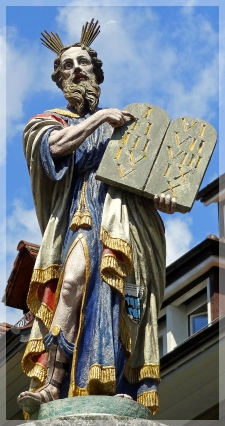
Moses Fountain - Bern - SwitzerlandOur Colorado church had a large worship center with excellent acoustics so, when the local Jewish congregation wanted to present a concert of Jewish music by a well-known Jewish performer, we were happy to offer our venue to them. The Christians in attendance never expected the evening to end with Jews and Christians joining hands and dancing the hora around the church while singing “Hava Nagilah” (Let Us Rejoice). What the Jews hadn’t expected were the Bibles on the back of every chair. Before the concert began, many intently looked through them and, after the concert, they expressed their surprise at finding their Hebrew Scriptures in our Christian Bibles!
While we call it the Old Testament, it isn’t called that by a Jew. When “testament” appears in the New Testament, it is a rendering of the Greek word diatheke, meaning covenant. While Christians recognize the old covenant God made with the Israelites, we also believe He made a new covenant (or testament) with the followers of Jesus. For a Jew, however, there’s nothing “old” about that covenant because there hasn’t been a new one. As a result, they much prefer the term Hebrew Bible or Hebrew Scriptures. The other term used for the Hebrew Bible is Tanakh—an acronym for its three categories: Torah (Law), Nevi’im (Prophets), and Ketuvim (Writings).

Even though the Hebrew Bible has 24 books divided into those three categories and our Old Testament has 39 books and four categories (Law, History, Wisdom and Poetry, and Prophecy), they both tell the same story, but in a different order. The number of books differs because the Hebrew Bible combines the first and second books of Samuel, Kings, and Chronicles, the books of Ezra and Nehemiah, and the 12 books of the minor prophets. Instead of ending with the Prophets as does our Old Testament, the Hebrew Bible ends with the Writings and the book of Chronicles.

The 1st century Jewish historian Flavius Josephus (37/38 – 100 AD) reported that there was an authoritative list of the twenty-two books Jews called “holy scriptures” that was determined by the time of Artaxerxes (464-424 BC). The book number differs because Ruth was attached to Judges and Lamentations to Jeremiah at that time. We know that the Scripture our Lord read, studied, and memorized as a boy in Galilee is the same Scripture we have today.

Jesus made frequent references to the Scriptures throughout His ministry and his enemies soon learned that they couldn’t argue the Word of God with the One who breathed that word! He defeated Satan’s temptations with words from Deuteronomy and, during his frequent confrontations with the Jewish rulers, Pharisees, and Sadducees, He made specific references to verses in Genesis, Leviticus, Deuteronomy, Exodus, Samuel, Isaiah, Hosea, and Psalms. He quoted from Malachi when speaking of John the Baptist and frequently quoted from Scripture to show how He would fulfill prophecies. He explained the writings of Moses and the prophets to Cleopas on the road to Emmaus. According to Liberty University’s Harold Willmington, of the 1,800 verses reporting Jesus’ words in the gospels, 180 verses are Old Testament quotes or allusions.

While I can understand a Jew’s unfamiliarity with a Christian Bible and surprise at finding the Hebrew Scriptures in it, I can’t understand why those of us who claim to follow Jesus are so unfamiliar with the words our Lord read, studied, quoted, and believed while He walked the earth! If it was important to Him, shouldn’t it be important to us?

Then he said, “When I was with you before, I told you that everything written about me in the law of Moses and the prophets and in the Psalms must be fulfilled.” Then he opened their minds to understand the Scriptures. [Luke 24:44-45 (NLT)]

Copyright ©2023 jsjdevotions. All rights reserved.

HIS SANCTUARY

Don’t you realize that your body is the temple of the Holy Spirit, who lives in you and was given to you by God? You do not belong to yourself, for God bought you with a high price. So you must honor God with your body. [1 Corinthians 6:19-20 (NLT)]

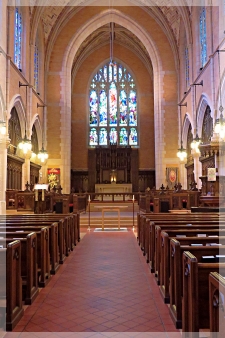
St. Paul's Cathedral - MNSince we both attended liturgical churches as girls, my friend and I were trying to recall the terms for the various parts of a traditional church building. We knew the foyer is called the narthex and the congregation sits the church’s nave. We also knew the altar rail usually separated the nave from the chancel in the front. It’s from the chancel that the service is conducted and where the altar, pulpit, and lectern are located. We even recalled that the sacristy was the room holding Communion supplies and linens. Since we were worshipping in a park that morning, my friend asked the location of our sanctuary. In historic usage, sanctuary and chancel were synonymous but, in modern usage, a sanctuary consists of the entire worship space of a church. With no building, we had no narthex, nave, or chancel but we did have a worship space; our sanctuary was a gazebo in a county park.

As God would have it, my next morning’s reading took me to today’s verse from 1 Corinthians. The Greek word usually translated as “temple” was naós, meaning a sanctuary, a divine dwelling-place, a temple, or place of divine manifestation. In Paul’s day, naós referred to the Temple proper, from the inner courts to the Holy Place with the seven-branched candlestick, golden incense altar, and showbread table all the way to the innermost area called the Holy of Holies—a place so sacred that it could be entered only by the High Priest once a year, on the Day of Atonement.

Having recently written about the lack of respect and reverence now common in a church sanctuary, Paul’s words gave me pause. The Temple and all its utensils—from the Ark, altars, and lamps to the snuffers, basins, oil, incense, and priest’s garments—were considered holy. Dedicated solely to serving God, they were not to be used for common or profane uses. If we are God’s sanctuary, a place of worship and the divine dwelling place of the Holy Spirit, do we treat ourselves with the reverence and respect due God’s temple? Are we solely dedicated to serving God? Are we ever used for vulgar, disrespectful, or profane purposes?

Do we ever desecrate our sanctuary by not treating our bodies properly? Do we treat them with the same care and regard we would Communion wafers, altar linens, or a Baptismal font? God’s sanctuary, however, is more than our physical bodies; it’s our entire being, our hearts and minds. Do we speak, read, look at, find humor in, think about, or do things we wouldn’t if we were in church? Do we always serve as a worship space of our amazing Triune God or just during prayers or worship service? Do we reflect the dignity, sanctity, and holiness that comes with being the house of God?

A great deal of responsibility comes with being God’s dwelling place. Just as the Temple was defiled in 168 BC when Antiochus Epiphanes sacrificed a pig on the altar of incense, our sins defile us. They are like obscene graffiti on a church walls, vandalism of the altar, defacement of the Bible, or leaving excrement on the pews. Preacher Harry Ironside reminds us, “How careful you and I ought to be that we grieve not that blessed One who dwells within, that we do not bring dishonor upon the name of the Savior who has sent His Spirit to live in our body.”

The Jews were so zealous about maintaining the purity of God’s sanctuary that a low fence  separated the court of the Gentiles from the rest of the Temple mount complex. Gentiles and ritually unclean Israelites were forbidden, on pain of death, from passing through its gates to the interior areas—the sanctuary of the Temple. Are we that zealous about keeping His dwelling place within us—His sanctuary—pure and undefiled?

For that matter, our brothers and sisters in Christ also serve as a dwelling place of God. Do we treat them with the same reverence and respect due God’s sanctuary? We should!

Don’t you realize that all of you together are the temple of God and that the Spirit of God lives in you?… All of you together are Christ’s body, and each of you is a part of it. [1 Corinthians 3:16,12:27 (NLT)]

Copyright ©2023 jsjdevotions. All rights reserved.