TREKKING POLES – LESSONS FROM THE TRAIL (3)

But he said to me, “My grace is sufficient for you, for my power is made perfect in weakness.” Therefore I will boast all the more gladly of my weaknesses, so that the power of Christ may rest upon me. [2 Corinthians 12:9 (ESV)]

Trust in the Lord with all your heart and do not lean on your own understanding. In all your ways acknowledge him, and he will make straight your paths. [Proverbs 3:5-6 (ESV)]

chipmunk- SSCO9368awebI always had a false sense of pride about not using trekking poles when hiking. They were for novices or ersatz hikers—not a seasoned hiker like me. After reading about hiking the Appalachian Trail, however, it occurred to me that I could be mistaken. With my arthritic knees, perhaps I could use a little assistance.

After a few hikes in the Rockies, I am now a proponent of trekking poles. Where, I wondered, are the aching muscles, stiff joints, and sore feet I expected after several strenuous hikes? The poles, however, greatly reduced the impact on my legs, knees, ankles and feet. Why was I able to walk as quickly and steadily? The poles helped propel me forward and maintain a rhythm. Why hadn’t I struggled more on the steeps? The poles increased my traction and helped me maintain my balance. Why hadn’t I been more frightened on the most challenging sections? I felt more secure with the poles’ assistance. Why no scratches from the brambles? The poles helped me push away nuisances like thorny branches. I suppose I could have used them as defense weapons if attacked, but the squirrels and chipmunks posed no threat and the dogs I met were all friendly.

It took a bit of humility to admit that I might need some help when hiking and now I wonder why it took me so long to realize what seasoned hikers have known for so long. Sometimes our relationship with God is that way, as well. We struggle on, exhausting ourselves, defenseless, getting discouraged, struggling, frightened, and even hurt, before admitting, “Lord, I can’t do it alone!” When we finally admit our weakness, He will ease our fears, keep us steady, and provide us with the skill, strength, confidence and protection needed to complete our walk.


So we can confidently say, “The Lord is my helper; I will not fear; what can man do to me?” [Hebrews 13:6 (ESV)]

For God have us a spirit not of fear but of power and love and self-control. [2 Timothy 1:7 (ESV)]

The Lord is my light and my salvation; whom shall I fear? The Lord is the stronghold of my life; of whom shall I be afraid? [Psalm 27:1 (ESV)]

THE INDIRECT WAY – LESSONS FROM THE TRAIL (2)

When Pharaoh let the people go, God did not lead them on the road through the Philistine country, though that was shorter. For God said, “If they face war, they might change their minds and return to Egypt.” So God led the people around by the desert road toward the Red Sea. [Exodus 13:17-18a (NIV)]

Paul and his companions traveled throughout the region of Phrygia and Galatia, having been kept by the Holy Spirit from preaching the word in the province of Asia. When they came to the border of Mysia, they tried to enter Bithynia, but the Spirit of Jesus would not allow them to. … After Paul had seen the vision, we got ready at once to leave for Macedonia, concluding that God had called us to preach the gospel to them. [Acts 16:6-7,10 (NIV)]

9-3-15_9280web
While hiking up the ski mountain, we discovered that what takes only nine minutes on the gondola takes several hours. A 2,200 vertical rise became a more than five mile hike. When looking at the trail map, it is easy to see why—rather than walking straight up the face and following the path of the gondola, the trail traverses back and forth across the mountain. Geometry taught us that the shortest distance between two points is a straight line yet, sometimes, the most direct way is not always the best way. In actuality, going straight up the face of the mountain is near impossible except for the fittest, most adventurous, and possibly craziest of hikers. Being none of those, we followed the meandering trail. There were moments of discouragement as we crossed back and forth across the face of the mountain, catching a brief glimpse of our destination in the distance, before passing again into the woods and continuing our slow ascent.

Is that what it felt like for the Israelites who spent forty years on a trip that should have taken only a matter of days? The forty years, of course, were tacked on for disobedience, but their initial route, given them by God, wasn’t the shortest one either. The shorter route from Goshen to Canaan, a four or five day’s journey, would have led them through Philistine country and was heavily guarded by a string of Egyptian fortresses. God wisely knew that His people, their spirits broken by years of slavery, were not yet ready for war. Their inexperience and possible cowardice would make them shrink from conflict and want to return to Egypt. Knowing this, God sent them the long way around to the Red Sea, an eleven days’ journey. Then, just as they’d gotten to the edge of the wilderness, instead of going forward, God re-directed them back to make camp by the sea. It probably made no sense to the people but it did to God. Pharaoh, thinking them lost and discouraged, would be lulled into a false sense of confidence. He would pursue them, giving God the opportunity at the Red Sea to prove to the Egyptians (and Israelites) exactly with whom they were dealing: the one true God.

God knows our abilities, our weaknesses and fears. By giving us lesser trials, He prepares us for greater ones, just as he did for the Israelites. Sometimes, the less direct route is necessary for us to gain knowledge and experience and learn to trust, obey and appreciate God and His blessings. Other times, God takes us the less direct route because He has a greater task for us elsewhere. When Paul wanted to go into the provinces of Asia, for example, he was directed instead to Macedonia where he brought the gospel message to Europe. He eventually got back to Asia but one look at his missionary journeys shows us that the Apostle never took the most direct route; instead, he followed God’s plan. Admittedly, when our journey takes longer than expected, it is frustrating to think we’ll never reach our objective. We must remember that God is guiding us to the destination that He has chosen by the path that He wants us to take. It may not be the shortest or easiest trail; it will, however, be the best.

There is a long way which is short and a short way which is long. [Babylonian Talmud, Eruvin 53b]

I know, O Lord, that a man’s life is not his own; it is not for man to direct his steps. [Jeremiah 10:23 (NIV)]

FINISHING THE RACE

Therefore, since we are surrounded by such a huge crowd of witnesses to the life of faith, let us strip off every weight that slows us down, especially the sin that so easily trips us up. And let us run with endurance the race God has set before us. We do this by keeping our eyes on Jesus, the champion who initiates and perfects our faith. [Hebrews 12:1-2 (NLT)]

turtle (western box) - NM1764awebRecently, my son ran a half-marathon on a blistering hot and humid Chicago day. A seasoned runner, he said it felt like the longest 13.1 miles he’d ever run. Fortunately, the water stations kept him well hydrated and then, just when he thought he’d “hit the wall,” he came to a spray station that cooled runners as they ran through the water. My son simply paused for a bit under the mist, feeling the cool water on his skin, until he felt ready to run again. He scaled back on his goal of a personal best—time no longer mattered; he just wanted to finish the race.

Although I’m not a runner, I am a writer trying to run the race God has set before me. I examined myself to see what extra weight could be shed and found the burdens of doubt and fear—doubt that I am up to the task and fear that I will run out of words and ideas. Moreover, it won’t be a private defeat—it will be in front of a crowd of witnesses—my readers. I knew I had to shed my negative thoughts and lighten my load, but how?

I thought about my son’s half-marathon and the water stations and cooling spray that had refreshed him during the grueling race. Rather than water and mist, perhaps I needed another kind of refreshment—prayer and meditation. I sat quietly with my Bible, prayed and read, and felt refreshed instead of burdened. Reading God’s word and sitting quietly in prayer was like a hydration station for the soul—it filled and refreshed me with living water. Instead of hurrying on to my tasks, I followed my son’s example and spent a good long time under God’s shower of peace. I stripped off the doubt and fear—they’ll only hold me back—and replaced them with faith and confidence.

God signed me up for this race. Even though I didn’t get a t-shirt or water bottle, it is a race that has given me tremendous joy and one I want to continue. Instead of sore muscles, there have been a few headaches but, without a doubt, I want to see it all the way to the finish line, whenever that may be. That pause to refresh, however, reminded me that God didn’t say I had to do a marathon—that was my decision. Perhaps, at my age, I’m more a 10K girl. Knowing I need to accept my own limitations, I’m going to run a shorter course of five messages a week and take extra time each day to be refreshed by that living water.

Slow but sure wins the race! [The Tortoise’s comment to the Hare in Aesop’s fable]

Jesus stood and shouted to the crowds, “Anyone who is thirsty may come to me! Anyone who believes in me may come and drink! For the Scriptures declare, “Rivers of living water will flow from his heart.” [John 7:37-38 (NLT)]

But those who trust in the Lord will find new strength. They will soar high on wings like eagles. They will run and not grow weary. They will walk and not faint. [Isaiah 40:31 (NLT)]

HE WILL PUMP US UP!

Yet, the strength of those who wait with hope in the Lord will be renewed. They will soar on wings like eagles. They will run and won’t become weary. They will walk and won’t grow tired. [Isaiah 40:31 (GW)]

7-24-15gorilla653we
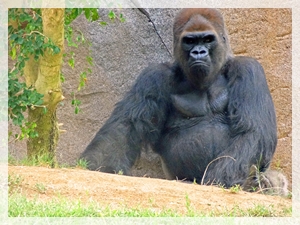
I’ve been known to protest to my trainer when he adds more weight as I exercise. Even knowing that I’ll never get any stronger without increasing the weight lifted, I grumble. Fortunately, I trust my trainer and know he’ll never give me more than I can handle. Moreover, he’s right there beside me, ready to help as I struggle with the last few reps. Pretty soon, I find I can manage on my own and, before I know it, the weight I struggled with becomes the weight I start with on my next set. To increase my endurance, rather than increase the weight, he makes me do more repetitions and extends the time I hold the weights.

In His infinite wisdom, God uses those same concepts to build strength and increase endurance in our spiritual lives. He doesn’t want spiritual weaklings; He wants spiritually strong men and women! When we think He’s given us too much to handle, we must trust that He’s there beside us, helping as we struggle with our load. When we wonder how much longer we can endure under the weight of our troubles, remember He knows our capabilities. God won’t ever give us more than we can handle for longer than we can hold it. He is, indeed, pumping us up!

If a man does not exercise his arm he develops no biceps muscle; and if a man does not exercise his soul, he acquires no muscle in his soul, no strength of character, no vigor of moral fiber, nor beauty of Spiritual growth. [Henry Drummond]

We can rejoice, too, when we run into problems and trials, for we know that they help us develop endurance. And endurance develops strength of character, and character strengthens our confident hope of salvation. And this hope will not lead to disappointment. For we know how dearly God loves us, because he has given us the Holy Spirit to fill our hearts with his love. [Romans 5:3-5 (NLT)]

AT LARGE AND IN CHARGE

5-30-15beach P naplesmes-cropweb
A righteous person will always be remembered. He is not afraid of bad news. His heart remains secure, full of confidence in the Lord. His heart is steady, and he is not afraid.
[Psalm 112:6b-8 (GW)]

Imagination leads to creativity which is good, especially when it results in a Pulitzer Prize-winning novel or an Academy Award screenplay. Unfortunately, our imaginations can run amok at times which can lead to unhappiness, fear, worry and even anger. We visualize the “would have,” “could have” and “should have” scenarios of the past. Previous situations are replayed—with the revised version having us saying and doing all the brilliant things we wish we’d said or done earlier. Then our imaginations take us on a ride to the future and we imagine all of the “what ifs” of tomorrow and even the day after. We picture conversations in which we are dazzling with our intelligence or practice snappy comebacks in situations that may never even take place. We picture and worry about all of the things that could possibly go wrong, plan our reactions to a variety scenarios, and might even get angry at or upset about something that hasn’t yet happened (and quite possibly won’t). With all the looking backwards and forwards, we’re likely to miss the joys of today.

One of my pastors often says, “God is at large and in charge!” Why is it so difficult to rest secure in that knowledge? To keep from forgetting who truly is in control, I have a small framed message at my bedside that serves as a reminder—I confess it’s one I frequently need. Too often, instead of living in the present, I attempt to rewrite yesterday or anxiously try to author the script for tomorrow. That, however, is not my job; it’s His. Why not let Him do his work? By the way, have a great day!

This day is a beautiful room that’s never been seen before. Let me cherish the seconds, minutes and hours I spend here. Help me to think before I speak and pray before I act. [From “Courage to Change”]

Sorrow looks back, worry looks around, faith looks up. [Anonymous, from “Guideposts” magazine]

May God, the source of hope, fill you with joy and peace through your faith in him. Then you will overflow with hope by the power of the Holy Spirit. [Romans 15:13 (GW)]

NO AMNESTY

Have mercy on me, O God, because of your unfailing love. Because of your great compassion, blot out the stain of my sins. Wash me clean from my guilt. Purify me from my sin. For I recognize my rebellion; it haunts me day and night. Against you, and you alone, have I sinned; I have done what is evil in your sight. [Psalm 51:1-4 (NLT)]

8-6-15DSC05651web
Tonight, we’ll experience what’s called a “blue moon,” a somewhat rare occurrence of two full moons in the same month. A few years ago the Chicago Public Library had what they called the “Once in a Blue Moon Amnesty” program. For three weeks, any late fees were waived on all overdue material, no matter how late it was. Apparently, many people prefer keeping their books, magazines and DVDs rather than paying steep fines as a consequence for their late return. The amnesty was offered in hope of getting more than two million dollars’ worth of media back on the shelves. It had been twenty years since the city ran a similar program of reprieve. Avoiding the consequences of our actions, like the Chicago Public Library’s amnesty offer, usually only happens “once in a blue moon!”

David was famous: he was a musician and shepherd, a giant killer and celebrated warrior, a great king and the author of most of the psalms. Nevertheless, he was human and David, like the rest of us, fell into sin. Adultery with Bathsheba was just one of them; he also murdered Bathsheba’s husband Uriah by sending him to his certain death. When David finally confessed his transgressions, the prophet Nathan assured him that they were forgiven. Nathan added that God’s forgiveness didn’t mean David wouldn’t suffer the consequences of his sins: his child by Bathsheba, conceived while she was still married to Uriah, would die. David’s confession and apology to God were not enough to eliminate the consequences of his actions; there was no amnesty for him.

Hopefully, when we wrong others, we confess, apologize and try to make amends. Nevertheless, our confession, someone’s forgiveness, and even restitution won’t free us from consequences. We may still lose respect, a job, a friend or even a marriage. Our actions may lead to a punishment as simple as a traffic ticket or as serious as time in prison. A child may be put in “time out,” a teenager might be grounded and a college student could be put on academic probation. We may receive a poor performance review, not be allowed to participate in an activity, be expelled from school or find a relationship irrevocably destroyed. We could lose money, status or even our family. If we choose to sin, we must be prepared for the consequences of that sin. Amnesty is rarely an option.

We ask God to forgive our sins and he does. We must never forget, however, that God’s promise of forgiveness is not like a “Get Out of Jail Free” card in the game of Monopoly. Neither God’s forgiveness nor the forgiveness of those we’ve wronged will exonerate us from the consequences of our actions in this game of life.

The people of Samaria must bear the consequences of their guilt because they rebelled against their God. [Hosea 13:16a (NLT)]

But they encouraged my people to worship idols, causing Israel to fall into deep sin. So I have taken a solemn oath that they must bear the consequences for their sins, says the Sovereign Lord. [Ezekiel 4:12 (NLT)]

And because you have forgotten me and turned your back on me, this is what the Sovereign Lord says: You must bear the consequences of all your lewdness and prostitution. [Ezekiel 23:35 (NLT)]