THE SENDING

“There’s a great harvest out there,” he said to them, “but there aren’t many workers. So plead with the harvest-master to send out workers for the harvest.” [Luke 10:2 (NTE)]
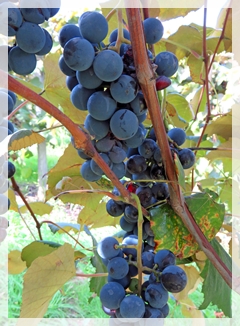
concord grapesWhat is the most important moment in your Sunday service? If your church follows a liturgy, perhaps it is the confession, absolution, or thanksgiving. Singing praise music, hearing an inspiring sermon or sharing in the Lord’s Supper may be the highlight of your worship. Reciting the Creed, saying the Lord’s Prayer, greeting one another, communal prayer—all are important parts of the day’s worship service but are they the most important part of it? I wonder if the holiest moment of our Sunday morning occurs when the service is over and we leave the sanctuary (or turn off the computer) and go into the world. When the service has concluded, instead of our obligation to God being over for the week, could it just be starting? Could the next six days and twenty-three hours be more critical than that hour or so we spent at church?

Our God is a God of sending—Jesus was sent to us and now He sends us into the world. When we stop for brunch at First Watch, make a purchase at Home Depot, or chat with people at the dog park, we are His workers sent into the fields to harvest. When we’re cut off in traffic, vie for a parking spot at the mall, our neighbor needs a favor, or customer service fails to serve, we remain His workers and Jesus is to be heard in our voices and seen in our actions.

When Jesus chose those seventy-two disciples to spread the word, He spoke of the lack of available workers. Here in the U.S., the Pew Research Center found that the number of adults identifying themselves as Christian was 65% of the population. Even though that percentage dropped from 78% in 2007, we’re still left with about 168 million potential workers. With an estimated 2.5 billion Christians worldwide, perhaps the problem isn’t a shortage of workers but rather a shortage of commitment to do God’s work. Fields ripe for harvest are everywhere we go—the office, grocery store, golf course, beach, hiking trail, yoga class, and post office. Are we willing to go where He sends us and do what He calls us to do? Granted, in this day and age of social distancing, working the harvest might look a little different than it did a year ago but, if we ask God for opportunities to be His witness, He will provide them.

If we had the cure for cancer, would we remain silent, only tell a select few, or shout it from the rooftop? As Christians, we have knowledge of something even more precious than cancer’s cure—we have the cure for death and it’s found in Jesus! Are we going to remain silent or will we spread the good news? This Sunday, when we’re released from church (or our on-line worship service), it’s not like being released from school for spring break or summer vacation. We may be dismissed from church but we are not dismissed from serving God. As a chosen people and a royal priesthood, the most important part of our week is just beginning.

But you are a “chosen race; a royal priesthood”; a holy nation; a people for God’s possession. Your purpose is to announce the virtuous deeds of the one who called you out of darkness into his amazing light. [1 Peter 2:9 (NTE)]

Jesus said to them again. “As the father has sent me, so I’m sending you.” [John 20:21 (NTE)]

Copyright ©2021 jsjdevotions. All rights reserved.

TAKE THE WEIGHT OFF! (Hebrews 12:1-2 – Part 2)

What about us, then? We have such a great cloud of witnesses all around us! What we must do is this: we must put aside each heavy weight, and the sin which gets in the way so easily. We must run the race that lies in front of us, and we must run it patiently. We must look ahead, to Jesus. He is the one who carved out the path for faith, and he’s the one who brought it to completion. [Romans 12:1-2 (NTE)]

When Alexander the Great’s army was advancing on Persia, his troops were so weighted down by the spoils of war they’d taken in earlier campaigns that they moved too slowly to be effective in combat. At one critical point, it seemed that defeat was inevitable. As much as the greedy Alexander desired the silver, gold, and other treasures they’d pillaged, he ordered that all the plunder be thrown into a heap, burned, and left behind. Although his troops complained bitterly, they did as directed. Once unencumbered by the excess weight of their treasure, his army saw the wisdom of Alexander’s command when their campaign turned from impending defeat to victory. “It was as if wings had been given to them—they walked lightly again,” said one historian.

While I’m not sure of the truth of this story, it makes an excellent illustration of what the writer of Hebrews means when he tells us to lay aside every weight that slows us down. He didn’t say “some” of the weight; using the word pas, he meant every bit of it—the whole enchilada! Using the word ogkos, which meant a bulk or bulging mass, he was referring to any hindrance, burden or impediment. While there’s a specific mention of sin, other things can weigh as down, as well: disappointment, grief, shame, fear, worry, and material possessions. Not every weight, however, is as obvious. The excess weight in our lives could be seemingly harmless distractions like constantly checking email or social media, surfing the Internet, Netflix, TikTok, YouTube, gaming, shopping, or even crafting.

How do we know what’s hindering us? If it isn’t helping; it’s hindering! For example, Walt Disney was ruthless when it came to cutting anything from a film that interfered with its pace. One animator worked for nearly eight months on a four-and-a-half minute sequence in Disney’s Snow White. In it, the dwarfs made soup for Snow White and nearly destroyed the kitchen in the process. Disney liked the scene but he cut it—not because it was bad but because, rather than adding to the narrative, it slowed it down. If it didn’t help move the story forward, Disney knew it hindered!

As we begin this new year, now is a good time to ask God (and ourselves) what might be hindering our progress. Along with the multitude of “bad” things we need to lay aside in order to make room for all the great things God has in store for us, this also is the time to ask if there might be some “good” things that should be eliminated, as well.

Runners in the ancient Olympics ran naked and, while I’m not advocating stripping down quite that much, they knew what it meant to rid themselves of any extra weight! Let us follow their example and run the race God sets before us as if we’re in it to win it!

It is a most lamentable thing to see how most people spend their time and their energy for trifles, while God is cast aside. He who is all seems to them as nothing, and that which is nothing seems to them as good as all. It is lamentable indeed, knowing that God has set mankind in such a race where heaven or hell is their certain end, that they should sit down and loiter, or run after the childish toys of the world, forgetting the prize they should run for. [Richard Baxter (Puritan theologian)]

Don’t you know that when people run on the race-track everybody runs, but only one person gets the prize? Run in such a way that you’ll win it. Everyone who goes in for athletics exercises self-discipline in everything. They do it to gain a crown that perishes; we do it for an imperishable one. [1 Corinthians 9:24-25 (NTE)]

Copyright ©2021 jsjdevotions. All rights reserved.

THE RACE (Hebrews 12:1-2 – Part 1)

Therefore, since we are surrounded by such a huge crowd of witnesses to the life of faith, let us strip off every weight that slows us down, especially the sin that so easily trips us up. And let us run with endurance the race God has set before us. We do this by keeping our eyes on Jesus, the champion who initiates and perfects our faith. Because of the joy awaiting him, he endured the cross, disregarding its shame. Now he is seated in the place of honor beside God’s throne. [Hebrews 12:1-2 (NLT)]

peonyIn a recent Pearls Before Swine comic (drawn by Stephen Pastis), Rat asked Pig if he would be getting out of bed that day. Replying no, the sweet little swine explained, “I fear the big bad world and want no part of it.” When Rat told him he couldn’t stay in bed forever, Pig disagreed. “I have a bed, a bathroom, and a food delivery app that I’ve asked to just throw my food through the window.” In the next frame, we see Rat snug in bed with his friend and asking to borrow a pillow. I understand. There certainly are days in this crazy world of ours that we’d all prefer to just snuggle under the covers and never have to get up to face the challenges of the day, especially if DoorDash would deliver bedside. That, however, is not an option.

In Hebrews 12, the writer compares the Christian life to a footrace. Agōna is the Greek word used for race and means contest or struggle. If the word looks familiar, it’s because agōna is the source of our English word agony, meaning torment, intense mental or physical suffering (and even torture). Our race is not meant to be a life spent safe in bed. Rather than a fifty-yard dash, the Christian’s life is more like one of those mud obstacle races in which people roll in muddy pits, wade through ice water, haul heavy sand bags, leap over fire, climb ropes and nets, scale giant walls, and army-crawl under barbed wire. There’s going to be some agony!

Unlike Pig and Rat, we don’t have to drop out of the race because we think it’s too challenging. We know that perseverance in trouble is doable because of the great cloud of witnesses who actually did it: people like Abraham, Joseph, Moses, and David. None of them knew when their severe trials would be over and yet they continued their journeys in faith.

It’s not just in Scripture that we find these witnesses. Serving in India for 41 years without ever taking a furlough, missionary William Carey preached for seven years before he baptized his first Hindu convert. Then, after laboring twenty years translating Scripture into several Indian languages, all of his work went up in flames when a fire tore through his printing plant and warehouse. Yet, Carey faithfully endured as did Corrie ten Boom, who lived through the hell of a Nazi concentration camp but survived to tell her story of unfaltering faith and hope in God. In spite of being a quadriplegic for over 53 years and enduring chronic pain and two bouts of cancer, evangelist, author, and advocate Joni Eareckson Tada continues to run God’s race (only from a wheelchair). The many months of a pandemic, political unrest, and financial challenges seem like a walk in the park compared to what others have undergone before us.

Lord, as this new year begins, guide us so that we look not to the long course or rough track, not to our own strength or to the strength of the enemy, but to only to you and the examples of those who faithfully ran or continue to run the race you set before them. Rather than listening to the discouraging voices of the world around us, let us hear your voice of encouragement and hope. Give us strength to endure the race you’ve given us and the vision to see past our struggles.

 If you look at the world, you’ll be distressed. If you look within, you’ll be depressed. But if you look at Christ, you’ll be at rest. [Corrie ten Boom]

Dear brothers and sisters, when troubles of any kind come your way, consider it an opportunity for great joy. For you know that when your faith is tested, your endurance has a chance to grow. So let it grow, for when your endurance is fully developed, you will be perfect and complete, needing nothing. … God blesses those who patiently endure testing and temptation. Afterward they will receive the crown of life that God has promised to those who love him. [James 1:2-4,12 (NLT)]

Copyright ©2021 jsjdevotions. All rights reserved.

THE SONG OF MOSES

I will sing to the Lord, for he has triumphed gloriously; he has hurled both horse and rider into the sea. The Lord is my strength and my song; he has given me victory. This is my God, and I will praise him—my father’s God, and I will exalt him! The Lord is a warrior; Yahweh is his name! [Exodus 15:1-3 (NLT)]

Capitol Reef - UtahFollowing the Israelites’ successful passage through the Red Sea and the destruction of Pharaoh’s army, we find Moses and the people singing a song of deliverance and praise in Exodus 15. This beautiful and powerful psalm vividly describes the warrior God Yahweh hurling Pharaoh’s chariots and army into the sea. This is Moses’ song but he doesn’t figure in the account at all. A paean to the supremacy and unrivaled power of Jehovah, all of the glory is given to God.

This psalm, however, doesn’t stop at Israel’s rescue from Egypt; looking ahead, it warns God’s enemies with its prediction of Israel’s successful entrance into the Promised Land. This is a victory song of both past and future divine deliverance with its promise that the Canaanites would “melt away” as terror and fear fell on them. Following this song, Miriam led the women as they danced and sang of God’s triumph. The confident words of their songs were quickly forgotten when, several months later, the fearful people, ignoring God’s promise of victory, rebelled and refused to enter the Promised Land. Walking through the sea on dry ground, witnessing the destruction of Pharaoh’s army, and having sung of God’s power and promised victory in Canaan were but a distant memory.

This psalm may be the oldest recorded song in history. With its expression of faith in God and recognition of Him as both protector and warrior, it could be considered the founding song of Israel. Jews know it as the Song at the Sea or Shirat Hayam. Recited every day at morning prayers, it has become a focal point of Jewish tradition and liturgy.

Many Christians know this psalm as the Song of Moses. It’s found in Roman Catholic, Eastern Orthodox, and other Christian liturgies at the Easter vigil when the history of salvation is recounted. Just as the exodus story defines Israel’s history, it also defines ours. Like the Israelites, we have been redeemed from slavery, not to Egypt, but to sin. Like the Israelites, we passed through the water, not of the Red Sea, but the water of baptism. Like the Israelites we have a redeemer who redeemed us in the past and will give us victory in the future. For both Jews and Christians, it is a song sung by people redeemed from slavery to the redeemer about their redemption. The difference is that the Jews are still awaiting the Messiah while we know that He has come!

The Song of Moses is the first song in the Bible and we find reference to it in the last song found in Revelation 15. Moses’ song was sung at the Red Sea and this one is sung in heaven at what appears to be a crystal sea. The first one, the song of Moses, celebrates God’s deliverance of His people from Egypt; the second one, the Song of the Lamb, celebrates God’s deliverance of His people from sin.

And they were singing the song of Moses, the servant of God, and the song of the Lamb: “Great and marvelous are your works, O Lord God, the Almighty. Just and true are your ways, O King of the nations. Who will not fear you, Lord, and glorify your name? For you alone are holy. All nations will come and worship before you, for your righteous deeds have been revealed.” [Revelation 15:3-4 (NLT)]

Copyright ©2021 jsjdevotions. All rights reserved.

IT’S CONTAGIOUS

With his great power the Lord warned me not to follow the road which the people were following. He said, “Do not join in the schemes of the people and do not be afraid of the things that they fear.” [Isaiah 8:11-12 (GNT)]

great blue heronKnowing that God’s people must be fully committed to their cause in battle, Deuteronomy 20 provided several exemptions from combat. An anxious man wouldn’t have his mind on battle and could make blunders that might endanger the entire army. Because men too preoccupied with concerns at home wouldn’t fight wholeheartedly, those who were engaged to be married, had built a house and not yet dedicated it, or planted a vineyard and not harvested it were released from service.  Moreover, anyone who admitted to being afraid was also sent home. This was done to keep their negativity and fear from infecting the entire army’s morale. A small army of faithful men was better than a large army of worried, frightened or fainthearted ones.

While the anxious and fearful soldiers were sent home, it’s not so easy to avoid those kinds of people in our daily lives. We all know people who seem to carry a dark cloud of pessimism over their heads. It doesn’t just rain on their parade—negativity pours down on everyone else’s, as well.

Several years ago, a friend’s husband had a slight cough. By the time she was done fretting about it to family and friends, she was sure it was bronchitis which would lead to pneumonia which would mean hospitalization. This led another family member to be sure the man’s death was imminent and funeral plans needed to be made. The wife’s negativity and fear were far more contagious than the man’s cough which, incidentally, never turned into bronchitis and is now long forgotten.

I’m not Pollyanna and I know that some coughs do lead to pneumonia, not all biopsies come out benign, bad things happen to good people, not everyone recovers from COVID, and not every story has a happy ending. That, however, doesn’t mean I have to put up my umbrella at the first cloud or focus on the storm rather than pray for a rainbow! Whether my glass is half empty or half full, I know that God will make sure I have all that I need in it.

The Old Testament advice is simple: stay away from the faint-hearted, pessimistic and fearful lest they infect you with their lack of faith. While we can be protected from measles, chicken pox, pneumonia, and even coronavirus, there’s no vaccine for panic, negativity or anxiety and they’re far more contagious than any virus! When dealing with a communicable disease, medical experts advise us to wear a mask, wash our hands, keep our distance, avoid crowds, and get vaccinated. Pessimism and fear are as infectious as COVID and, since there’s no vaccination for them, we can avoid exposure by washing our hands of doom scrolling, socially distancing ourselves from the “Debbie Downers“ of life, and avoiding groups of grumblers and faultfinders. Rather than being infected by pessimism, complaint or anger, let us prevent contagion by trusting in the Lord and choosing faith over fear and gratitude over grievance.

Fear is catching. He whose heart fails him makes his brethren’s heart to fail, like his heart. [Matthew Henry]

In conclusion, my friends, fill your minds with those things that are good and that deserve praise: things that are true, noble, right, pure, lovely, and honorable. Put into practice what you learned and received from me, both from my words and from my actions. And the God who gives us peace will be with you. [Philippians 4:8-9 (GNT)]

Do not use harmful words, but only helpful words, the kind that build up and provide what is needed, so that what you say will do good to those who hear you. [Ephesians 4:29 (GNT)]

Copyright ©2021 jsjdevotions. All rights reserved.

THE BACK BURNER

For everything there is a season, a time for every activity under heaven. … Yet God has made everything beautiful for its own time. He has planted eternity in the human heart, but even so, people cannot see the whole scope of God’s work from beginning to end. [Ecclesiastes 3:1,11 (NLT)]

red-bellied turtleWhen we spent winters in the mountains, our early morning walk took us by a gourmet restaurant. Occasionally, we’d get a whiff of a delectable mouth-watering aroma as we passed. What we smelled was a large pot of roasted beef and veal bones that had simmered on the back burner overnight. In this day and age of microwaves, Instant Pots, mixes and prepared foods, it’s difficult to understand a chef simmering stock for over 12 hours to concentrate it into a rich demi-glace. That, however, is how the restaurant’s chef gets the flavorful base she uses in her delicious sauces.

Sometimes prayer is like making stir-fry: put the ingredients in a hot wok, stir, and get quick results. Other times, prayer is more like making a demi-glace. We put it all together and then let it do a slow simmer on the back burner with just an occasional check to skim off the fat or impurities. Back-burner prayers are those far-reaching ones that take a long time coming, like the restoration of a ruptured relationship, the salvation of a child, a loved one’s sobriety, or a prodigal’s return.

When we put our prayers at a low simmer on the back burner, we trust God to do the work. As tempted as we are to fret, panic, meddle or intervene, God really doesn’t need us to keeping lifting the lid, stirring the pot, or adding ingredients. In fact, if we were making a demi-glace, our stirring would just slow things down by making the stock cloudy and greasy. The same thing usually happens when we try to do God’s job for Him!

I think of Sarah. Rather than leaving God’s promise of a child to simmer on the back burner until the time was right, she decided to stir the pot by giving Hagar to Abraham. Her interference didn’t turn out well for anyone! On the other hand, David, who’d been a teen when anointed king by Samuel, spent at least fifteen years waiting for the crown. Twice during that time he passed up the opportunity to speed things along by killing King Saul. Instead, he chose to trust in God’s timing saying, ”Surely the Lord will strike Saul down someday, or he will die of old age or in battle.” [2 Samuel 26:10]

God answers our prayers the moment we speak them; it’s just that we don’t immediately know His answer. It could be “Yes!” or, if what we asked isn’t in His will, “No!” After all, God might have something better in store for us! Sometimes, however, God’s answer is, “Not right now!” Those prayers go on the back burner to simmer until God’s time is right (or He tells us, “No!”)

Putting prayers on the back burner doesn’t mean we stop praying them any more than putting that stock pot on the back burner means the chef turned off the stove or forgot about it. It simply means that we have given our prayer over to the fullness of God’s time.

Persistent praying never faints or grows weary. It is never discouraged. It never yields to cowardice. It is motivated and sustained by a hope that knows no despair, and a faith that will not let go. Persistent praying has patience to wait and strength to continue. It never prepares itself to quit praying, and it refuses to get up from its knees until an answer is received. [E. M. Bounds]

Now all glory to God, who is able, through his mighty power at work within us, to accomplish infinitely more than we might ask or think. [Ephesians 3:20 (NLT)]

Copyright ©2021 jsjdevotions. All rights reserved.