FILL THE TANK

Hungry and thirsty, they nearly died. “Lord, help!” they cried in their trouble, and he rescued them from their distress. … Let them praise the Lord for his great love and for the wonderful things he has done for them. For he satisfies the thirsty and fills the hungry with good things. [Psalm 107:5-6,8-9 (NLT)]
Trumbull cemetery - OhioMy father had what’s often described as a Type-A personality. An impatient workaholic, he always took on more than he could handle. Life, for him, was one crucial task after another, none of which anyone else could do, at least not correctly. Always in a hurry, he never wanted to stop for anything, even when his gas gauge read precariously close to empty. Something more pressing always took precedence over a brief stop for gas. As a result, his car was often left on the roadside while he trudged off with a gas can to find the nearest service station. Instead of saving time, his refusal to stop cost him time. Living that way actually cost him his life; he died of a massive coronary at the age of fifty-six. It’s often been said that your in-box still will be full when you die and, indeed, his was. None of us can accomplish everything on our to-do list and we may well destroy both our relationships and ourselves while trying.

Unlike my father, most of us will stop at a gas station when our cars need fuel. Having spent hours stranded on country roads waiting for my father to return with a can of gasoline, my gas tank is never less than half full. But, like my father, I’m not always so careful about keeping my spiritual tank full. No matter how organized I try to be, my to-do list seems to get longer while the days remaining get shorter. Sometimes, I feel like I’m just running on fumes and I don’t think I’m the only one!

Unfortunately, just as my father ignored his gas gauge, we often ignore signs like anger, worry, sadness, impatience, and temper that tell us our supply of spiritual fruit is dangerously low. It often takes a squabble, blow-up or crisis before we finally stop and refuel with God. Of course, the wiser choice is to top off our tanks with daily prayer and meditation so we never run low!

When asked about his plans for the following day, it’s been said that theologian, professor, author, Bible translator, reformer, pastor, husband and father Martin Luther replied: “Work, work from early until late. In fact, I have so much to do that I shall spend the first three hours in prayer.” If we’re too busy to stop for gas, we’re busier than we should be. Martin Luther knew that, if we’re too busy to pray, we’re busier than God wants us to be.

Heavenly Father, sometimes we allow the challenges of everyday life to keep us from spending time with you and we run precariously low of the love, joy, peace, patience, kindness, goodness, faithfulness, gentleness, and self-control your Spirit so graciously provides. Help us accept that we can’t do it all and that there will always be another task waiting right around the corner. Guide our priorities, Lord so that you’re on the top of our to-do list every day. Remind us that you are all we really need and help us see a brighter tomorrow in your promises. Lead us to that peaceful place of your presence. Refresh and renew us and let your Holy Spirit fill us up again.

No one ever said at the end of his days, “I have read my Bible too much, I have thought of God too much, I have prayed too much, I have been too careful with my soul. [J.C. Ryle]

The Lord is my shepherd; I have all that I need. He lets me rest in green meadows; he leads me beside peaceful streams. He renews my strength. He guides me along right paths, bringing honor to his name. [Psalm 23:1-3 (NLT)]

I pray that God, the source of hope, will fill you completely with joy and peace because you trust in him. Then you will overflow with confident hope through the power of the Holy Spirit. [Romans 15:13 (NLT)]

Copyright ©2021 jsjdevotions. All rights reserved.

JOB’S LAMENT (Part 2)

My God, my God, why hast thou forsaken me? Why art thou so far from helping me, from the words of my groaning? O my God, I cry by day, but thou dost not answer; and by night, but find no rest. [Psalm 22:1-2 (RSV)]

taos NMYesterday, I wrote about Job’s lamentation. 19th century bible scholar George Granville Bradley said this about Job 3: “Where in the world will you find a sadder strain of more hopeless, uncontrolled, and unbroken lamentation and mourning? … Filled to the brim, they run over with pain.” I have to agree.

Nevertheless, as sad as that chapter is, there is beauty in its words. Job’s anguished speech lets us know that it’s okay to express our emotions. It tells us that God doesn’t expect us to stoically maintain silence in the face of tragedy and pain. Job’s words, like those in the many psalms of lament, are the anguished cries of a faithful believer—someone who can uninhibitedly express his pain and grief to God.

Job’s lament, however, is not a laundry list of grievances. He’s not complaining about his sudden poverty, that no one will carry on his name, his loss of status, or going into gory detail about his physical maladies and grumbling that scraping his skin with potsherds brings no relief. Rather than an account of his misery, grief, and misfortune, his is simply a cry to escape his suffering. When God finally speaks to Job, He doesn’t take the man to task for his honesty in pouring out his deepest emotions; it is for accusing God of acting unjustly and questioning His wisdom.

Faith in God and despair in our situation are not incompatible. Out of the 150 psalms, one third are considered psalms of lament. Considered a man after God’s heart, David is credited with writing 73 psalms and many of those are laments. Clearly, ours is a God who allows us to be brutally honest with Him as we voice our anger, distress, fear, anguish, frustration, doubt, shame, heartache, and disappointment.

For some unknown reason, David felt that God has abandoned him in Psalm 22 and he echoed Job’s question of “why?” These same words were repeated by Jesus as He hung on the cross and, in His torment, cried out, “Eloi, Eloi, lema sabachthani?” Jesus was sinless, which means His anguished words were not sinful; feeling God is absent is not the same as believing it. Like Job and David, Jesus was calling out to God in His misery but their words of lament didn’t mean they’d lost faith in God. They wouldn’t have called out to God in their despair had they not believed their words would reach God’s ears!

As happened with Job, one moment it can seem like God is smiling down at our lives when, suddenly, life goes down the tubes and it seems like God has turned His back on us. Feeling abandoned and alone in our suffering and sorrow, we must never be afraid to express our heartfelt emotions to the God who created us with the ability to have those very emotions! Dark and silent brooding turns us inward and away from God while expressing our shock, grief, and despair turns us outward toward Him!

Let us never be hesitant to approach the Lord in our tears and despondency. A child instinctively calls out to a parent when he’s hurting, sick, frightened, or lost; we should be no different. Rather than a denial of our Father in Heaven, a lament directed toward Him is both a plea for help and an affirmation of His presence and power.

Cast your burden on the Lord, and he will sustain you; he will never permit the righteous to be moved. [Psalm 55:22 (RSV)]

Humble yourselves therefore under the mighty hand of God, that in due time he may exalt you. Cast all your anxieties on him, for he cares about you. [1 Peter:5:6-7 (RSV)]

Copyright ©2021 jsjdevotions. All rights reserved.

CURSE THE DAY! (Part 1)

Curse that day for failing to shut my mother’s womb, for letting me be born to see all this trouble. Why wasn’t I born dead? Why didn’t I die as I came from the womb? [Job 3:10-11 (NLT)]

baby feetAfter Satan took Job’s loved ones and wealth, the grieving man remained a pillar of patience and faith. Rather than blaming God, the stoic man acknowledged God’s sovereign authority saying, “The Lord gave me what I had, and the Lord has taken it away. Praise the name of the Lord!” [1:21]
Things took a turn for the worse when Satan attacked Job’s body. With boils from head to foot, Job’s body was covered with scabs, pus oozed from his sores, his skin was black and peeling, and maggots fed on him. As if that weren’t enough, the man suffered from insomnia, nightmares, fever, and pain in his bones. His symptoms sound as horrific and deadly as Ebola Hemorrhagic Fever.

When Job’s wife told him to curse God and die, the faithful man responded, “Should we accept only good things from the hand of God and never anything bad?” [2:10] Although he seemed resigned to his fate, the despondent Job came dangerously close to falling into Satan’s trap when, in Job 3, he questioned God’s wisdom in giving him life.

I can understand someone like Job, someone suffering terribly who sees no end to the misery, wishing for a quick end to his life and praying for the release offered by death. What I find difficult to understand is Job’s wish that he’d never been born. Cursing the day of his birth and the night of his conception, the despairing man literally wished his life erased from its existence.

Until Satan’s attack, Job’s life appears to have been picture perfect for decades. With his many servants and more than 10,000 head of livestock, he was the richest man around. The father of seven sons and three daughters, he probably had numerous grandchildren. The family regularly gathered together for long feasts so they must have enjoyed each other’s company. A prominent man, well-respected in the community, Job was principled, generous and charitable. In spite of having everything his heart desired, Job’s heart remained set on God and the Lord called him, “the finest man on earth…blameless…a man of complete integrity.” [1:8] Yet, by cursing his very existence, Job wanted to obliterate all the blessings and joy that existed between his birth and his affliction.

In his pain, Job forgot about growing up in a loving home, playing with his brothers and sisters, the bliss of young love, the wonder of touching his wife’s belly and feeling his unborn child move, the delight of holding his children in his arms, the laughter of his family, the satisfaction that came from being able to right a wrong or help the poor, and the joy of bouncing a grandchild on his knee. If he’d never been born, he would have missed sunrises and sunsets, the taste of grapes, the sound of birds’ songs, the pleasure of a kiss, and the joy of praising the Lord. Although Job began his story as a sterling example of accepting of God’s will when disaster strikes, cracks developed in his spirit as his suffering intensified.

Job’s outburst of despair, however, does not mean that Satan won. While Job cursed his day of birth, he never cursed God. Moreover, even though he wondered why people who longed for death continued to live, Job never considered suicide. Because he operated on a false retribution theology, Job believed that God had forsaken him. Rather than losing faith in God, he lost faith in himself.

For many of us, these last several months have challenged our physical, emotional, spiritual, and financial resources and, like Job, we may feel overwhelmed by all that has beset us. Job lost perspective; let us not do the same. God did not forsake Job and He has not forsaken you! We must never forget our past blessings or rue the day of our birth. After all, had we never been given life, we wouldn’t have had the opportunity to know Jesus, be born again, or enjoy eternal life!

For God has said, “I will never fail you. I will never abandon you.” So we can say with confidence, “The Lord is my helper, so I will have no fear. What can mere people do to me?” [Hebrews 13:5-6 (NLT)]

Why am I discouraged? Why is my heart so sad? I will put my hope in God! I will praise him again—my Savior and my God! [Psalm 43:5 (NLT)]

Copyright ©2021 jsjdevotions. All rights reserved.

FOLLOWING HIM

Then, calling the crowd to join his disciples, he said, “If any of you wants to be my follower, you must give up your own way, take up your cross, and follow me.” [Mark 8:34 (NLT)]

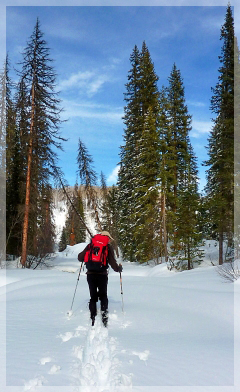
cross country skiingOur pastor recently did a sermon series called “Following Jesus” which reminded me of our first time backcountry skiing in Colorado more than forty years ago. As novices, we knew enough not to venture into the wilderness by ourselves so we hired Wyatt to be our guide. Insisting we delay our trek several days until we’d acclimated to the high altitude and were ready for such a trip, he gave us a long list of items we had to carry in our packs. When I asked why we needed all the survival gear along with additional food, water, and clothing, he said we had to be prepared to spend the night. Protesting that I didn’t want to spend the night out in the cold and snow, he explained, “Neither do I, but we better be prepared to do it.”

Before starting out, Wyatt examined our backpacks to make sure we had everything on his list. Our packs were heavy but his was much heavier with a tent, extra ski tips, ax, first aid kit, shovel, and more. Because falling in several feet of Colorado powder is far different than falling in a few inches of Midwest snow, Wyatt insisted on teaching us a new way of getting up after a fall and made us practice the technique several times before we began.

Once we got started, Wyatt did the hard part by breaking trail in the deep snow and keeping us clear of any slopes posing avalanche danger. To allow us to fully experience the wilderness, we waited until the skier ahead was just out of sight before starting out. Winding our way through both open meadows and woods in this great expanse of white, we would have been hopelessly lost if we hadn’t been following Wyatt’s tracks. Without seeing each other, I felt alone in the wilderness but I never was. Wyatt frequently stopped to check on us and made us rest and hydrate before continuing. We followed his tracks to a picturesque spot for lunch where he showed us how to stomp out a place for a fire and use our skis as chairs. As pleasant as our lunch in the forest was, Wyatt didn’t let us linger too long since he wanted us back to our car before dusk.

Late that afternoon, some tired but happy skiers made their way back toward the road. Just as we caught sight of our car, a winter storm blew in and, by the time we’d stowed our gear, our tracks were completely covered by snow. Caught in that unexpected whiteout, I finally understood why Wyatt had insisted we be prepared to spend the night in the mountains. Had we started out a half hour later, lingered over lunch, or skied back a little slower, we would have been caught in the blinding storm and might well have spent the night on the mountain. Without his guidance, what should have been a delightful day up on the pass could have had a bad ending but, because we followed a good guide, we returned safely home that night.

Even though Wyatt merely guided us on a high mountain pass and Jesus guides us through life, I can’t help but see parallels between following a mountain guide and following Jesus. In either case, we must recognize our inability to make the journey on our own and submit to the guide’s directions, requirements, and timeline. Both prepare us for the challenges ahead, point out hazards, teach us new skills, and never take us beyond our ability. Knowing we’ll fall, they show us how to get up again and, while we may carry a heavy pack, they carry the heaviest one and do most of the work. Keeping us from danger, both mountain guide and Jesus lead the way so we can follow in their footsteps. Even when we feel alone and can’t see them, we can have faith in both guide and Jesus, secure in the knowledge that neither will ever abandon us. Although they’ll make us rest, they’ll urge us on when we should get moving. Most important, just as our choice to follow Wyatt meant the difference between a good or bad outcome, our choice to follow Jesus means the difference between life and death.

There are, of course, some major differences between a mountain guide and Jesus. Even a guide as experienced as Wyatt can get lost but Jesus never will! To Wyatt, we were just paying customers but, to Jesus, we are beloved friends and children of God! Jesus wants us to follow Him, weather every storm, and arrive safely home not because it’s His job, but because He loves us! Through the years, we took several more backcountry tours until we learned enough to venture into the wilderness without a guide but we know that we’ll never be skilled enough to journey through life without following Jesus!

Hang this question up in your homes – “What would Jesus do?” and then think of another – “How would Jesus do it?” For what Jesus would do, and how He would do it, may always stand as the best guide to us. [Charles Spurgeon]

The Lord says, “I will guide you along the best pathway for your life. I will advise you and watch over you. [Psalm 32:8 (NLT)]

Show me the right path, O Lord; point out the road for me to follow. Lead me by your truth and teach me, for you are the God who saves me. All day long I put my hope in you. [Psalm 25:4-5 (NLT)]

Copyright ©2021 jsjdevotions. All rights reserved.

PREFECT TIMING

God makes everything happen at the right time. Yet none of us can ever fully understand all he has done, and he puts questions in our minds about the past and the future. [Ecclesiastes 3:11 (CEV)]

Big Cypress Fox SquirrelSaturday mornings we usually walk through a nearby park that is home to a unique subspecies of squirrel found here in southwest Florida: the Big Cypress fox squirrel (or BCFS for short). Larger than a common gray squirrel, the BCFS has a black head and back, buff sides and belly, white ears and nose, and a long bushy tail.

We’re always on the lookout for these black-masked critters, but they are cautious and secretive and it had been two years since spotting one. Thinking the endangered rodent no longer inhabits the park, I’d given up hope of seeing one again. Recently, while trying to focus my camera on some holly berries, the shaking branches above them caused me to look up. A large BCFS was staring down at me and even stayed long enough for a photo! Our brief encounter was exactly what I needed to lift my spirits after several discouraging weeks. As I thanked God for the “Aha!” moment, I pondered how God’s timing is both unpredictable and perfect.

I’m not sure David thought God’s timing perfect while spending fifteen years on the run hiding from Saul and his army and I suppose the Israelites questioned God’s timing as they waited 400 years in Egypt and 40 more in the desert before entering the land promised to them. Joseph may have questioned God’s timing during the years he spent as a slave in prison before becoming Pharaoh’s second in command. Sarah and Abraham waited twenty-five years between God’s promise of a son and Isaac’s birth and, after waiting decades, Zechariah and Elizabeth had given up any hope of a child when she became pregnant with John. I look at my prayer list and see that God often seems painfully slow. Nevertheless, the squirrel’s unexpected appearance reminded me that God is present whether or not we see Him. Rather than losing hope, we must trust in His perfect timing.

Rather than providing photo ops, the squirrels’ lives revolve around berries, seeds, nuts, one another, and avoiding predators. They’ve been in the park all the time but, because my timing isn’t perfect, I missed seeing them. God’s timing, however, always is perfect. Like the squirrels, His purpose is not to satisfy or entertain us. God wants to teach us to trust Him as we grow more like Christ. While we may not always understand or appreciate His timing, the appearance of that BCFS was a reminder that faith in God means faith in His presence, plan, and timetable.

If the Lord Jehovah makes us wait, let us do so with our whole hearts; for blessed are all they that wait for Him. He is worth waiting for. The waiting itself is beneficial to us: it tries faith, exercises patience, trains submission, and endears the blessing when it comes. The Lord’s people have always been a waiting people. [Charles Spurgeon]

The Lord says: “My thoughts and my ways are not like yours. Just as the heavens are higher than the earth, my thoughts and my ways are higher than yours. [Isaiah 55:8-9 (CEV)] 

Dear friends, don’t forget that for the Lord one day is the same as a thousand years, and a thousand years is the same as one day. [2 Peter 3:8 (CEV)]

Copyright ©2021 jsjdevotions. All rights reserved.

EXPECT TROUBLE

alligator - CREWThen Jesus, full of the Holy Spirit, returned from the Jordan River. He was led by the Spirit in the wilderness, where he was tempted by the devil for forty days. [Luke 4:1-2a (NLT)]

We must not count temptation a strange thing. “The disciple is not greater than his master, nor the servant than his lord.” If Satan came to Christ, he will also come to Christians. [J.C. Ryle]

One of my favorite trails is an old tram road through a maple-cypress swamp. After a short walk on a crushed shell path and a boardwalk, we come to a slightly raised grassy trail originally used for logging. It is on this narrow path, with water on both sides of it, that we frequently encounter an alligator sunning himself on the trail! Since it’s a swamp, we should expect gators, snakes, raccoons, otters, and birds but seeing an alligator directly in our path is disconcerting. More alarming, however, was when I stepped out of the car at another park and found an alligator sunning himself just a few feet away from my feet! A gator in the swamp should be expected but one in the picnic area is an unpleasant surprise (as are the alligators that occasionally move into the lake by our home or rest amid the flowers at the botanic garden).

Following his baptism, Jesus was led by the Holy Spirit into the wilderness. Had He been led to a pagan temple or the 1st century equivalent of a bar or gentleman’s club, Satan’s presence could be expected but you’d think the wilderness would be a temptation-free zone. Perhaps that’s why the Spirit specifically led Him there to be tempted—it’s a vivid reminder that we don’t have to be where we don’t belong or doing what we shouldn’t be doing to have Satan come looking for us. Going where the Spirit leads is no guarantee that Satan won’t try to follow. Like alligators, he’s no respecter of boundaries and will show up where least expected.

In various mythologies, evil supernatural beings like vampires can’t enter your house unless they’re invited inside. Make no mistake about it, Satan doesn’t wait for an invitation and he’ll show up when and where we least expect him. Eve didn’t ask that serpent into the garden nor did the naïve woman expect the evil one to lie. But, he lied to her, he lied to Jesus, and he’ll lie to us.

Here in Florida, we don’t have to be walking in a swamp to encounter danger; wherever there’s brackish or fresh water, alligators should be expected. Whether or not we see them, they’re there. The same can be said for Satan—he’s lurking somewhere near and we don’t have to be in the equivalent of a swamp. Satan and alligators are opportunistic and both will quickly lunge at prey should the opportunity arise. The gator’s preferred method of hunting, however, is to patiently stalk his prey, silently sneak up, and then attack. Satan works much the same way. We must walk cautiously whether in a swamp or a garden because no place is truly safe. When we happen upon a gator, we keep our distance, turn around, and go the other way. When we encounter Satan, with the power of the Holy Spirit, like Jesus, we’ll stand our ground, rest on the Word of God, and send him packing.

As the most dangerous winds may enter at little openings, so the devil never enters more dangerously than by little unobserved incidents, which seem to be nothing, yet insensibly open the heart to great temptations. [John Wesley]

When the devil had finished tempting Jesus, he left him until the next opportunity came. [Luke 4:13 (NLT)]

There he told them, “Pray that you will not give in to temptation.” [Luke 22:40 (NLT)]

Copyright ©2021 jsjdevotions. All rights reserved.