
Jesus answered, “You say that I am a king. For this I was born, and for this I have come into the world, to bear witness to the truth. Every one who is of the truth hears my voice.” Pilate said to him, “What is truth?” [John 18:37-38b (RSV)]
In the movie A Few Good Men, while being questioned in court, Colonel Jessep asks, “You want answers?” When Lt. Kaffee answers, “I want the truth!” Jessep responds, “You can’t handle the truth.” What eventually follows, while revealing the facts, is really just the colonel’s version of the truth. So, what exactly is truth?
The question of truth has fascinated philosophers for centuries. We know that truth isn’t falsehood or lies but defining it is harder, especially since some people believe truth can be subjective: truth is what things seem to be, involves preference and opinion, can be arrived at by consensus, or that no ultimate standards exist. We’ve all heard of alternative facts and know that even the most accurate statistics can be manipulated, massaged, and misstated to say just about anything. Tyler Vigen illustrated that by finding correlations between totally unrelated things such as a 99.26% correlation between the divorce rate in Maine and the per capita consumption of margarine and a 98.51% correlation between total arcade revenue and the number of computer science doctorates awarded each year in the U.S.
Truth in Scripture, however, is absolute. Pastor John MacArthur explains that, “Truth is that which is consistent with the mind, will, character, glory, and being of God….Truth is the self-expression of God.” Since truth is related to the character of God, something eternal and unchanging, the nature of truth is fixed. It has no expiration date and, unlike a computer program, it’s not up for revision, correction or updating. Author Josh McDowell defines truth as, “That which is true at all times in all places for all people.”
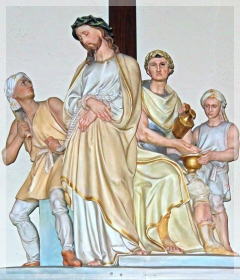
Pilate asked Jesus, “What is truth?” Wouldn’t you love to have heard His answer to this profound question? Pilate, however, never waited for an answer because his was just a rhetorical question. Pilate didn’t care about the truth once he knew Jesus hadn’t incited rebellion against Rome. Wanting to do the expedient thing, he went back outside to tell the people that Jesus wasn’t guilty of a crime. Thinking the crowd that had welcomed Jesus’ arrival less than a week earlier would call for His release, the governor offered to free Him. Pilate ended up trading the life of the man he’d already found innocent for that of Barabbas, an insurrectionist and murderer! The truth was swapped for a lie!
In Latin, Pilate’s question would have been, “Quid est veritas?” Samuel Johnson, one of the greatest literary figures of the 18th century, made an anagram of Pilate’s question and came up with the answer: “Est vir qui adest,” meaning, “It is the man before you!” Indeed, truth stood right in front of Pilate and he never recognized it.
Perhaps, instead of asking Jesus what truth was, Pilate would have been better served to have asked Jesus who truth was!
 If we are unfaithful, he remains faithful, for he cannot deny who he is. [2 Timothy 2:13 (NLT)]
 “You have to drill through mud and water to get oil; you have to sift through sand and silt to get gold; you have to chop and hack through stone to get diamonds. So why do so many people feel that the treasure of ideas should come to them with little or no effort?” asked Sydney J. Harris. Even though he wasn’t referring to the Bible, the journalist’s words made me think of the way we often approach Scripture; complaining that it’s too hard to understand, we simply don’t study it!
 The wages paid by sin, you see, are death; but God’s free gift is the life of the age to come, in the Messiah, Jesus our Lord. [Romans 6:23 (NTE)]
 Devotions of the Heart