
The kingdom of heaven may be compared to a man who sowed good seed in his field, but while his men were sleeping, his enemy came and sowed weeds among the wheat and went away. So when the plants came up and bore grain, then the weeds appeared also. And the servants of the master of the house came and said to him, “Master, did you not sow good seed in your field? How then does it have weeds?” He said to them, “An enemy has done this.” [Matthew 13:24-28 (ESV)]
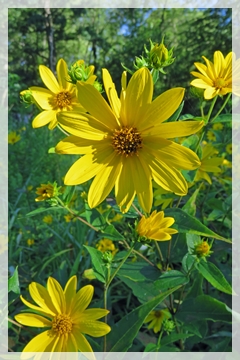 While we usually reap what we sow, we also can receive unexpected and undeserved harvests! When we lived in the north, courtesy of God and nature, wildflower seeds took root in the field next to our house and Spiderwort, Sunflowers, Dame’s Rocket, and Wild Bergamot grew there without any effort on my part. Although I hadn’t sowed them, I never protested those beautiful wildflowers; I just thanked God for them. None of us are likely to complain to God about the many undeserved blessings He regularly bestows on us!
While we certainly don’t object when we get a harvest of blossoms, we’re sure to protest when we receive an unexpected (and seemingly undeserved) harvest of life’s thistles. Like the farmer who sowed high-quality seeds only to discover weeds growing in his field, we were distressed the year we discovered our beautiful field of wildflowers had been invaded by thistles. Although we hadn’t planted the invasive weeds, the unwelcome thistles were there!
Shortly before his eviction from Eden, Adam was told that the ground would yield thistles and thorns along with grain. That warning was both literal and figurative. Satan will spread his seeds wherever and whenever the opportunity arises and the enemy’s seeds of evil can invade people’s lives no matter how many good seeds they’ve sown. We can sow the seeds of love and fidelity but still be betrayed by an unfaithful spouse, we can work carefully and industriously but get downsized, we can drive cautiously and courteously but get hit by a drunk driver, and, even though we pray for and love our enemy, he may continue to hate us!
While we should expect more of the same when we sow thistle seeds, we’re perplexed when we’ve sown seeds of righteousness and get things like misfortune, difficulty, suffering, or loss. That’s the enemy assaulting us and we can’t allow his seeds of hatred, anger, resentment, doubt, or violence to take root in our hearts. Rather than wonder why, our job is simply to faithfully tend our fields and keep sowing seeds of righteousness. When the time is right, God will take care of the weeds and we’ll be part of a wonderful harvest.
If I ask, “Why me?” about my troubles, I would have to ask, “Why me?” about my blessings. … I take the good with the bad, and I try to face them both with as much calm and dignity as I can muster. [Arthur Ashe]

 Back in the ‘70s, comedian Flip Wilson coined the phrase, “The devil made me do it!” Actually, Wilson really can’t be credited with its origin. Eve used pretty much the same excuse when she blamed the serpent back in Eden and Adam kept the ball rolling when he blamed Eve! Instead of the devil, Aaron blamed the people for the golden calf, Moses blamed the Israelites for his failure to enter Canaan, and Saul blamed his soldiers for his refusal to follow God’s command. Of course, they all were wrong. The responsibility for all of our actions falls solely on us and yet, like them, we’d prefer blaming our missteps on someone or something else.
 When friends moved into an apartment in a brand-new senior living community, I asked the wife how she liked it. While she liked their new home, she admitted being tired of meeting new people—and everybody there was new to the community! She then confided that it wasn’t the new people that exhausted her; it was having to listen to her husband tell their latest acquaintances the same old stories she’s heard him recite for the last thirty plus years! As nice as he is, I’m not sure I could have lasted three years, let alone three decades, with her loquacious husband. We’ve vacationed with this couple and her husband is best taken in small doses!
 In a sermon, J.C. Ryle (1816-1900) called Matthew 5:38-48 “our Lord Jesus Christ’s rules for our conduct towards one another.” The Anglican bishop added, “They deserve to be written in letters of gold: they have extorted praise even from the enemies of Christianity. Let us mark well what they contain. The Lord Jesus forbids everything like an unforgiving and revengeful spirit.” Indeed, these ten verses describe a Christian as he or she is meant to be (which explains why I’ve spent the last three days writing about them).
 When Jesus said to turn the other cheek, was he teaching total nonresistance in every circumstance? Are Christians to be doormats to be walked all over? Was he telling the battered wife to remain a punching bag to her abusive husband, the father not to defend his family in a home invasion, the teacher not to protect his students from a crazed shooter, or the girl being molested not to fight back? Having nothing to do with pacifism, Jesus’ words don’t mean we ever should place ourselves or others in danger nor did He say we shouldn’t resist the forces of evil. Using an easily understood example (at least for a 1st century person in Judah), Jesus made it clear that He was speaking about our reaction to personal insults. Rather than not resisting evil, we are not to resist an evil person by seeking retaliation.
