HE CAME FOR US ALL – Christmas Day 2014

ccbc-11-30j-0439redWEBPut on your new nature, and be renewed as you learn to know your Creator and become like him. In this new life, it doesn’t matter if you are a Jew or a Gentile, circumcised or uncircumcised, barbaric, uncivilized, slave, or free. Christ is all that matters, and he lives in all of us. [Colossians 3:10-11 (NLT)]

Most of us probably just skim through those long genealogies found in the Old Testament. Matthew’s gospel, the beginning of the New Testament, also starts with genealogy, and for a very good reason. Since the promised Messiah had to be a descendant of Abraham and from the House of David, Matthew had to go through Jesus’ family tree to firmly establish His lineage. By doing so, he proved that Jesus’ genealogy fulfilled the Old Testament prophecies about the Messiah’s line. What Matthew didn’t have to do was mention women in his list of ancestors. In fact, women were rarely mentioned in genealogy, yet Matthew mentions five of them by name. Moreover, the women mentioned were hardly the type about which a good Jew would boast!

We start with Tamar. The widowed Tamar was done wrong by her father-in-law Judah, so she took matters into her hands and duped him into having sex with her, resulting in the births of Perez and Zerah. That’s a blemish on the family tree, to say the least, but nothing when compared to the next woman mentioned: Rahab. She may have been the heroine who saved Joshua’s spies in Jericho, but she was also a Canaanite prostitute. Now there’s a blot on the pedigree of the Prince of Peace. Ruth is the next woman mentioned. We know her as the widowed woman who accompanied her mother-in-law back to Judah. She was, however, a Moabite. Because they’d opposed the Israelites, her people had been cursed and they were never to be helped. She’s not really the ancestor you’d expect of the man who came to save the Jews. We then come to Bathsheba, the beautiful adulteress, whose husband was murdered by King David. We’ve got the plot line of a soap opera now. We finish with Mary, the mother of Jesus: a poor young girl who became pregnant before marriage!

Matthew mentions only these five women: a woman who used sex to trick a man, a prostitute from Canaan, a cursed Moabite, an adulteress, and an unwed mother! Why them and no one else? There must have been a few upstanding women along the line whose reputations were without blemish. Perhaps Matthew chose to mention them to make clear to us that Jesus came for all people: men and women, rich and poor, strong and weak, honored and disgraced, respectable and notorious, Jews and Gentiles. Sinners all, He came to save each and every one of us and to make us members of the same family! Thank you, God, for the Christmas gift of salvation for all who believe.

 In Christ there is no East or West, In Him no South or North;
But one great fellowship of love Throughout the whole wide earth.
In Him shall true hearts everywhere Their high communion find;
His service is the golden cord, Close binding humankind.
Join hands, then, members of the faith, Whatever your race may be!
Who serves my Father as His child Is surely kin to me.
In Christ now meet both East and West, In Him meet North and South;
All Christly souls are one in Him Throughout the whole wide earth.
[“In Christ There is no East or West” by Will­iam Dunk­er­ley, 1908]

For you are all children of God through faith in Christ Jesus. And all who have been united with Christ in baptism have put on Christ, like putting on new clothes. There is no longer Jew or Gentile, slave or free, male and female. For you are all one in Christ Jesus. And now that you belong to Christ, you are the true children of Abraham. You are his heirs, and God’s promise to Abraham belongs to you. [Galatians 3:26-29 (NLT)]

Wishing you and yours a joy filled holiday.  May the blessings of our Lord shower down upon you.

 

NOT HOW, BUT WHO (Genesis, part 2)


Grand Canyon-cape royal 171aFaith convinces us that God created the world through his word. This means what can be seen was made by something that could not be seen. [Hebrews 11:3 (GW)]

For some of us, the Book of Genesis doesn’t satisfactorily explain how the world was made. But that doesn’t matter, because it does explain who made it all happen. It answers the basic questions we all have. Who made the universe? God. Who created me? God. Why am I here? To have a relationship with God. What keeps me from this relationship? Man’s sinful nature.

The Book of Genesis tells us about man’s character: we sin. We want what we can’t have, we lie, we get jealous, we disobey and we don’t trust God. More important, however, the Book of Genesis tells us about God’s character. We see that God is omnipotent; He has unlimited power and authority over all things. He not only gave form to the universe, but He also filled the earth with all sorts of living things. He can speak things into existence and create something from nothing. He is omnipresent; He can be everywhere all of the time. He was here before anything else existed and yet He is transcendent. He exists outside of our universe; things like time and space don’t limit Him. He is omniscient; He knows everything. No one can hide from Him and nothing escapes His notice. Although He is a demanding and jealous God, He is also loving and forgiving. He is a personal God who will speak to us. That is what Genesis tells us and that is all I really need to know and understand.

O Lord, you have been our refuge throughout every generation. Before the mountains were born, before you gave birth to the earth and the world, you were God. You are God from everlasting to everlasting. … Indeed, in your sight a thousand years are like a single day, like yesterday—already past—like an hour in the night. You are God from everlasting to everlasting. [Psalm 90:1-2,4 (GW)]


IT’S NOT A DEAL BREAKER! (Genesis, part 1)

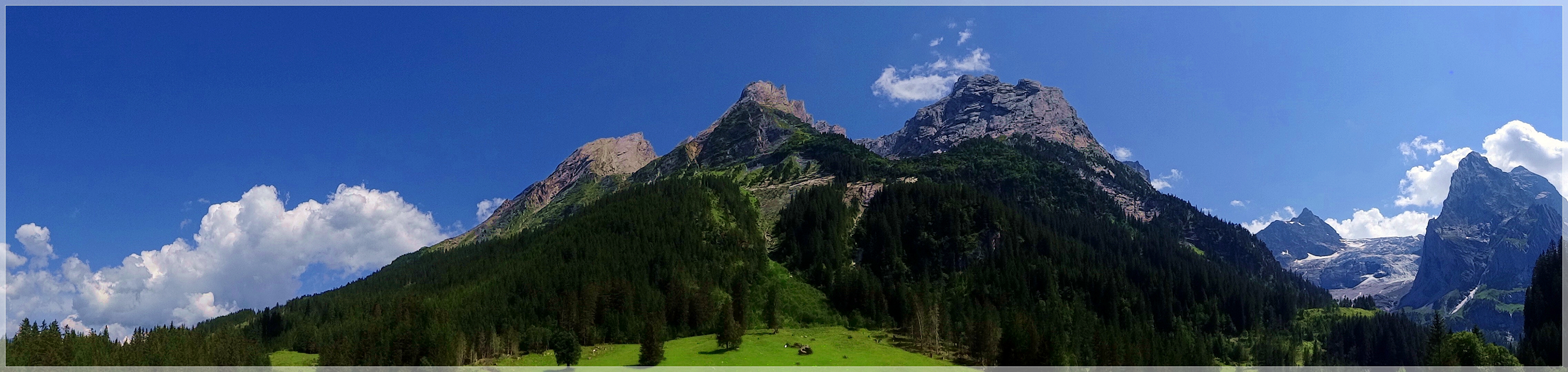
DSC03664-Rosenlaui1WEB2
All Scripture is inspired by God and is useful to teach us what is true and to make us realize what is wrong in our lives. It corrects us when we are wrong and teaches us to do what is right. God uses it to prepare and equip his people to do every good work. [2 Timothy 3:16-17 (NLT)]

For some people, the Book of Genesis keeps them from becoming Christians. “How can you possibly believe it all happened in six days?” they ask. Because they can’t reconcile apparent contradictions between science and Genesis’ story of creation, they reject the entire Bible. To borrow my mother’s phrase, “That’s like throwing out the baby with the bath water!”

The accuracy of the creation story can bring about heated discussions but, for me at least, it is a nonessential debate. Let the creationists and evolutionists, the fundamentalists and liberals, the scientists and theologians argue all they want. I’ve chosen not to become preoccupied with the cosmology, biology and geology of the creation story. Whether the creation of our world took six twenty-four hour days or six million year days is not the foundation of my faith. I’ve seen models of DNA, taken astronomy, studied biology and geology and I can’t really understand, let alone explain, the big bang theory, black holes, geologic eras, gene mutation, or evolution. I would hardly expect ancient people to understand these concepts. Genesis is not a book of science; it is a book of theology! The Bible’s purpose is not to be a scientific document; its purpose is to tell us about God and its ultimate goal is our salvation.

I accept the Book of Genesis as the word of God told in such a way that His people could understand and comprehend its meaning. Many others, however, have more fundamental or more liberal interpretations. While we may disagree about the exactness of the creation story as told in Genesis, this disagreement should never keep us from agreeing about the important things like sin, forgiveness, redemption, salvation, love, faith, resurrection and the Father, Son, and Holy Spirit. Our purpose is not to win people to our interpretation of Genesis; our purpose is to win people for God!

The Lord merely spoke, and the heavens were created. He breathed the word, and all the stars were born. He assigned the sea its boundaries and locked the oceans in vast reservoirs. Let the whole world fear the Lord, and let everyone stand in awe of him. For when he spoke, the world began! It appeared at his command. [Psalm 33:6-9 (NLT)]

ON A MISSION FROM GOD

Then Moses went back to the Lord and protested, “Why have you brought all this trouble on your own people, Lord? Why did you send me? Ever since I came to Pharaoh as your spokesman, he has been even more brutal to your people. And you have done nothing to rescue them!” [Exodus 5:22-23 (NLT)]

Sunday mornings, I take photographs for our church’s website. Last week, due to a cranky computer, only a handful of over 100 photos got edited, the day’s pics temporarily went AWOL, and my three editing programs eventually stopped working. In frustration, after hours of unsuccessful work, I gave up and tried to upload the few photos I’d managed to edit. That’s when I discovered my computer was on strike; there would be no uploading of anything from it! Panic set in and I resorted to what I usually do in such a situation: cry and complain.

Like Moses, I complained to God. If He wanted me to do this job, why was it so difficult? I then did what I should have done at first: asked for God’s blessing and guidance. “Lord, bless my work. If it’s your work as well, show me what I need to do to accomplish it.” After praying, it occurred to me that I didn’t have the only computer in the house! Duh! In fact, not only was my husband’s computer available, but I’d also installed a photo editing program on it several years ago. Using his laptop and my flash drive, I finished the editing in record time and uploaded all of the photos.

Moses was given a mission from God: get Pharaoh to free the Israelites and lead them to the Promised Land. Things weren’t going well; in fact, the situation had only gotten worse and Moses complained to God. After all, if we’re on a mission from God, shouldn’t it be trouble-free? Reading his complaint, I imagined what God was thinking. “Moses, you think this is tough? Just wait until you have Pharaoh’s army chase you into the sea, or you’ve had to provide food and water for over 600,000 men and their families, or listened to forty years of complaints before your task is done! Toughen up, big guy; you’ll encounter greater problems down the road. Trust me; I’ll never let you down. Don’t give up; you’re learning some valuable lessons that will help you in the future!”

Although God gives us tasks, He doesn’t promise they’ll be easy. It’s difficult to reconcile our problems with God’s assignments. As we struggle to achieve His work, however, we learn to depend on God and not ourselves. There’s nothing like a few obstacles to humble a prideful attitude. As He guides us through our difficulties and challenges, we become smarter, stronger and more determined. Moses’s early challenges prepared him for the trials of leading over half a million people as they walked forty years in the wilderness. Mine taught me about prayer, trust, perseverance, and backing up valuable computer files.

By the way, the next morning, my computer woke up in a far better mood. I had to do some minor clean up, delete some old files and back up others, but it is running smoothly again! Coincidence? I think not: more like a lesson from above.

“They’re not gonna catch us. We’re on a mission from God.” [Elwood to Jake in “The Blues Brothers”]

Dear brothers and sisters, when troubles of any kind come your way, consider it an opportunity for great joy. For you know that when your faith is tested, your endurance has a chance to grow. So let it grow, for when your endurance is fully developed, you will be perfect and complete, needing nothing. [James 1:2-4 (NLT)]

NEVER TOO BUSY

After sending them home, he went up into the hills by himself to pray. [Matthew 14:23a (NLT)]

It was a busy day for Jesus and the disciples. Having learned that John the Baptist had been beheaded, he went off to be alone but a large crowd followed him. Pitying them, he preached and healed the sick and then managed to feed 5,000. Sad and tired as he probably was, however, Jesus still managed to find time to pray.

We’ve all had those days when we hit the floor running and don’t stop until night. Everywhere we turn there is another task to be done, someone to call, someplace to go, some new crisis, or a deadline lurks. Even though Jesus told us that, apart from Him, we can do nothing, we allow life to interfere. “God knows how busy I am,” we say, “Surely He’ll understand if I skip prayers.” We fully intend to catch Him later, but later turns into tomorrow or the next day or never. God knows how busy we are but I’m not so sure he approves of our priorities.

If we needed dialysis to survive, we’d never be too busy for our treatment. If we needed an oxygen tank to breathe, we’d take the time to make sure we had a fresh supply. If we were diabetic, we’d surely find the time for our daily medication. If we’re not too busy to save our physical lives, how can we be too busy to save our souls? God’s got a busy day ahead, but He’s never too busy to hear our prayers. How can we be too busy for Him?

For apart from me you can do nothing. [John 15:5b (NLT)]

Never stop praying. [1 Thessalonians 5:17 (NLT)]

SEND IT INTO THE WILDERNESS (Day of Atonement)

10-4-14 wildernessWEBHappy is the person whose sins are forgiven, whose wrongs are pardoned. [Psalm 32:1 (NCV)]

Today is the Day of Atonement, a Jewish holy day. The book of Leviticus describes the rituals the Israelites were to perform on this most sacred day of the year. In one ceremony, two goats were taken from the people. One goat would be given to the Lord and the other would be the “scapegoat.” The goat given to God was sacrificed as a sin offering to make atonement for the sins of the people; its purpose was forgiveness. The second goat was then brought before the altar. The priest laid his hands on the goat and confessed the sins and transgressions of the people. He then sent it away into the wilderness; its purpose was to remove the people’s guilt.

The Christian, however, doesn’t need this kind of yearly ritual. Our sacrifice has already been made: Jesus was our sacrificial lamb. It was his blood that was shed for our sins. Because of him, once we repent and confess our sins, they are forgiven and forgotten. God forgives us and lets us start anew, free from guilt.

Sometimes, however, we don’t accept His forgiveness. We hang on to our guilt by replaying our actions, blaming ourselves and others, and regretting our failures. We carry embarrassment, humiliation, and shame around even after God has forgotten all about it. Perhaps we need to take a lesson from the ancient Israelites. Knowing that a sacrifice has been made to atone for our sins, we need to send our guilt out into the wilderness, never again to be seen!

He has removed our sins as far from us as the east is from the west. [Psalm 103:12 (NLT)]