
The land that you are going over to possess is a land of hills and valleys, which drinks water by the rain from heaven, a land that the Lord your God cares for. The eyes of the Lord your God are always upon it, from the beginning of the year to the end of the year. [Deuteronomy 11:11-12 (ESV)]
 The Israelites were camped on the east side of the Jordan River, in view of Canaan, when Moses addressed them. After spending the last forty years as nomads in the wilderness of the Sinai Peninsula, can you imagine their excitement at the thought of finally having a place to call their own and their eagerness for a new beginning in a new land? There must have been some apprehension, as well. They weren’t naïve; they knew there would be conflict, battles, and even loss before Canaan was conquered.
Moses was not addressing the original generation of adults he brought out of Egypt—they died in the wilderness because of their disobedience the first time Israel approached Canaan. This was the second generation of adults—the ones who had been under twenty when their parents refused to enter the Promised Land. This generation were eye-witnesses to God’s power and provision. As children, they witnessed the plagues God visited on Egypt. They were there when the waters of the Red Sea parted and watched Pharaoh’s soldiers drown. They experienced Israel’s defeat of the Amalekites at Rephidim, enjoyed God’s provision of quail, and observed water pouring out of a rock more than once. They beheld the glory of the Lord fill the Tabernacle and knew that God faithfully provided them with manna for forty years.
At the same time, this generation also knew the consequences of disobedience. They survived the plague God sent because Israel worshiped the golden calf, saw the earth split open and swallow the men (and their families) who rebelled against Moses, and spent most of their lives as nomads because of their parent’s defiance. They had first-hand knowledge of God’s discipline as well as His faithfulness, provision, compassion, and mercy.
As Canaan was for the Israelites, so a new year is for us. Like a new land, the new year means a fresh start but, like the Israelites, we wonder what trouble the year may bring. Will there be more dark valleys than sunny hilltops? Will our journey be challenging or easy, rocky or smooth, crooked or straight? Will obstacles or detours cause us to lose our way? Will we encounter times of plenty or famine, profit or loss? Will there be storms or sunshine, floods or drought, abundance or scarcity? Rather than being attacked by Amorites, Hittites, or Jebusites, will cancer, divorce, or job loss strike? Just as those Israelites knew that both challenges and blessings lay ahead in Canaan, we know that the new year will bring its share of both grief and joy, chaos and calm, hardship and ease, loss and gain.
Moses told the people not to fear the inhabitants of Canaan because God was with Israel. They didn’t go into new territory alone and neither do we. God was with them and He is with us. While we haven’t gathered manna in the morning, seen bitter water become sweet, experienced God’s victory over Midian, or followed a pillar of cloud or fire through the Sinai wilderness, we know God did all that and more for Israel. Moreover, we have firsthand experience of the many ways He has been faithful to us. In previous years, He transformed discord into harmony, heartbreak into joy, chaos into order, defeat into victory, unhappiness into contentment, and scarcity into enough! God’s faithfulness and power in the past tells us there is nothing to fear in the days ahead!
While we don’t know what 2024 holds, we do know the One who holds the new year in His hands. Let us stride confidently into the challenges of the future knowing that, “The eyes of the Lord your God are always upon it, from the beginning of the year to the end of the year.”
New Year’s Day is a good time to fix one’s eyes on the only One who knows what the year is to hold. [Elisabeth Elliot]
 Along the road to the Serengeti, somewhere near the Olduvai Gorge in Tanzania, is a crescent-shaped sand dune. Measuring about 30-feet in height and 328-feet long along its curves, it is known as the Shifting Sands. Rich in iron and highly magnetized, the sand sticks to itself when tossed in the air. When the wind blows, its particles fall back on the dune rather than get carried away by the breeze. The dune, however, is constantly on the move as the prevailing winds slowly move the entire thing across the land. Moving about 50-feet a year, it’s believed that the Shifting Sands have been traveling the savannah for more than three thousand years, sometimes changing both shape and direction. Of course, the dune moves so gradually that you don’t see its motion. Nevertheless, stakes in the ground indicate its location in previous years.
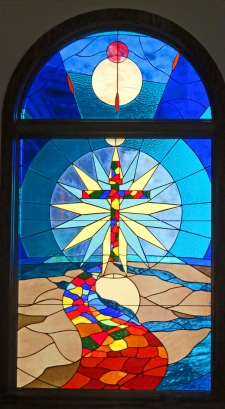 In the first Advent, Jesus came as a suffering servant in a manger. In His second Advent, Jesus will return in righteousness as the conquering King who makes all things right. His return means the final destruction of sin, injustice, hate, disease, death, decay and evil. Our God, however, is one of both mercy and judgement and Malachi’s promise of the Messiah included a warning about the coming day of judgment.
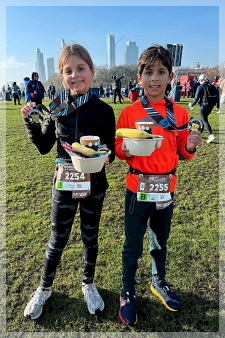 Like their parents, my youngest grands like to race and recently did this year’s 5K “Hot Chocolate” run. When Paul referred to running, he wasn’t referring to fun runs like theirs or a marathon like the one their parents ran nor were his boxing and wrestling references to the sports we know today. His allusions were to the Panhellenic games and Olympics which were well known throughout the Roman Empire in his day.
 Last October, we went north to watch our son and daughter-in-law run the Chicago Marathon. This 26.2-mile race passes through 29 Chicago neighborhoods and the city’s streets were lined with spectators ringing bells, beating drums, holding signs, cheering, and applauding as the runners ran past. Like us, some were there to cheer on specific runners but many were there to encourage all who were running. When we saw Sam and Nina, they were nine miles into their run and had stripped off the jackets, gloves, and hats they’d been wearing earlier that morning. The whole scene reminded me of today’s verse from Hebrews in which the author likens Christian living to running a race with endurance.
 While browsing a bookstore (yes, they still exist), I came across a book offering more than 100 ways to say “Thank you.” It suggested ways to express one’s appreciation for milestone celebrations, business opportunities, assistance, social events, and assorted gifts. It even offered “damage control” for tardy thank you notes. There also were chapters devoted to topics like stationery, envelopes, and internet etiquette. One chapter offered a “thank you thesaurus” complete with several “glowing superlatives and energetic adjectives.”
 Devotions of the Heart