
And he told them a parable to the effect that they ought always to pray and not lose heart. [Luke 18:1 (ESV)]
 I began my prayer with, “Lord, you’ve got to…” but got no further. “God doesn’t ‘got to’ do anything!” said a still small voice and the Spirit’s point was well taken. By beginning with an impertinent demand like a selfish petulant child in a toy store, I showed chutzpah of the worst kind and began again.
From the Yiddish word khutspe, meaning impudence or gall, Leo Rosten’s classic definition of chutzpah is, “that quality enshrined in a man who, having killed his mother and father, throws himself on the mercy of the court because he is an orphan.” The brazen way I started my prayer displayed chutzpah’s negative characteristics of rudeness, impertinence, presumption, insolence, and arrogance.
A little chutzpah, however, isn’t necessarily bad. On the positive side, chutzpah includes the qualities of fearlessness, pluck, mettle, and boldness; it questions, challenges assumptions, speaks up, and stands its ground. Chutzpah, at its worst, is rude, disgraceful, and harmful. At its best, however, this combination of audacity and gumption can bring glory to God’s name. This difference is in motivation—rather than being done for personal gain, “holy chutzpah” is done to reveal God’s kingdom on earth.
Moses showed holy chutzpah on Mt. Sinai when he debated God about the destruction of the Israelites and Abraham showed chutzpah when he negotiated with God over the complete destruction of Sodom and Gomorrah. When Jacob wrestled with God, the man persisted despite a dislocated hip until he’d received a blessing! That’s chutzpah!
In Cana, Mary showed chutzpah by expecting Jesus to solve a wine shortage when the problem wasn’t His to solve and His power was unknown to others. The Syrophoenician woman certainly showed chutzpah by challenging Jesus after he denied her request to heal her demon-possessed daughter. Think of the chutzpah of Bartimaeus, the blind beggar who, despite a scolding by the crowd, persisted in calling out to Jesus; the woman with the bleeding disorder with the audacity to come out in public and the gumption to touch the fringe on Jesus’ robe; and the parents who ignored the disciples’ rebukes by bringing their little children to be blessed by the Lord!
A pastor friend frequently says, “Ours in an audacious God; we should honor Him with audacious prayers.” Do we? When King Hezekiah fell ill, Isaiah told him he would not recover. Unwilling to accept his fate, the king had the chutzpah to ask God for more years. God heard, healed him, and Hezekiah lived another fifteen years! What if he hadn’t asked for those years? Consider how different his story and those of people like Moses, Abraham, and the Syrophoenician woman would have been if they hadn’t had the chutzpah to make their audacious pleas and petitions! Ours is a big God for whom nothing is impossible! Let us come before the Lord, not with arrogance and impudence, but with boldness, humility, respect, and faith.
Praying recklessly brave prayers humbles me, reminding me of both my own great need and his great strength. In asking him for big, impossible things, I expect my dependence on him to grow, my willingness to take risks for his kingdom to increase, and my intimacy with him to deepen. [Lisa Schrad]
 While writing Monday’s devotion about the seemingly insurmountable giants we face, I wondered about the identity of my Goliath. Of who or what am I afraid? What giant looms over me and blinds me to the presence of God?
 The Israelites had experienced about two years of God’s power and faithfulness the first time they approached Canaan. After walking through the Red Sea on dry land, they saw Pharaoh’s army drown in the same waters. They heard God’s voice and were led through the wilderness by His cloud during the day and fire at night. God’s power turned bitter water sweet, fed them with quail and manna, and led them to victory against the Amalekites. Nevertheless, it seems as if all of that was forgotten when the twelve spies returned from their forty days scouting Canaan.
 If I were doing what accountants call a cost-benefit analysis of our living in Florida, the cost side would include venomous snakes, poisonous cane toads, hurricanes, alligators, sink holes, fire ants, and mosquitos along with humidity, allergies, high insurance, and seasonal traffic. On the other hand, the benefits would include never having to shovel snow, scrape sleet from a windshield, or drive on icy roads, along with the enjoyment of beaches, beautiful birds, colorful flowers, ocean breezes, “early-bird” specials, sunshine, no state income tax, and never-ending summer. While not one hundred times better, the pluses outweigh the negatives and make it worthwhile (at least for us)!
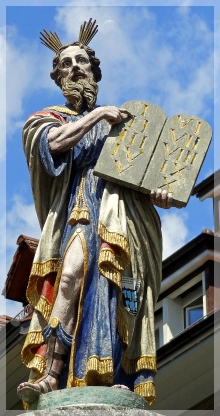 Although three places in Scripture tell us that the Lord proclaimed ten commandments and wrote them on stone tablets, those tablets weren’t numbered (especially not with Roman numerals)! The original languages of the Bible (Hebrew, Aramaic, and Greek) didn’t contain punctuation and the earliest manuscripts didn’t even have spaces between the words. While the words in Scripture are God-breathed, the punctuation was at the discretion of later copyists and translators. Without numbering, punctuation, or paragraphs, we can’t know for sure where one commandment ends and the other begins. As a result, while Jews, Roman Catholics, Protestants, and Orthodox Christians all observe the Ten Commandments, their commandments are not all the same!
 In what’s known as the Abrahamic covenant, God promised Abram (later called Abraham) that he would found a great nation and that through him all nations would be blessed. After receiving God’s promise, Abraham departed Haran, arrived in Canaan, went to Egypt to escape a famine, returned to Bethel, separated from Lot, and rescued him from King Kedorlaomer. In those ten years, however, despite God’s promise, Abraham’s wife Sarai (later known as Sarah) had not become pregnant. When he grew despondent that he was without an heir, God repeated his promise of a son through Sarah and reassured Abraham of as many descendants as there were stars in the sky.
 Devotions of the Heart