KARMA

Don’t be misled—you cannot mock the justice of God. You will always harvest what you plant. Those who live only to satisfy their own sinful nature will harvest decay and death from that sinful nature. But those who live to please the Spirit will harvest everlasting life from the Spirit. So let’s not get tired of doing what is good. At just the right time we will reap a harvest of blessing if we don’t give up. [Galatians 6:7-9 (NLT)]

maccawCutting in and out of traffic, the sports car sped around us and raced through a red light. A few minutes later, we saw it pulled off to the side of the road with a policeman at the driver’s side window. While the driver deserved the ticket, what happened was not karma. Nevertheless, when seeing someone suffer the consequences of their bad behavior, people often say, “It was karma—what goes around comes around!” Granted, what goes around often comes back around but the word “karma” is not a word that should be in our Christian vocabulary.

Although Christianity says we will harvest what we’ve planted, karma is not a Christian concept. Karma tells us that every good or bad action will result in a comparable good or bad consequence. Because the full reward or penalty doesn’t happen in this lifetime, it’s necessary to return to life again to reap the consequences of previous actions. The behavior during this and previous lives determines one’s destiny (and form) in future lives. Not only do people get what they deserve in karma, but they also get whatever their past life deserves! This life’s cancer, poverty, or paralysis is the result of a previous life’s transgressions or offenses (and we don’t even remember what they were)!

Karma requires reincarnation and there is no such thing as reincarnation in the gospel message. We die once and we’re judged once; our eternal reward or punishment is determined in a single lifetime. We’ll be reborn, but that rebirth is in this life, not in some future life. Yes, there will be an afterlife—but it will be as us (not something or someone else) and it only will be in one of two places: heaven or hell.

As Christians, we sow in this world and reap both in this world and the next. Because there are consequences to our actions, we often reap what we sow in this lifetime, but not completely. We live in a fallen world where the wicked can prosper, the righteous can suffer, and not every reckless driver gets a ticket. Nevertheless, a final day of judgment is promised in Revelation. It is God, however, not karma, who ensures that righteousness is rewarded and sin punished. While there will be rewards for good works and judgment for failures, there will be no condemnation to hell for the Christian. Rather than a pronouncement of doom, our judgment will be more like an assessment of value. What did we do with the gifts with which we’d been blessed? While I don’t understand how this judgment will work or what rewards we might receive or forfeit, I do know that it won’t be in some future life as an insect, dog, pauper or prince.

Thankfully, because of God’s mercy, Christians don’t receive what they ought to get; as sinners, what we deserve is death! Thankfully, because of God’s grace, we also get what we don’t deserve: salvation, forgiveness of sins, abundant life, the Holy Spirit, and an eternity in heaven!

We have one and only one opportunity to get it right and live according to God’s plan. Let’s not waste it!

Each person is destined to die once and after that comes judgment… [Hebrews 9:27 (NLT)]

For we must all stand before Christ to be judged. We will each receive whatever we deserve for the good or evil we have done in this earthly body. [2 Corinthians 5:10 (NLT)]

Copyright ©2020 jsjdevotions. All rights reserved.

RENEW – NEW YEAR’S DAY

But this is the new covenant I will make with the people of Israel after those days,” says the Lord. “I will put my instructions deep within them, and I will write them on their hearts. I will be their God, and they will be my people. … And I will forgive their wickedness, and I will never again remember their sins. [Jeremiah 31:33,34b (NLT)]

Come, let us use the grace divine, and all with one accord,
in a perpetual covenant join ourselves to Christ the Lord;
Give up ourselves, thru Jesus’ power, his name to glorify;
and promise, in this sacred hour, for God to live and die. [Charles Wesley]

queen butterflyJohn Wesley had an excellent alternative to making a New Year’s resolution that’s unlikely to be kept. Believing that Christians should reaffirm their covenant with God, in 1755, he introduced a covenant service to the Methodist Societies. By 1775, this service was usually held on New Year’s Eve (and called a Watch Night Service) or New Year’s Day. This was a service of renewal in which believers would gather for self-examination and reflection and then renew their covenant with God by dedicating themselves wholly to Him. The practice of a covenant renewal service held on the Sunday nearest January 1st continues in some Methodist churches today and is a practice that has crossed denominational lines.

A covenant is a promise between two (or more) parties to perform certain actions. The covenant of the New Testament between God and man is that He will restore fellowship with and forgive the sins of those whose hearts are turned to Him; it is a covenant of salvation by grace through faith. Our part of this promise is our faith in Jesus and a giving up of self so that He can fill us with His Spirit; it is the taking of His yoke and a commitment to follow Him. Unlike a resolution to eat healthier or exercise more, it is God’s power, not our good intentions, that keeps this covenant in place.

I don’t know if you’re making any resolutions today, but let us all join together in renewing the covenant of grace—to be God’s people, trusting in His word, empowered by Him to be His hands and feet, seeking to bring His light into this dark world. Our prayer can be as simple as, “O Lord, I dedicate my life to you and will serve you in every way I can!”

Lord, I am no longer my own, but Yours. Put me to what You will. Rank me with whom You will. Let me be employed by You or laid aside for You, exalted for You or brought low by You. Let me have all things. Let me have nothing. I freely & heartily yield all things to Your pleasure and disposal. And now, O glorious and blessed God, Father, Son, and Holy Spirit, You are mine and I am Yours. So be it. Amen. [John Wesley]

Now may the God of peace—who brought up from the dead our Lord Jesus, the great Shepherd of the sheep, and ratified an eternal covenant with his blood—may he equip you with all you need for doing his will. May he produce in you, through the power of Jesus Christ, every good thing that is pleasing to him. All glory to him forever and ever! Amen. [Hebrews 13:20-21 (NLT)]

Copyright ©2020 jsjdevotions. All rights reserved.

THE LEAST OF THESE

And the King will say, “I tell you the truth, when you did it to one of the least of these my brothers and sisters, you were doing it to me!” [Matthew 25:37-40 (NLT)]

zebra longwing butterflyMy friend called to make sure I’d be at an event and then asked, “Do you have a minute?” When people ask that, we all know they really mean twenty minutes. With a to-do list as long as my arm, I had a minute to spare but not twenty. Nevertheless, I’ve been praying for this woman and her family for several years. I knew she needed to unburden her heavy heart, so I said, “Yes.” Twenty minutes later, she asked to meet for lunch the following day. Again, I really didn’t have the time, but I knew she needed guidance, encouraging words and reassurance about some difficult decisions she’d made. She needed a friend!
When we read the parable in Matthew 25, we’re told not to ignore “the least of these.” When reading that verse, we are likely to think about those who are homeless, infirm, disadvantaged, impoverished, disabled, hungry or abused. But, there are suffering people everywhere and they can be suburban grandmas, wealthy businessmen, co-workers, neighbors, or in our book club, Bible study or yoga class. Sometimes, one of “the least of these” lives right next door or just down the street. While their needs are vastly different from those who are indigent or disabled, they often are just as pressing. Moreover, their needs won’t be eased by donating food, clothing or money. Serving the least doesn’t always mean providing necessities for the indigent, visiting prisoners, or even welcoming strangers. It means being present when you’re needed; giving someone an opportunity to share their loneliness, sorrow, fear, or distress; sitting silently and listening; encouraging and supporting; and praying both for and with someone. While we can schedule the day we work at the resale shop or pack groceries at the food bank, times like these are rarely on our busy calendars. Nevertheless, they are just as important.

Writing a check to a good cause would have taken far less time than the time I spent with my friend, but it would have done nothing to lift her spirits or help her find her way. Do I still have the long “to do” list? Yes. I know, however, that the time I spent with her was time spent sharing God’s love and compassion; it was time doing for Him. Moreover, I’m confident that God will somehow provide me with the time I need to complete my other tasks. He always does!

To be glad instruments of God’s love in this imperfect world is the service to which man is called. [Albert Schweitzer]

Don’t just pretend to love others. Really love them. [Romans 12:9 (NLT)]

And God will generously provide all you need. Then you will always have everything you need and plenty left over to share with others. [2 Corinthians 9:8 (NLT)]

Copyright ©2019 jsjdevotions. All rights reserved.

A HANDMAID’S HEART

And Mary said, “Behold, I am the handmaid of the Lord; let it be to me according to your word.” And the angel departed from her. [Luke 1:38 (RSV)]

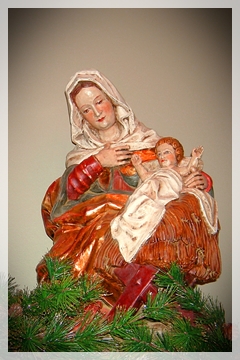
Mary - ChristmasIgnoring the fact that most of us in the room couldn’t qualify as virgins, are well-past child-bearing age, and our genealogies don’t link us to the tribe of Judah and the line of David, the pastor leading our women’s Bible study asked if we were the kind of women God would chose to give birth to His son.

Aside from being young, virginal, and of the right lineage, what kind of woman was Mary? At first glance, she seems little different than any other young girl in the obscure village of Nazareth. There is no mention of her having wealth, exceptional beauty, or social status. Looking like any other peasant girl, she seems unsuitable for a job as mother of God. What about Mary set her apart from every other girl in Palestine who met the lineage and virtue requirements?

Rather than looking at outward appearance, God looks into hearts; while we don’t know about Mary’s physical beauty, her character must have been exceptionally beautiful. Faithful, obedient and humble, she was filled with love for God. She risked her entire future when she submitted to Him. In many translations, Mary calls herself the “Lord’s servant.” The original Greek, however, was doule, which means bondmaid, female slave or handmaid. A doule wasn’t hired help who could quit when she wanted. She was someone who surrendered completely to her Master’s will.

I thought about the pastor’s question. Had I fit the physical and lineage requirements, would God have chosen me to bear His son? He wouldn’t have given me a second look when I was Mary’s age—I was far too willful, rebellious, selfish and unsure of myself to ever call myself a servant to anyone, even God! Even if the woman I am today fit the physical and lineage requirements, God wouldn’t consider me. It’s not that He wouldn’t trust me to feed, comfort, teach, love, guide, encourage, and protect His Son; I’d qualify in the mothering department. It’s that submission thing; I don’t think I’d freely surrender my will to His and God will not force Himself upon anyone. Mary had enough faith to yield her will to God but, even with 72 years of experiencing God’s faithfulness under my belt, I’m not sure I have the heart of a handmaiden. Humble and complete submission to the Master’s will does not come easily. “Thy will be done,” are some of the hardest words to pray and truly mean.

Both Mary and Jesus submitted to God’s divine will; should we do anything less? Father, forgive us for choosing our will over Yours. Give us a handmaid’s heart.

And he withdrew from them about a stone’s throw, and knelt down and prayed, “Father, if thou art willing, remove this cup from me; nevertheless not my will, but thine, be done.” [Luke 22:41-42 (RSV)]

Pray then like this: Our Father who art in heaven, Hallowed be thy name. Thy kingdom come, Thy will be done, On earth as it is in heaven. [Matthew 6:9-10 (RSV)]

Copyright ©2019 jsjdevotions. All rights reserved.

HIS FAMILY

mallard familyYou must have the same attitude that Christ Jesus had. Though he was God, he did not think of equality with God as something to cling to. Instead, he gave up his divine privileges; he took the humble position of a slave and was born as a human being. [Philippians 2:5-7 (NLT)]

Jesus may have been the Son of God but, for most of His life, He chose to live as the son of a man. Luke’s words that Jesus “grew in wisdom and in stature” [2:52] lead us to believe that Jesus was bound, both physically and mentally, by the normal course of human development. He didn’t arrive as an infant who could speak in full sentences, recite the Torah, discuss Scripture with the rabbis, turn water into wine, or walk (let alone walk on water). Like other human children, Jesus had to grow, mature, and obey His earthly parents. While fully God, Jesus also was fully man, with a human nature and will; when He overcame mankind’s sinful nature by never sinning, He did that as a man.

Even though Mary and Joseph knew Jesus was conceived by the Holy Spirit and would reign over Israel, they didn’t know the details of God’s plan or the magnitude of His power. Although they knew their son was special, they had no idea how special He really was! I can’t help but wonder what Jesus was like as a child, what was it like for Joseph and Mary to raise the Son of God, and what it was like to have God for a brother.

The gospels specifically mention Jesus’ sisters and four brothers: James, Joses, Simon, and Judas. [Matthew 13:55; Mark 6:3] Some say that these siblings weren’t the children of Joseph and Mary but were cousins or distant relatives. The Greek words used, however, were specific: adelphos (brothers) and adelphe (sisters). After the wedding at Cana, John tells us that Jesus went to Capernaum with Mary, the disciples and “his brothers.” [John 2:12] Matthew, Mark, and Luke all mention that ”Jesus’ mother and brothers” came to see Him and John tells us that our Lord’s brothers had doubts about Him being the Messiah. That they eventually came to believe in Jesus is clear; they were united in prayer with the disciples after the resurrection prior to Pentecost. Paul refers to James as “the Lord’s brother” and both James and his brother Jude wrote epistles we find in the New Testament. That Jesus had siblings is clear; how they came to be is less clear.

There are many who hold that Mary remained a perpetual virgin: that she and Joseph never consummated their union. The Bible, however, does not support that assertion. Matthew wrote that Joseph did not “know” Mary (a polite euphemism for having sexual relations) until the baby was born, clearly implying that he did “know” her later. Both Matthew and Luke refer to Jesus as Mary’s “firstborn” rather than her “only” son. God ordained marriage and sex before sin entered the world and there is no reason to think Joseph and Mary did not follow His command to “become one flesh” and “be fruitful and multiply.” The sin would have been if Mary had refused to have relations with her husband. For those who want to think of Mary as a perpetual virgin, however, an alternate explanation is that Joseph was a widower and those six or more siblings were from his earlier marriage. In that case, Joseph would have been quite a bit older than Mary and, while he is described as being a righteous man, nothing indicates he’d been previously married. In this scenario, unless those children were all grown and out of his house, where were they that Christmas night in Bethlehem? No mention of a family is made.

Although He was God, Jesus came to earth to live and die as a man. I can’t imagine God wanting Jesus to grow up without experiencing the mayhem, noise, tears, conflict, teasing, and laughter that come with brothers and sisters in the house. As part of a family, Jesus learned how to play, share, wait His turn, tolerate annoying siblings, and help the little ones. The lessons He taught us about love, patience, forgiveness, generosity, and turning the other cheek were all lessons Jesus had to learn as part of a family unit. As Jesus “grew in wisdom and in stature,” he learned how to live peacefully with others, lessons that were invaluable when dealing with the petty rivalries and disputes of His disciples. As we approach the holiday season and the stress of large family gatherings, let us remember that we’re not encountering any challenges that Jesus didn’t face. He managed to do it without sin; can we?

This High Priest of ours understands our weaknesses, for he faced all of the same testings we do, yet he did not sin. So let us come boldly to the throne of our gracious God. There we will receive his mercy, and we will find grace to help us when we need it most. [Hebrews 4:15-16 (NLT)]

Copyright ©2019 jsjdevotions. All rights reserved.

WORDS

A word out of your mouth may seem of no account, but it can accomplish nearly anything—or destroy it! It only takes a spark, remember, to set off a forest fire. A careless or wrongly placed word out of your mouth can do that. By our speech we can ruin the world, turn harmony to chaos, throw mud on a reputation, send the whole world up in smoke and go up in smoke with it, smoke right from the pit of hell. [James 3:4-6 (MSG)]

rabbitJames warns of the dangers of an untamed tongue and the damage that can be done with ill-considered words. Although he was speaking of speech, the same goes for the written word. Whether we’re holding a pen, our fingers are speeding across a keyboard, or our thumbs are tapping out a text, our words are powerful. Whether we use them to build or destroy is our choice.

C.S. Lewis, one of the great Christian minds of the 20th century, authored more than thirty books. A man who never used a typewriter, he also was a prolific letter writer. Writing not just to friends and colleagues, he answered every letter sent to him. Most of us probably have trouble responding to someone with a quick email, yet this busy man never hesitated to handwrite a response, even to strangers or children who wrote after reading one of his books or hearing him on radio. More than 3,200 of Lewis’ handwritten letters remain and have been published in various collections. They range from the somewhat mundane (thanking someone for a ham) to the exceptional (reassuring a woman who is afraid of dying).

Often writing more than 100 letters a month, his letters show not just a deep thinker with a brilliant mind but also a compassionate man generous enough to take the time to instruct, explain, empathize, encourage, and reveal himself and his vulnerabilities. Nevertheless, Lewis once complained, “If I didn’t have so many letters to answer, I’d have time to write another book.” His words from another letter, however, explain why he did it: “Ever since I became a Christian, I have thought that perhaps the best, perhaps the only service I could do for my unbelieving neighbours was to explain and defend the belief.” He wrote those letters out of obedience to God and concern for the people who’d written to him.

While many proverbs give dire warnings about imprudent words, the other half of those proverbs often are about judicious ones. That C.S. Lewis’ letters continue to be read today illustrates the power of the written word. Rather than start a wildfire with cruel words, Lewis sowed seeds of Christ with his kind ones; may we do the same. Let us never forget the beautiful things our words, both spoken and written, can do when used wisely and with love!

Words kill, words give life; they’re either poison or fruit—you choose. [Proverbs 18:21 (MSG)]

The words of the wicked kill; the speech of the upright saves. [Proverbs 12:6 (MSG)]

Copyright ©2019 jsjdevotions. All rights reserved.