
I will be your God throughout your lifetime—until your hair is white with age. I made you, and I will care for you. I will carry you along and save you. [Isaiah 46:4 (NLT)]
 While writing Monday’s devotion about the seemingly insurmountable giants we face, I wondered about the identity of my Goliath. Of who or what am I afraid? What giant looms over me and blinds me to the presence of God?
Unlike David’s Philistine foe, my Goliath doesn’t look imposing, strong, or powerful. Rather than being nearly nine feet tall, he has osteoporosis and is stooped, frail, and weak. Instead of wielding a sword and being accompanied by an armor bearer, this fearsome enemy uses a cane and has a caregiver. My Goliath isn’t surrounded by an army because he’s outlived his spouse and most of his friends. It’s the inadequacies, limitations, and loss that accompany old age that frighten me.
Back in 1819, Thomas Jefferson painted a vivid but grim picture of those limitations with these words: “First one faculty is withdrawn and then another, sight, hearing, memory, eucrasy [physical well-being], affections & friends, filched one by one till we are left among strangers, the mere monuments of times past, and specimens of antiquity for the observation of the curious.” My in-laws lived to the ages of 96 and 102 and we saw first-hand the toll those years took both physically and mentally. Unfortunately, no matter how well we care for ourselves, as the years progress, our bodies and minds start to wear out and cease operating at full capacity.
It was when our family gathered to celebrate our youngest child’s 50th birthday that my eyes were opened to the gifts accompanying advanced years. As I relished the time with family that weekend, I thought of my parents. Having died at 47 and 56, they never celebrated a child’s 30th birthday, let alone a 50th, nor did they get to celebrate their 100th surrounded by their great-grands as did my mother-in-law! Although they’d planted the field, they never got to enjoy the harvest! It wasn’t just the red-letter days like weddings, birthdays, and graduations they missed; they never enjoyed the special moments that come with grands and greats—another round of soccer matches, Legos and Tinker Toys, tea parties and dress-up, and endless games of Crazy-8s and LCR.
Although my parents avoided things like arthritis, memory loss, hip replacements, cataracts, and assisted living, I think they would have accepted all that and more to have had additional years with their children and to hold a grandbaby or a great. A walker, hearing aids, and macular degeneration are a small price to pay for watching one’s children and grands develop into the kind of people you’d want to spend time with even if they weren’t family! Indeed, as daunting as it is, old age is a privilege granted to few and should be embraced.
My Goliath really isn’t old age; it’s my fear of old age! I can’t vanquish the indignities and decline of the oncoming years nor can I evade my body’s final defeat, but God will give me the power to rout my defeatist attitude. Knowing He is with me, I can confidently face the future with confidence. As long as God gives me breath, He will continue to calm my fears and give me both purpose and strength in the coming years (whatever they may bring).
 The Israelites had experienced about two years of God’s power and faithfulness the first time they approached Canaan. After walking through the Red Sea on dry land, they saw Pharaoh’s army drown in the same waters. They heard God’s voice and were led through the wilderness by His cloud during the day and fire at night. God’s power turned bitter water sweet, fed them with quail and manna, and led them to victory against the Amalekites. Nevertheless, it seems as if all of that was forgotten when the twelve spies returned from their forty days scouting Canaan.
 If I were doing what accountants call a cost-benefit analysis of our living in Florida, the cost side would include venomous snakes, poisonous cane toads, hurricanes, alligators, sink holes, fire ants, and mosquitos along with humidity, allergies, high insurance, and seasonal traffic. On the other hand, the benefits would include never having to shovel snow, scrape sleet from a windshield, or drive on icy roads, along with the enjoyment of beaches, beautiful birds, colorful flowers, ocean breezes, “early-bird” specials, sunshine, no state income tax, and never-ending summer. While not one hundred times better, the pluses outweigh the negatives and make it worthwhile (at least for us)!
 When a rich man asked Jesus what he needed to do to have eternal life, the Lord told him to sell everything and give it to the poor. More willing to part with eternal life than his riches, the disappointed man departed. When Jesus explained, ”It is easier for a camel to go through the eye of a needle than for a rich person to enter the kingdom of God,” the disciples were astonished. Jewish tradition held that riches were a sign of God’s blessings and favor while poverty and sickness were God’s curse. If a rich man couldn’t get into the kingdom, they wondered who could.
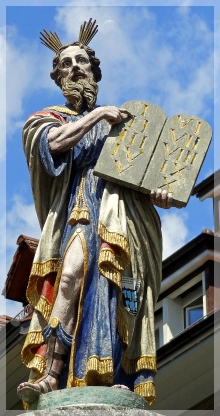 Although three places in Scripture tell us that the Lord proclaimed ten commandments and wrote them on stone tablets, those tablets weren’t numbered (especially not with Roman numerals)! The original languages of the Bible (Hebrew, Aramaic, and Greek) didn’t contain punctuation and the earliest manuscripts didn’t even have spaces between the words. While the words in Scripture are God-breathed, the punctuation was at the discretion of later copyists and translators. Without numbering, punctuation, or paragraphs, we can’t know for sure where one commandment ends and the other begins. As a result, while Jews, Roman Catholics, Protestants, and Orthodox Christians all observe the Ten Commandments, their commandments are not all the same!
 On June 19, Louisiana’s Governor Jeff Landry signed legislation requiring all public K-12 classrooms and state-funded universities to display a poster-sized version of the Ten Commandments in “large, easily readable font” in every classroom next year. As expected, a lawsuit has been filed to block what some say is an unconstitutional requirement. I’ll leave the arguments about civil liberties and constitutional law to the lawyers and courts; Louisiana’s law is troubling for other reasons.
 Devotions of the Heart