
For we must all appear before the judgment seat of Christ, so that each one may receive what is due for what he has done in the body, whether good or evil. Therefore, knowing the fear of the Lord, we persuade others. But what we are is known to God, and I hope it is known also to your conscience. [2 Corinthians 5:10-11 (ESV)]
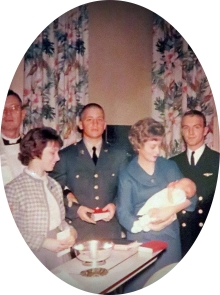 Earlier this week, I wrote about my nephew Johnny’s baptism in my mother’s hospital room. Because she was at death’s door, my brother took emergency leave and he and I served as the baby’s sponsors in Baptism (or Godparents).
As Johnny’s Godmother, I made three promises for him during the service: that he would “renounce the devil and all his works…believe all of the Articles of the Christian Faith and…keep God’s holy will and commandments.” In a perfect world, Johnny would have made those same promises again at his confirmation when he was old enough to personally know Jesus. But the world isn’t perfect; he never came to know Jesus and make those vows for himself.
As his Baptismal sponsor, I promised to make sure Johnny learned the Creed, the Lord’s Prayer, the Ten Commandments, and “all the other things which a Christian ought to know and believe to his soul’s health.” Sometimes promises are easier said than done and I did not keep my vows any better than did my nephew the promises made on his behalf. I can make all sorts of excuses for my failure—I only was 15 when I made those vows, at least 1,500 miles always separated us, and I saw him less than ten times in his 60 years. Nevertheless, I did not try to keep those promises and I will answer to God for my failure.
When I stand at God’s judgment seat, my sins will not be an issue; they already have been forgiven and my ticket to heaven is secure. But I will be asked to give an accounting for what I have done (and failed to do) since becoming a believer. While I kept my nephew in my prayers, I squandered my opportunity, small as it was, to share God’s love and the good news of the Gospel with him. I can’t say that anything I could have done would have made a difference in his troubled life but I should have tried. That weighs heavy on my heart—not because I may miss out on some heavenly reward, but because I missed an opportunity to be a disciple of Christ.
When believers stand before God, we will be judged. Since each of us have been uniquely created and gifted, my evaluation will not be the same as yours; nevertheless, each one of us will give an accounting of ourselves. What did we do with the spiritual light we had, what did we do with the opportunities given to us, and what did we do with the time, talents, and property God entrusted to us?
My nephew is one of the reasons I served our church’s children’s ministry and support both recovery ministries and programs serving the homeless and mentally ill. I suspect I continue writing these devotions as a way of atoning for not keeping the promises to God I made at my mother’s bedside 63 years ago. Older, wiser, and having more light, opportunity, time, and ability, more is expected of me now. While I no longer pray for my nephew, I continue to pray for God’s protection, grace, and mercy on others like him. As for those of us who are Christ followers, I pray that we will make good use of all that God has given us and that through our words and deeds we will live and teach the Creeds, the Lord’s Prayer, the Ten Commandments, and “all the other things which a Christian ought to know and believe to his soul’s health.”
 In 1962, my 2-month-old nephew Johnny and his parents traveled 1,500 miles for his Baptism. Because my mother was hospitalized (and soon would be dead), the sacrament took place at her bedside. This was the only time Johnny and his grandmother met and the last time my sister saw our mother alive.
 We once had neighbors who left our church for what I’ll call the “church of what’s happening now.” Its members have a variety of beliefs about God and, while they acknowledge a “higher power,” they do not share a concept of it. It could be God, a sacred force, or the spirit of life and there is no right or wrong way to understand Him, Her, or It. While some may regard Jesus as a great moral and spiritual leader or prophet (and possibly even supernatural), they don’t believe He was God and reject the Trinity. Theirs is an eclectic mix of beliefs with each person having his or her own personal truth. Embracing uncertainty, some believe there may be an afterlife and/or reincarnation but, for others, this life is all there is. Although they look to the Bible for wisdom, they also find spiritual inspiration in texts like the Bhagavad Gita, Dhammapada, and Tao Te-Ching. Our neighbors were loving caring people who believed in good things like justice, compassion, peace, protecting the environment, and the dignity of the individual. Nevertheless, while some of their thinking was correct, their conclusion was very wrong.
 Earlier this week, I compared a fictional 21st century Noah with the original ark builder. Although I was told there had been no rain on earth before the Flood, since I hadn’t read it myself, I wanted to make sure before writing it. As it turns out, there is no clear decisive answer to whether or not there was rain before Noah’s day so I didn’t mention it at all.
 Thousands of years ago, God told Noah to build a boat the height of a four-story house, the length of one-and-a-half football fields, and with the storage capacity of about 450 semi-trailers. Without benefit of Home Depot or power tools, he managed to do it. What would happen if God gave Noah those same instructions today?
 Devotions of the Heart