
Martha was frantic with all the work in the kitchen. “Master,” she said, coming in to where they were, “don’t you care that my sister has left me to do the work all by myself? Tell her to give me a hand!” … He replied, “You are fretting and fussing about so many things. Only one thing matters. Mary has chosen the best part, and it’s not going to be taken away from her.” [Luke 10: 40-42 (NTE)]
 The guest pastor shared an experience when he was an intern at a large church. Posted on the door leading into the senior pastor’s office was this quote by Stephen Covey: “The main thing is to keep the main thing the main thing.” At eye level and in large letters, anyone entering the pastor’s office was sure to see it. He’d given the sign little thought until one day, hot under the collar and ready to voice a complaint, he started to knock on his boss’s door. Seeing the sign, he paused, quietly returned to his desk, gave his complaint more thought, and asked himself if he was keeping the main thing main with his grievance.
Of course, to keep the main thing main, we must identify it first. Scripture, however, makes the main thing rather clear: love God, love others, and follow Jesus. Nevertheless, even when we’ve determined the main thing, it’s easy to get distracted and shift our focus. Like a reader who nitpicks over semi-colons and spelling while ignoring the significance of the words, we frequently cease focusing on God and His purpose to focus on ourselves and our interests.
Martha, for example, lost sight of the main thing when she complained to Jesus about her sister Mary. The mother of James and John lost sight of the main thing when she demanded special treatment for her boys and the disciples lost sight of the main thing when they squabbled over who was the greatest. Losing sight of the main thing, Elijah threw himself a pity party when things got tough, Jonah tried to escape his assignment in Nineveh, and the Pharisees carefully tithed their spices but neglected their parents and neighbors.
Our complaints to others (and to God) usually have little or nothing to do with God’s plan but rather with how it affects us. I’m busy, tired, bored, annoyed, angry, unappreciated, taken advantage of, better than him, too good for that, underpaid, or over-scheduled. Maybe some of our complaints are true. The question, however, remains—are any of them the main thing? If not, what is?
Father in heaven, help us keep our eyes on the main thing—you, accepting your plan, and furthering your kingdom. May we always remember that the main thing is never about us and always about you!
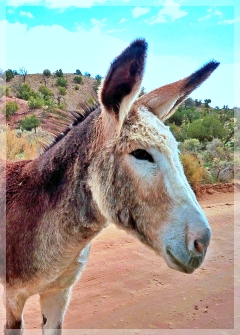 The story is told of a donkey who fell into a deep pit. Unable to get out, the animal brayed loudly until the farmer came to investigate. Seeing no way to get his donkey out of the pit, the farmer decided the only thing he could do was to put the poor animal out of its misery. Since the pit needed to be filled anyway, he got a spade and started to shovel dirt into it. When the donkey felt those first clods of dirt on his back, he lost all hope of rescue and brayed even louder. As he shook the dirt off his back, however, he discovered a growing mound of dirt beneath his feet. Seeing a possible solution, the donkey grew silent as he continued to shake dirt off his back and started tamping it down with his hooves. As the dirt piled up beneath his feet, the donkey got higher and higher in the pit. Paying no attention to the now silent animal, the farmer kept shoveling until he finally stopped for a rest. When he turned around, the man was shocked to see the donkey step out of the pit and trot away. The animal could have chosen to wallow in his misery—simply hung his head and let that dirt cover him up—but he didn’t. Instead, he took steps to change his situation.
 Days bled into weeks, weeks into months, and every day seemed the same for much of the last eighteen months. Life became a series of postponements, rebookings, cancelations, setbacks, inconveniences, letdowns, and disappointments. Visiting Grandma meant waving at her through a window, final farewells were FaceTime calls on a nurse’s cell phone, and we mourned from a distance while attending celebrations of life virtually. Weddings were postponed, family reunions put on hold, shut-downs and travel restrictions kept loved ones apart, theaters and concert halls went dark, vacations were delayed, businesses closed, jobs were lost, and junior year abroad became junior year on Zoom.
 When all the people in the synagogue heard these things, they became very angry. They got up, forced Jesus out of town, and took him to the edge of the cliff on which the town was built. They planned to throw him off the edge, but Jesus walked through the crowd and went on his way. [Luke 4:28-30 (NCV)]
 While every thesaurus says that hate is the opposite of love, I’m not so sure. Authors like Wilhelm Stekel, John Le Carré, Rollo May, Elie Wiesel, and George Bernard Shaw have said that indifference (or apathy) is the opposite of love. Disagreeing, Reverend Billy Graham said the opposite of love is selfishness.
 Devotions of the Heart