
Then he withdrew from them about a stone’s throw, knelt down, and began to pray, “Father, if you are willing, take this cup away from me—nevertheless, not my will, but yours, be done.” Then an angel from heaven appeared to him, strengthening him. Being in anguish, he prayed more fervently, and his sweat became like drops of blood falling to the ground. [Luke 22:41-44 (CSB)]
I am never afraid of exaggeration, when I speak of what my Lord endured. All hell was distilled into that cup, of which our God and Savior Jesus Christ was made to drink. [Charles Spurgeon]
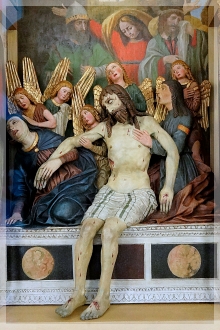 Although the common position for prayer was standing, Jesus fell to His knees that night in the garden of Gethsemane. Luke describes Him as praying so intensely that His sweat dropped like blood. Having used the word hósei, meaning “as if it were, like, as, as though, or much like,” Luke may have meant Jesus sweat so profusely that it dripped from Him like blood. Nevertheless, Luke was a doctor who paid great attention to detail; he may have described hematidrosis, a rare medical condition in which the capillaries rupture causing blood to seep into the sweat glands and then out onto the skin. It’s caused by high blood pressure, a bleeding disorder, or extreme distress or fear, such as facing abuse, torture or death on the cross! Whether Jesus’ sweat poured off his body as if it were blood or He literally sweat blood, the Lord’s prayer was so intense that an angel came and strengthened Him.
In Jesus’ prayer that Thursday night, we clearly see His two natures—that He was both fully human and fully divine. While the divine and human natures were united in Jesus, the two wills were not. As fully God, Jesus was in sync with His Father’s plan and walked willing to the cross to suffer and die, to bear our sins, and to redeem us from the gates of hell. On the other hand, Jesus also had a man’s will—a will like ours—one that could be tempted—a will that freely chooses whether or not to walk in obedience to God. We can be sure that Satan was attacking Jesus with false promises, doubt, and fear that night.
By beginning His prayer with, “Father, if you are willing,” Jesus acknowledged both His Father’s right to determine the answer to His prayer and His power to do so. Jesus then asked, “take this cup away from me.” The cup He wanted taken away was the horror that lay ahead for Him—not just suffering on the cross, but death itself. Fully man, Jesus must have trembled at what being the sacrificial lamb who bore the sins of the world would entail. As this fully human man grappled with being obedient to God’s horrific plan of torture and death, Jesus may have sweat real blood.
When Satan tempted another sinless man in another garden long ago, Adam said, “My will be done,” and sin entered the world. In Gethsemane, Satan tempted the second sinless man to say the same thing. Had the enemy been successful, the lamb of God would not have taken away the sins of the world. But, instead of saying “My will be done,” Jesus prayed these beautiful words: “Not my will, but yours, be done.” Like any man, Jesus would have preferred avoiding the physical, emotional, and spiritual agony awaiting Him; nevertheless, His words were ones of complete and unqualified submission to God’s will. Could we have done the same? Thank you, Jesus!
 Fowlers are professional bird catchers. In ancient Israel, they supplied the market with wild pigeons and doves destined for sacrifice, small birds (like quail) for food, and doves and other birds for caged pets. Since most of us get our poultry at the grocery, we’re probably unfamiliar with the fowler and his methods. To capture birds, fowlers spread nets or set traps and snares on the ground, camouflage them with natural materials, and cover them with grain. Tempted by the food, the birds leave the safety of the sky and come down to the ground where they are caught.
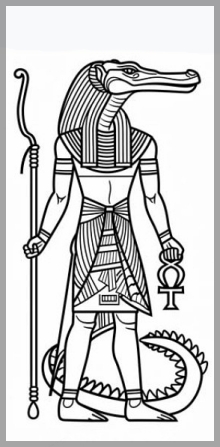 Over a period of 3,000 years, ancient Egypt’s pantheon of gods numbered between 1,400 and 2,000. During that time, some faded in prominence and new gods appeared. Often depicted as part human and part animal, Egypt’s gods had names, unique back-stories, and their own domain and expertise. Each god/goddess was responsible for a certain part of daily life, from motherhood to music, record keeping to funerals, and cosmic order to hunting. While the ten plagues God sent Egypt through Moses and Aaron may seem somewhat arbitrary to us in the 21st century, every one of them was a direct attack on one or more Egyptian god. They were the ultimate “smack-down” between God Almighty and Egypt’s deities.
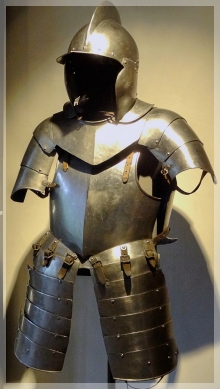 A Latin word, lorica originally meant armor or breastplate. Because of an ancient practice of inscribing a prayer on the armor or shields of knights who then recited the prayer before combat, lorica came to mean a prayer of protection.
 When we celebrate St. Patrick’s Day tomorrow, I suspect the revered bishop who brought Christianity to Ireland in the 5th century wouldn’t recognize this day in his honor. Originally a religious feast, it’s now a day for parades, sales, “Kiss Me I’m Irish” t-shirts, corned beef and cabbage, music, dancing, and lots of green (including hair, cookies, the Chicago River, milk shakes, and kegs of beer). St. Patrick, however, would recognize the common symbol of the day: the shamrock. Of course, to Patrick, the shamrock, with its three leaflets bound by a common stem, was a metaphor for the Holy Trinity. The shamrock’s three leaflets also came to symbolize faith, hope, and love.
 Flawed people that we are, we want to play down our culpability before God by minimizing sin and thinking of some sins as less significant than others. We’d like to think if we avoid the “big ten” Moses brought down from Mt. Sinai that we’re good and righteous people. God didn’t stop telling us how to behave with those two tablets! What about the hundreds of commands we find in the New Testament? Can we truthfully say we do nothing “out of selfish ambition or conceit” while we do everything “without grumbling and arguing?” [Phil 2:3,14] Are we ever conceited, boastful, or envious? [Gal 5:26] Do we show favoritism or partiality? [James 2:3-4] How are we doing in the loving our enemies and praying for them, forgiveness, and self-denial departments? [Matt 5:22,44;16:24] Are we truly free of “malice, all deceit, hypocrisy, envy, and all slander”? [1 Pet 2:1] Those sins are no less an affront to God than worshipping an idol or murdering a spouse. Every sin we commit damages our relationship with God.
 Devotions of the Heart