HOW TO PRAY (Prayer – 2)

I desire then that in every place the men should pray, lifting holy hands without anger or quarreling. [1 Timothy 2:8 (ESV)]

We always knelt for prayer in the church I attended as a girl so I used to think the only way to pray was on my knees with head bowed and hands tightly clasped. While I now pray in a variety of postures, I wondered if Scripture tells us exactly how we should pray.

In Jesus’ day, both Jews and pagans usually raised their heads, stretched out their arms, and stood to pray. John tells us Jesus prayed with his head lifted before heading out to the Garden of Gethsemane but Matthew tells us He prayed prostrate on his face once he got there. When praying, Moses bowed his head before the Lord and the tax collector stood, bowed his head, and beat his breast. Solomon and Daniel both knelt in prayer, a leper knelt at Jesus’ feet when praying for healing, and the 2nd century church historian Hegesippus reported that James (the earthly brother of Jesus) spent so much time on his knees praying that “his knees became hard like those of a camel.”  Elijah climbed to the top of Mt. Caramel, bowed down, and put his face between his knees when he prayed but Israel’s army fasted, wept, and sat when they prayed at Bethel. People seemed to pray every which way.

Pictures in the Catacombs of Rome show early Christians praying with their arms extended out to the side but, at some point, arms were brought closer to the body. Perhaps it was to avoid the very thing Jesus warned about—praying in an affected or exaggerated manner to appear more pious. Then again, it simply may have been a practical matter of space when people gathered for worship.

Eventually, people started praying either with clasped hands or by crossing their arms and touching each shoulder with the opposite hand. Legend has it that monks would fold strips of leftover dough into the shape of crossed arms and, when children had memorized a prayer, they’d be rewarded with these treats called pretiola, Latin for “little reward” or preces, Latin for “prayers.” In Germany, however, the country known for pretzels, they’re called bretzels. The origin of bretzel, however, is brachium, Latin for “arms.” Whether the word initially meant reward, prayer, or arms and the validity of a monk inventing the knotted shape of the pretzel to symbolize arms crossed in prayer, we’ll never know. It does, however, make a nice story.

By the 9th century, Greek Christians claimed that the only way to pray was with the hands crossed over the breast but Pope Nicholas vehemently opposed it and defended the practice of folded hands during prayer. The Roman and Orthodox churches split in the 11th century and today it is considered proper etiquette in an Orthodox church to cross one’s arms when approaching the chalice during Communion. The Old Orthodox Prayer Book calls for the “brethren to stand with their arms folded over their breasts and their heads slightly bowed” during the reading of the Six Psalms. One source said such a stance symbolizes the folding of angels’ wings, standing before the throne of God.

Standing, sitting, kneeling, or prone? Hands clasped, arms raised, crossed, or at our sides? Eyes open or shut? While various denominations have their traditions or rules, the Bible gives no guidance as to our posture during prayer. While silent on the position of our bodies in prayer, Scripture isn’t when it comes to the position of our hearts! They should be bowed in submission to the Lord, free of anger and quarreling, and forgiving of others. Our prayers should come from an earnest, trusting, sincere, and thankful heart. We are to pray in truth and faith, in the power of the Spirit, and in Jesus’ name. How we do it, however, is up to us.

Perhaps there is no one special position for prayer because we are to pray without ceasing, meaning prayer isn’t limited to a specific time, place or situation—it is to be an essential ongoing part of our lives. Standing upright with head raised while on the battle field would be as problematic as kneeling in prayer (or closing your eyes) while driving, praying with arms crossed while serving food at the shelter, or lying face down on the floor of your workplace! As Reverend Billy Graham so aptly put it, “It is not the body’s posture, but the heart’s attitude that counts when we pray.”

A concentrated mind and a sitting body make for better prayer than a kneeling body and a mind half asleep. [C.S. Lewis]

Rejoice always, pray without ceasing, give thanks in all circumstances; for this is the will of God in Christ Jesus for you. [1 Thessalonians 5:16-18 (ESV)]

Copyright ©2022 jsjdevotions. All rights reserved.

TEACH US TO PRAY (Prayer – 1)

Once Jesus was in a certain place praying. As he finished, one of his disciples came to him and said, “Lord, teach us to pray, just as John taught his disciples.” [Luke 11:1 (NLT)]

Hawaiian sunset vineWhile asking one’s teacher how to pray was a typical request in Jesus’ day, Jesus was anything but a typical teacher. He’d walked on water, stilled storms, healed the sick, raised the dead, and turned water into wine, but His disciples didn’t ask how to do those impressive miracles. Instead, they asked Him how to pray.

Even though they didn’t completely recognize the divinity of Jesus, the disciples understood that His power seemed to come from prayer. Jesus prayed at his baptism and before choosing his disciples; He prayed before heading to Galilee and both before and after feeding the 5,000. He said a prayer of thanksgiving before offering His rest and yoke to the people and prayed with Peter, John, and James before His transfiguration. He prayed after healing people in Capernaum and before raising Lazarus from the dead. He prayed for the disciples and “all who will ever believe in me through their message.” [John 17:20] He prayed when blessing the little children, for Peter’s faith, in Gethsemane, and when He was nailed to the cross. When He wasn’t teaching or sleeping, Jesus seemed to be praying. In fact, he’d been praying when the disciples asked him how to pray!

Jesus didn’t conduct a seminar, preach a three-point sermon, categorize types of prayers, or set special requirements like those found in the Torah. He said nothing about the wearing of phylacteries, putting fringe on a prayer shawl, or the number of times to pray in a day. Instead of talking about prayer, Jesus simply prayed. This uncomplicated prayer we know as the Lord’s Prayer gave them (and us) the guidelines for all prayer. In simple everyday language Jesus offered praise, thanksgiving, petition, and asked for forgiveness and protection from evil.

Yet, for some reason, we Christians aren’t satisfied with such a straightforward process. Surely something as powerful as prayer should be more complicated! Convinced there must be a secret technique to mastering the art of prayer, we wonder if there are special words or phrases we should say. There aren’t. Prayer simply is an intimate interaction with God and isn’t supposed to be difficult. In fact, God really gave us only one rule: “You must not have any other god but me.” [Exodus 20:3]

Other than the Lord’s Prayer, which is just a blueprint for prayer, we haven’t been given a specific prayer to recite. In fact, the only prayer Jesus commends is perhaps the simplest one—that of the repentant tax collector who just said, “O God, be merciful to me, for I am a sinner.” [Luke 18:13] It’s a plainly expressed sincere prayer, offered with a humble and repentant heart, and Jesus assures us that it will be heard.

We already know all we really need to know about prayer to pray and praying is far easier (and safer) than riding a bike. We just need to do it. Just like bike riding, however, we’ll get better at praying the more we do of it!

Prayer is talking with God. God knows your heart and is not so concerned with your words as He is with the attitude of your heart. [Josh McDowell]

Don’t worry about anything; instead, pray about everything. Tell God what you need, and thank him for all he has done. Then you will experience God’s peace, which exceeds anything we can understand. His peace will guard your hearts and minds as you live in Christ Jesus. [Philippians 4:6-7 (NLT)]

Never stop praying. [1 Thessalonians 5:17 (NLT)]

Copyright ©2022 jsjdevotions. All rights reserved.

KEEPING THE PEACE

But the wisdom that comes from heaven is first of all pure and full of quiet gentleness. Then it is peace-loving and courteous. It allows discussion and is willing to yield to others; it is full of mercy and good deeds. It is wholehearted and straightforward and sincere. [James 3:17 (TLB)]

tiger swallowtail - butterflyWe were having lunch at a local sports bar filled with televisions airing football, soccer, BMX, skiing, and hockey all at the same time. I find the restaurant’s many glaring screens disconcerting and were it not for the gyro my husband claims is the best one in town, we wouldn’t have been there. While sitting across from him, I looked up and saw two fighters viciously pounding one another in an MMA bout. Evoking images of Roman gladiators in battle and combining combat techniques from boxing, wrestling, judo, jiu-jitsu, and the back alley, this sport seems to allow just about everything short of eye gouging and biting! With neither fighter wanting to be the loser, no matter how battered or bloody, they continue until someone is knocked out, a fighter submits, or the referee stops it because of severe injury.

Unfortunately, most fights aren’t limited to a cage or boxing ring and, while they may be less violent, they are no less damaging. Rather than punching, twisting arms, kicking, or choking our opponent, we use our words, voices, and even social media in an attempt to pummel him or her into submission! With neither party willing to submit, both are determined to keep going until the other person yields to their viewpoint or simply surrenders. Instead of conceding that we might learn something from those with whom we disagree, our sole goal is to convince them of the correctness of our way of thinking and the idiocy of theirs. Wanting to win the bout, we’re unwilling to hear one another or admit that our opposition could have a valid viewpoint. It rarely occurs to us that our differences are something to be respected or that there’s a possibility (however remote) we actually could be wrong.

Rarely, in a disagreement, do we even consider the option of yielding to the other person. Yet, if both people expect the other person to concede and are unwilling to make any concessions themselves, how can our disagreements ever be resolved? Unlike an MMA match, we don’t have a referee to stop the fight, judges to decide the victor, or even a corner man who will “throw in the towel” to stop the bout! Sadly, what often begins as a difference of opinion ends up becoming an argument of huge proportions. At least there’s a time limit for an MMA match; there’s none for arguments and I’ve known some people who have remained in fight mode for decades.

I’ve never been in an MMA bout but I do remember being in a tug-of-war and, from my experience, neither side ever really wins and victory comes at a cost. One side may end up with bragging rights but both sides end up with rope burns, sore muscles, bruises, and muddy clothing! The easiest way to end a tug of war is to drop the rope and the easiest way to end an argument is to stop arguing!

The wisdom from above doesn’t escalate conflicts or contribute to discord. It respects, listens, and knows how to get out of “no-win” situations. God’s wisdom doesn’t let pride take over when peace should reign. It is willing to step back and let the other side “win,” knowing that it hasn’t lost a thing. Wisdom is willing to negotiate and, if necessary, to concede. True wisdom remembers that nobody wins if someone ends up feeling humiliated, besmirched, or defeated.

A Christian has no right being in a fight unless it’s a spiritual fight. [Charles Stanley]

And those who are peacemakers will plant seeds of peace and reap a harvest of goodness. [James 3:18 (TLB)]

Copyright ©2022 jsjdevotions. All rights reserved

NO SMALL PARTS 

Here is a simple, rule-of-thumb guide for behavior: Ask yourself what you want people to do for you, then grab the initiative and do it for them. Add up God’s Law and Prophets and this is what you get. [Matthew 7:12 (MSG)]

gardeniaWhen the Academy Awards were held recently, Oscars were presented for things like best director, best lead and supporting actors and actresses, and even best make-up and hair styling. If it’s true (as my theater teachers claimed) that, “There are no small parts, only small actors!” how is it that no awards were given to the best small part players? Regardless of the perfection with which they may have fulfilled their “bit parts”, their screen time was too short to be nominated for anything. To add insult to injury, they may have been known only as Dog Walker or Nurse #2! The small role, however, doesn’t mean the character played an insignificant part in the story. Nevertheless, after moving the story forward, the bit part players just fade into the background. Even so, while their names may be forgotten, the story wouldn’t have been the same had they not played their roles.
When thinking of the people who passed through our lives, we know who the major players are but what of the others, the ones who left a small but indelible mark on us—the people with the bit parts in the scripts of our lives? We may have forgotten their names or never have known them at all. Perhaps it was a neighbor who always waved and smiled when you passed by, the teacher who said you weren’t “dumb,” the trucker who changed your flat tire, or the nurse who let you hold your stillborn baby until you were ready to let him go. It may have been the stranger on the plane who prayed with you as tears rolled down your cheeks, the woman who said “You’re beautiful!” when the scarf slipped off your bald chemo-head, or the stranger who listened when you desperately needed to talk. Whether it was a small kindness, words of encouragement, a little unasked-for (but much needed) help, prayers, a chat over coffee, or just a hug, the bit players in our lives played fleeting but pivotal roles and our interactions, while short-lived, changed us in unexpected ways. They listened, challenged, suggested, assisted, shared, taught, and demonstrated God’s love. They had only a few lines of dialogue in the script but the movie of our lives would be incomplete had their scenes been cut by the film editor.

Granted, there probably are a few unpleasant, painful, or upsetting encounters with bit part players we might prefer having been edited out of our lives, but we don’t need to dwell on those. Let’s remember, however, that we are the small part players in other people’s lives—whether it’s the bagger at the grocery, the receptionist at the doctor’s, the busser at the restaurant, the lonely widow down the street, the kid trying to sell over-priced candy or popcorn for his team, the person giving us technical assistance on the phone, the mom with the crying baby on the plane, or the annoying telemarketer. How will we play our role? Will it be worthy of a heavenly award?

What does love look like? It has the hands to help others. It has the feet to hasten to the poor and needy. It has eyes to see misery and want. It has the ears to hear the sighs and sorrows of men. That is what love looks like. [Augustine]

So let’s not allow ourselves to get fatigued doing good. At the right time we will harvest a good crop if we don’t give up, or quit. Right now, therefore, every time we get the chance, let us work for the benefit of all, starting with the people closest to us in the community of faith. [Galatians 6:9-10 (MSG)]

Copyright ©2022 jsjdevotions. All rights reserved.

PHILIP AND THE EUNUCH – Part 3

When they came up out of the water, the spirit of the Lord snatched Philip away, and the eunuch didn’t see him any more, but went on his way rejoicing. Philip, however, turned up at Azotus. He went through all the towns, announcing the good news, until he came to Caesarea. [Acts 8:39-40 (NTE)]

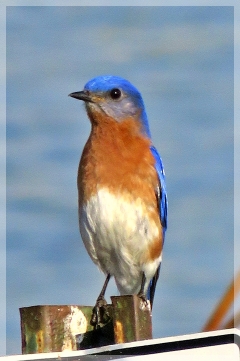
blue birdWe don’t know how far Philip and the Ethiopian traveled together before the eunuch spotted water. The book of Isaiah is 66 chapters long and there was a lot to cover as Philip told him about the man called Jesus, so it may have been as far as Gaza. It is there that the road split—north to Caesarea and south to Egypt and Ethiopia. While we don’t know the location, we just know that the Ethiopian was baptized when they came to water.

After the baptism, the logical thing for Philip would be to continue south beyond Egypt to the Ethiopian’s homeland. With the support of a rich and powerful man like the Queen’s treasurer, Philip would have been remarkably effective in bringing the gospel to a new part of the world. God’s logic, however, is nothing like man’s. When the men emerged from the water, we’re told that the “Spirit of the Lord” snatched Philip away and the eunuch never saw him again.

The Greek word Luke used was harpazó which meant to seize, catch up, or snatch away. Often used when speaking of a robbery or an arrest, the power clearly belonged to the snatcher rather than the snatchee. Does this mean that Philip was supernaturally carried away north to Azotus? Or does it mean that Philip was carried away by a vision of the Spirit and he immediately changed direction and departed on another God-ordained appointment? It’s unclear whether Luke was writing figuratively or literally, but we do know that the men abruptly departed from one another.

After this significant episode in the advancement of the Gospel, what became of these two men? It hardly seems likely that the Holy Spirit would leave a new convert like the Ethiopian high and dry! Perhaps the scroll, Philip’s words, and the Holy Spirit’s presence were all the man needed. In the 2nd century, Irenaeus, bishop of Lyon, wrote that the eunuch became a missionary to the Ethiopians and, in the 4th century, Eusebius (260-339), the man called “the father of church history,” asserted that, filled with the Holy Spirit, the Ethiopian planted a flourishing church in Ethiopia. All we know for sure, however, is that he “went on his way rejoicing.”

Scripture does tell us that Philip preached the gospel in the coastal cities of Palestine from Azotus north to Caesarea. Because Paul and Luke stayed with him some twenty years later, we know Philip eventually settled in Caesarea, married, and had four daughters. The men stayed with Philip several days and it may have been then when Luke learned of Philip’s encounter with the Ethiopian eunuch.

Rather than an apostle, Philip was one of the seven men selected as a deacon for the early church. A deacon’s job was to distribute food to the widows and alms to the poor and to handle everyday church business so that the apostles could spend their time praying and teaching. Along with identifying Philip by his position as deacon, Luke identified him by his passion and called him “the Evangelist.” The Greek word translated as evangelist was euaggelisté. Used to mean “preacher of the gospel,” its literal meaning is “bringer of good news” or “bearer of glad tidings.”

Evangelism isn’t an occupation; it is a passion. While most of us don’t qualify as “preachers of the gospel,” all can be bearers of glad tidings! When we look at Philip, we see someone who had a passion for Christ—who, when given an opportunity to share the gospel, didn’t say it wasn’t his job. He didn’t doubt, negotiate, hesitate, or refuse—he simply followed the Spirit’s lead and was a “bringer of good news.” Can we do anything less?

This is my solemn charge to you, in the presence of God and King Jesus, who will judge the living and the dead, and by his appearance and his kingdom: 2 announce the word; keep going whether the time is right or wrong; rebuke, warn and encourage with all patience and explanation. … But as for you, keep your balance in everything! Put up with suffering; do the work of an evangelist; complete the particular task assigned to you. [2 Timothy 4:1-2,5 (NTE)]

Copyright ©2022 jsjdevotions. All rights reserved.

PHILIP AND THE EUNUCH – Part 2

Tent Rock - New MexicoGo therefore and make disciples of all nations, baptizing them in the name of the Father and of the Son and of the Holy Spirit, teaching them to observe all that I have commanded you. And behold, I am with you always, to the end of the age. [Matthew 28:19-20 (ESV)]

As Philip was walking down the road to Gaza, a chariot overtook him. Riding in it was the Ethiopian eunuch. Scripture tells us he’d been to Jerusalem to worship. Deuteronomy 23:1, however, stipulates that no emasculated male can be included within the Jewish religious community or allowed to enter the Temple area. Even though he’d been to Jerusalem to worship, possessed a costly sacred scroll, and hungered for God, this man who feared God and identified with Judaism wasn’t welcome. As a castrated man, he wasn’t a Jewish convert and never could hope to be.

The Spirit instructed Philip to walk beside the eunuch (who just happened to be reading aloud the words of Isaiah). While reading out loud seems strange to us, it was a common practice at the time. With no punctuation or space between the words, reading aloud aided in understanding the text. When Philip asked if the man understood what he was reading, the eunuch replied with a question of his own: “How can I, unless someone instructs me?” When Philip joined him in the chariot, the man wondered to whom Isaiah’s prophecy of the suffering servant applied. Was Isaiah speaking of himself or someone else? Beginning with Isaiah 53 and continuing on through the scroll, Philip told him all about Jesus.

When the eunuch saw water, rather than asking to be baptized, he asked why he couldn’t be baptized. As a Jewish sympathizer, he knew that a full immersion baptism, known the tevilah, was essential for conversion to Judaism but was prohibited to him. Perhaps he expected Philip to tell him that Jesus found him as unacceptable as did Jewish law. Philip didn’t; instead, the two men immediately stopped and Philip baptized the Ethiopian man!

What do you think are the are the odds of a Greek-speaking Nubian (Greek was the language of the royal courts), who’s a follower of Judaism, reading aloud from a Jewish scroll written in Greek (the Hebrew Scriptures had been translated into Greek in the 3rd century BC) that prophesized Jesus and, at that very moment, encountering a Jewish Greek-speaking follower of Jesus from Samaria on a 50-mile stretch of road between Jerusalem and Gaza? What are the odds of them coming upon water on a “desert road” exactly when the man wants to be baptized? What are the odds of a wealthy foreign official allowing a mere commoner (one who’d been walking for several days) into his chariot? For that matter, what are the odds of the man who ran the national treasury admitting he didn’t understand a simple scroll? This, however, was a divine appointment orchestrated by God!

God took Philip 50 to 100 miles out of his way to meet someone considered unacceptable and defective under the old law and bring him to Jesus under the new one! In that one encounter, by bringing the Good News to a foreign eunuch, Philip fulfilled a prophecy found in Isaiah 56! When circumstance align perfectly, as they do in this narrative, we often attribute them to coincidence. There are, however, no coincidences in God’s plan. Both the Ethiopian and Philip may have been surprised that day, but God certainly wasn’t! He never is!

Divine appointments await us all if we are obedient to God’s leading!

Let not the foreigner who has joined himself to the Lord say, “The Lord will surely separate me from his people”; and let not the eunuch say, “Behold, I am a dry tree.” For thus says the Lord: “To the eunuchs who keep my Sabbaths, who choose the things that please me and hold fast my covenant, I will give in my house and within my walls a monument and a name better than sons and daughters; I will give them an everlasting name that shall not be cut off. [Isaiah 56:3-5 (NLT)]

Copyright ©2022 jsjdevotions. All rights reserved