
“Yes,” Jesus replied, “and I assure you that everyone who has given up house or brothers or sisters or mother or father or children or property, for my sake and for the Good News, will receive now in return a hundred times as many houses, brothers, sisters, mothers, children, and property—along with persecution. And in the world to come that person will have eternal life. [Mark 10:29-30 (NLT)]
 If I were doing what accountants call a cost-benefit analysis of our living in Florida, the cost side would include venomous snakes, poisonous cane toads, hurricanes, alligators, sink holes, fire ants, and mosquitos along with humidity, allergies, high insurance, and seasonal traffic. On the other hand, the benefits would include never having to shovel snow, scrape sleet from a windshield, or drive on icy roads, along with the enjoyment of beaches, beautiful birds, colorful flowers, ocean breezes, “early-bird” specials, sunshine, no state income tax, and never-ending summer. While not one hundred times better, the pluses outweigh the negatives and make it worthwhile (at least for us)!
When Peter asked Jesus how His followers would be rewarded, he simply was doing a cost-benefit analysis. Knowing the sacrifices they made, he wanted to know the reward. At first, Jesus’ answer to the disciple’s question seems the kind of puffery we’d expect from politicians and used car dealers. Promising blessings both in this life and in the next, Jesus assured Peter of a hundredfold return. A return of 100% would be exactly what had been forsaken but a return of a hundredfold is one hundred times better than whatever was sacrificed!
As for that hundredfold return of houses, property, and family—thank you, Jesus, but I don’t want 100 houses, 200 cars, 100 spouses, or 300 children, let alone 500 grands! I’ve got more than I can handle with what I have right now! While any people or things we sacrifice to follow Jesus are literal, common sense tells us that any people or possessions gained are figurative, spiritual, and eternal. A soul, while not of substance, is irreplaceable and its worth is incalculable! Additionally, along with eternal life, Christ’s followers actually do get a new and larger family in His church and a new home in His Kingdom! Moreover, His promise was not one of prosperity! Although Jesus promised His followers their lives would be richer for their sacrifices, He never said they’d be wealthier!
Unlike politicians and car dealers who might hide the true cost of their promises, Jesus reiterated the price of discipleship throughout the Gospels. In fact, smack dab in the middle of that hundredfold return, He promised persecution! While we prefer His promised blessings to any persecution, sacrifice, trials, or suffering, they’re a package deal—we won’t get one without the other. Moreover, that hundredfold return is conditional! The sacrifices are to be made for His sake and that of the gospel rather than for personal gain. Jesus never promised that life will get easier when we follow Him but He did promise that it would become immeasurably better—both in this world and the next!
Jesus told us to count the cost before choosing to follow Him. A cost-benefit analysis of discipleship tells us the price we pay is our lives but the benefits of God’s Kingdom and eternal life outweigh the cost more than a hundredfold! There certainly are times serving Jesus and His church with our time, talents, gifts, and money seems a heavy price to pay but true discipleship (and all of the sacrifice, difficulty, and even persecution that may arise from it) comes with the territory just as living with hurricanes and mosquitos come with retiring in Florida! In both cases, it’s more than worth it.
Not one man has ever sacrificed for his Lord without being richly repaid. If the cross is only contrasted with earthly pleasures lost, it may seem hard and threatening. But when the cross is weighed in the balances with the glorious treasures to be had through it, even the cross seems sweet. [Walter J. Chantry]
 When a rich man asked Jesus what he needed to do to have eternal life, the Lord told him to sell everything and give it to the poor. More willing to part with eternal life than his riches, the disappointed man departed. When Jesus explained, ”It is easier for a camel to go through the eye of a needle than for a rich person to enter the kingdom of God,” the disciples were astonished. Jewish tradition held that riches were a sign of God’s blessings and favor while poverty and sickness were God’s curse. If a rich man couldn’t get into the kingdom, they wondered who could.
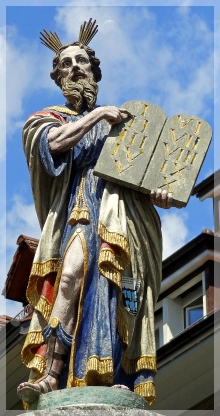 Although three places in Scripture tell us that the Lord proclaimed ten commandments and wrote them on stone tablets, those tablets weren’t numbered (especially not with Roman numerals)! The original languages of the Bible (Hebrew, Aramaic, and Greek) didn’t contain punctuation and the earliest manuscripts didn’t even have spaces between the words. While the words in Scripture are God-breathed, the punctuation was at the discretion of later copyists and translators. Without numbering, punctuation, or paragraphs, we can’t know for sure where one commandment ends and the other begins. As a result, while Jews, Roman Catholics, Protestants, and Orthodox Christians all observe the Ten Commandments, their commandments are not all the same!
 On June 19, Louisiana’s Governor Jeff Landry signed legislation requiring all public K-12 classrooms and state-funded universities to display a poster-sized version of the Ten Commandments in “large, easily readable font” in every classroom next year. As expected, a lawsuit has been filed to block what some say is an unconstitutional requirement. I’ll leave the arguments about civil liberties and constitutional law to the lawyers and courts; Louisiana’s law is troubling for other reasons.
 Although our Bibles call Hagar a servant, she had no choice in the matter. Along with sheep, goats, cattle, donkeys, and camels, the Egyptian woman probably was given to Abraham as part of the bride-price Pharaoh paid for Sarah in Genesis 12:16. As his property, Hagar couldn’t refuse when Sarah decided to use her servant’s womb and Abraham impregnated her. Once pregnant, the powerless victim of Sarah’s scheme taunted her mistress with her fertility and Sarah retaliated by treating her harshly. Abraham washed his hands of the women’s conflict by telling Sarah the way she treated (or mistreated) the woman was her business, not his! Hagar meant nothing to Abraham; she was little more than a brood mare who served her purpose.
 In what’s known as the Abrahamic covenant, God promised Abram (later called Abraham) that he would found a great nation and that through him all nations would be blessed. After receiving God’s promise, Abraham departed Haran, arrived in Canaan, went to Egypt to escape a famine, returned to Bethel, separated from Lot, and rescued him from King Kedorlaomer. In those ten years, however, despite God’s promise, Abraham’s wife Sarai (later known as Sarah) had not become pregnant. When he grew despondent that he was without an heir, God repeated his promise of a son through Sarah and reassured Abraham of as many descendants as there were stars in the sky.
 Devotions of the Heart