BURDENS AND LOADS (Galatians 6:2-5 – Part 2)

Each of you, you see, will have to carry your own load. [Galatians 6:5 (NTE)]

he ain't heavyAfter saying we must carry each other’s burdens, the Apostle Paul seems to reverse himself three sentences later when he tells us we each must carry our own loads. It’s confusing; if we’re all supposed to carry our own loads, then nobody should need help carrying their burdens!
A few sentences previous to these verses, however, Paul encourages the Galatian church to follow the Spirit’s lead in their lives and now he’s explaining how walking in the Spirit actually looks—carrying one another’s burdens and carrying our own load. The Greek word Paul used for load was phortion, meaning load or cargo, and it was the word used for a marching soldier’s pack. Paul used the word figuratively to speak of the general responsibilities of life which we all have to bear. Like a soldier’s pack, this load is neither excessively heavy nor difficult to carry. In contrast to the oppressive burden of the Law demanded by the Pharisees, this load is the same phortion Jesus assigned to His followers. Things like discipleship, loving others, and forgiving one another are our load or phortion—obligations for which we alone are responsible.

When Paul wrote of carrying one another’s burdens a few sentences earlier, however, he used the Greek word baros, meaning something extremely heavy. Unlike a soldier’s pack, a baros is a crushing load too heavy for one person to bear alone. Baros was the word Paul used when describing the crushing weight that “was far too heavy for us; it got to the point where we gave up on life itself,” in 2 Corinthians 1:8. It is burdens like his that we are called to carry for one another.

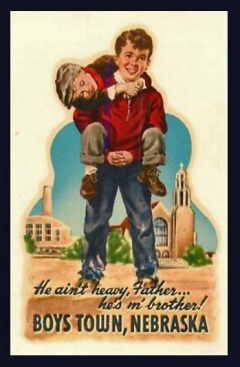
When I was a girl, Christmas seals were sent to us as a method of fundraising by Father Flanagan’s Boys Town. The story behind the picture on those stamps illustrates baros and phortion. A young boy named Howard was abandoned at Boys Town shortly after it opened in 1917. Having had polio, he wore heavy leg braces and couldn’t negotiate the staircases so the bigger boys carried him up and down the stairs. When Father Flanagan asked one of the boys if carrying Howard was hard, the answer was, “He ain’t heavy, Father, he’s my brother!” Years later, those words, accompanied by a photo of the two boys, became the organization’s logo. The burden of going up and down stairs was too great for Howard to bear alone. Because it was a baros, the other boys carried him. On the other hand, Howard was fully capable of doing his school work and helping the younger boys. Had he not done so, he would have failed to carry his own phortion.

While each of us is responsible for fulfilling our Christian duties by carrying our own phortions, one of those duties is to carry another person’s baros! It won’t seem heavy because we’ll be carrying our brother!

Pick up my yoke and put it on; take lessons from me! My heart is gentle, not arrogant. You’ll find the rest you deeply need. My yoke is easy to wear, my load (phortion) is easy to bear. [Matthew 11:29-30 (NTE)]

Copyright ©2021 jsjdevotions. All rights reserved.

FILL THE TANK

Hungry and thirsty, they nearly died. “Lord, help!” they cried in their trouble, and he rescued them from their distress. … Let them praise the Lord for his great love and for the wonderful things he has done for them. For he satisfies the thirsty and fills the hungry with good things. [Psalm 107:5-6,8-9 (NLT)]

Trumbull cemetery - OhioMy father had what’s often described as a Type-A personality. An impatient workaholic, he always took on more than he could handle. Life, for him, was one crucial task after another, none of which anyone else could do, at least not correctly. Always in a hurry, he never wanted to stop for anything, even when his gas gauge read precariously close to empty. Something more pressing always took precedence over a brief stop for gas. As a result, his car was often left on the roadside while he trudged off with a gas can to find the nearest service station. Instead of saving time, his refusal to stop cost him time. Living that way actually cost him his life; he died of a massive coronary at the age of fifty-six. It’s often been said that your in-box still will be full when you die and, indeed, his was. None of us can accomplish everything on our to-do list and we may well destroy both our relationships and ourselves while trying.

Unlike my father, most of us will stop at a gas station when our cars need fuel. Having spent hours stranded on country roads waiting for my father to return with a can of gasoline, my gas tank is never less than half full. But, like my father, I’m not always so careful about keeping my spiritual tank full. No matter how organized I try to be, my to-do list seems to get longer while the days remaining get shorter. Sometimes, I feel like I’m just running on fumes and I don’t think I’m the only one!

Unfortunately, just as my father ignored his gas gauge, we often ignore signs like anger, worry, sadness, impatience, and temper that tell us our supply of spiritual fruit is dangerously low. It often takes a squabble, blow-up or crisis before we finally stop and refuel with God. Of course, the wiser choice is to top off our tanks with daily prayer and meditation so we never run low!

When asked about his plans for the following day, it’s been said that theologian, professor, author, Bible translator, reformer, pastor, husband and father Martin Luther replied: “Work, work from early until late. In fact, I have so much to do that I shall spend the first three hours in prayer.” If we’re too busy to stop for gas, we’re busier than we should be. Martin Luther knew that, if we’re too busy to pray, we’re busier than God wants us to be.

Heavenly Father, sometimes we allow the challenges of everyday life to keep us from spending time with you and we run precariously low of the love, joy, peace, patience, kindness, goodness, faithfulness, gentleness, and self-control your Spirit so graciously provides. Help us accept that we can’t do it all and that there will always be another task waiting right around the corner. Guide our priorities, Lord so that you’re on the top of our to-do list every day. Remind us that you are all we really need and help us see a brighter tomorrow in your promises. Lead us to that peaceful place of your presence. Refresh and renew us and let your Holy Spirit fill us up again.

No one ever said at the end of his days, “I have read my Bible too much, I have thought of God too much, I have prayed too much, I have been too careful with my soul. [J.C. Ryle]

The Lord is my shepherd; I have all that I need. He lets me rest in green meadows; he leads me beside peaceful streams. He renews my strength. He guides me along right paths, bringing honor to his name. [Psalm 23:1-3 (NLT)]

I pray that God, the source of hope, will fill you completely with joy and peace because you trust in him. Then you will overflow with confident hope through the power of the Holy Spirit. [Romans 15:13 (NLT)]

Copyright ©2021 jsjdevotions. All rights reserved.

FOLLOWING HIM

Then, calling the crowd to join his disciples, he said, “If any of you wants to be my follower, you must give up your own way, take up your cross, and follow me.” [Mark 8:34 (NLT)]

cross country skiingOur pastor recently did a sermon series called “Following Jesus” which reminded me of our first time backcountry skiing in Colorado more than forty years ago. As novices, we knew enough not to venture into the wilderness by ourselves so we hired Wyatt to be our guide. Insisting we delay our trek several days until we’d acclimated to the high altitude and were ready for such a trip, he gave us a long list of items we had to carry in our packs. When I asked why we needed all the survival gear along with additional food, water, and clothing, he said we had to be prepared to spend the night. Protesting that I didn’t want to spend the night out in the cold and snow, he explained, “Neither do I, but we better be prepared to do it.”

Before starting out, Wyatt examined our backpacks to make sure we had everything on his list. Our packs were heavy but his was much heavier with a tent, extra ski tips, ax, first aid kit, shovel, and more. Because falling in several feet of Colorado powder is far different than falling in a few inches of Midwest snow, Wyatt insisted on teaching us a new way of getting up after a fall and made us practice the technique several times before we began.

Once we got started, Wyatt did the hard part by breaking trail in the deep snow and keeping us clear of any slopes posing avalanche danger. To allow us to fully experience the wilderness, we waited until the skier ahead was just out of sight before starting out. Winding our way through both open meadows and woods in this great expanse of white, we would have been hopelessly lost if we hadn’t been following Wyatt’s tracks. Without seeing each other, I felt alone in the wilderness but I never was. Wyatt frequently stopped to check on us and made us rest and hydrate before continuing. We followed his tracks to a picturesque spot for lunch where he showed us how to stomp out a place for a fire and use our skis as chairs. As pleasant as our lunch in the forest was, Wyatt didn’t let us linger too long since he wanted us back to our car before dusk.

Late that afternoon, some tired but happy skiers made their way back toward the road. Just as we caught sight of our car, a winter storm blew in and, by the time we’d stowed our gear, our tracks were completely covered by snow. Caught in that unexpected whiteout, I finally understood why Wyatt had insisted we be prepared to spend the night in the mountains. Had we started out a half hour later, lingered over lunch, or skied back a little slower, we would have been caught in the blinding storm and might well have spent the night on the mountain. Without his guidance, what should have been a delightful day up on the pass could have had a bad ending but, because we followed a good guide, we returned safely home that night.

Even though Wyatt merely guided us on a high mountain pass and Jesus guides us through life, I can’t help but see parallels between following a mountain guide and following Jesus. In either case, we must recognize our inability to make the journey on our own and submit to the guide’s directions, requirements, and timeline. Both prepare us for the challenges ahead, point out hazards, teach us new skills, and never take us beyond our ability. Knowing we’ll fall, they show us how to get up again and, while we may carry a heavy pack, they carry the heaviest one and do most of the work. Keeping us from danger, both mountain guide and Jesus lead the way so we can follow in their footsteps. Even when we feel alone and can’t see them, we can have faith in both guide and Jesus, secure in the knowledge that neither will ever abandon us. Although they’ll make us rest, they’ll urge us on when we should get moving. Most important, just as our choice to follow Wyatt meant the difference between a good or bad outcome, our choice to follow Jesus means the difference between life and death.

There are, of course, some major differences between a mountain guide and Jesus. Even a guide as experienced as Wyatt can get lost but Jesus never will! To Wyatt, we were just paying customers but, to Jesus, we are beloved friends and children of God! Jesus wants us to follow Him, weather every storm, and arrive safely home not because it’s His job, but because He loves us! Through the years, we took several more backcountry tours until we learned enough to venture into the wilderness without a guide but we know that we’ll never be skilled enough to journey through life without following Jesus!

Hang this question up in your homes – “What would Jesus do?” and then think of another – “How would Jesus do it?” For what Jesus would do, and how He would do it, may always stand as the best guide to us. [Charles Spurgeon]

The Lord says, “I will guide you along the best pathway for your life. I will advise you and watch over you. [Psalm 32:8 (NLT)]

Show me the right path, O Lord; point out the road for me to follow. Lead me by your truth and teach me, for you are the God who saves me. All day long I put my hope in you. [Psalm 25:4-5 (NLT)]

Copyright ©2021 jsjdevotions. All rights reserved.

NEVER OBSOLETE 

Wisdom shouts in the streets. She cries out in the public square. She calls to the crowds along the main street, to those gathered in front of the city gate: “How long, you simpletons, will you insist on being simpleminded? How long will you mockers relish your mocking? How long will you fools hate knowledge? Come and listen to my counsel. I’ll share my heart with you and make you wise. I called you so often, but you wouldn’t come. I reached out to you, but you paid no attention. You ignored my advice and rejected the correction I offered.” [Proverbs 1:20-25 (NLT)]

When my little grands came to play, I’d dig out the Fisher-Price “little people” village that had been their parents. Being from the early 70s, it included a free standing phone booth and I had to explain what it was and why pay phones were necessary. Phone booths are so scarce now that I suspect Superman needs to find another changing room! I can’t remember when last I dialed a phone, let alone filled a fountain pen, used carbon paper or even a typewriter. Mimeograph machines, 45s, rabbit-ear antennas, 8-track, VHS, and cassette tapes are all long forgotten. 35 mm film has been replaced by digital technology, dictionaries by spell check, and that cumbersome 26 volume encyclopedia by search engines. If you don’t understand my references, you probably don’t have a landline phone or use an alarm clock, address book, pocket calendar or travel agent. You stream your music rather than play CDs, use a GPS rather than maps, and get your news on the Internet! It’s amazing how many things have become antiquated in just my lifetime. There is, however, one thing that hasn’t become obsolete in 3,500 years: the Bible!

The Bible isn’t some old book with no relevance to our modern lives; it is filled with stories that are as relevant to us today as they were thousands of years ago. Granted we have hybrid cars and iPads rather than donkeys and stone tablets, but mankind’s nature and desires haven’t changed in all these years. Instead of Bathsheba, it could be the pretty blond down the street and, instead of an apple, it might be that Gucci purse you can neither resist nor afford. Like Samson, we’re often tempted to brag and make poor choices in sweethearts and, like Jonah, we often are given tasks we don’t want. We must learn to set priorities as did Martha and to be as patient as Job. Like him, we may encounter overwhelming tragedy or, like David, face adversity, temptation, and loss. Responsibilities that seem overwhelming and endless will be thrust upon us as they were on Moses and, like Elijah, we’ll even get depressed and lonely.

The Bible is far more than a rule book; it’s life’s instruction manual. It’s a guide to finding God and knowing His will. Moreover, it gives us the benefit of thousands of years of other people’s experience. Of course, all that knowledge means nothing if we don’t apply its lessons to our daily lives.

Time can take nothing from the Bible. It is the living monitor. Like the sun, it is the same in its light and influence to man this day which it was years ago. It can meet every present inquiry and console every present loss. [Richard Cecil]

Be careful to obey all the instructions Moses gave you. Do not deviate from them, turning either to the right or to the left. Then you will be successful in everything you do. Study this Book of Instruction continually. Meditate on it day and night so you will be sure to obey everything written in it. Only then will you prosper and succeed in all you do. [Joshua 1:7-8 (NLT)]

Copyright ©2021 jsjdevotions. All rights reserved.

TAKE THE WEIGHT OFF! (Hebrews 12:1-2 – Part 2)

What about us, then? We have such a great cloud of witnesses all around us! What we must do is this: we must put aside each heavy weight, and the sin which gets in the way so easily. We must run the race that lies in front of us, and we must run it patiently. We must look ahead, to Jesus. He is the one who carved out the path for faith, and he’s the one who brought it to completion. [Romans 12:1-2 (NTE)]

When Alexander the Great’s army was advancing on Persia, his troops were so weighted down by the spoils of war they’d taken in earlier campaigns that they moved too slowly to be effective in combat. At one critical point, it seemed that defeat was inevitable. As much as the greedy Alexander desired the silver, gold, and other treasures they’d pillaged, he ordered that all the plunder be thrown into a heap, burned, and left behind. Although his troops complained bitterly, they did as directed. Once unencumbered by the excess weight of their treasure, his army saw the wisdom of Alexander’s command when their campaign turned from impending defeat to victory. “It was as if wings had been given to them—they walked lightly again,” said one historian.

While I’m not sure of the truth of this story, it makes an excellent illustration of what the writer of Hebrews means when he tells us to lay aside every weight that slows us down. He didn’t say “some” of the weight; using the word pas, he meant every bit of it—the whole enchilada! Using the word ogkos, which meant a bulk or bulging mass, he was referring to any hindrance, burden or impediment. While there’s a specific mention of sin, other things can weigh as down, as well: disappointment, grief, shame, fear, worry, and material possessions. Not every weight, however, is as obvious. The excess weight in our lives could be seemingly harmless distractions like constantly checking email or social media, surfing the Internet, Netflix, TikTok, YouTube, gaming, shopping, or even crafting.

How do we know what’s hindering us? If it isn’t helping; it’s hindering! For example, Walt Disney was ruthless when it came to cutting anything from a film that interfered with its pace. One animator worked for nearly eight months on a four-and-a-half minute sequence in Disney’s Snow White. In it, the dwarfs made soup for Snow White and nearly destroyed the kitchen in the process. Disney liked the scene but he cut it—not because it was bad but because, rather than adding to the narrative, it slowed it down. If it didn’t help move the story forward, Disney knew it hindered!

As we begin this new year, now is a good time to ask God (and ourselves) what might be hindering our progress. Along with the multitude of “bad” things we need to lay aside in order to make room for all the great things God has in store for us, this also is the time to ask if there might be some “good” things that should be eliminated, as well.

Runners in the ancient Olympics ran naked and, while I’m not advocating stripping down quite that much, they knew what it meant to rid themselves of any extra weight! Let us follow their example and run the race God sets before us as if we’re in it to win it!

It is a most lamentable thing to see how most people spend their time and their energy for trifles, while God is cast aside. He who is all seems to them as nothing, and that which is nothing seems to them as good as all. It is lamentable indeed, knowing that God has set mankind in such a race where heaven or hell is their certain end, that they should sit down and loiter, or run after the childish toys of the world, forgetting the prize they should run for. [Richard Baxter (Puritan theologian)]

Don’t you know that when people run on the race-track everybody runs, but only one person gets the prize? Run in such a way that you’ll win it. Everyone who goes in for athletics exercises self-discipline in everything. They do it to gain a crown that perishes; we do it for an imperishable one. [1 Corinthians 9:24-25 (NTE)]

Copyright ©2021 jsjdevotions. All rights reserved.

IDLE WORDS

For whatever is in your heart determines what you say. A good person produces good things from the treasury of a good heart, and an evil person produces evil things from the treasury of an evil heart. And I tell you this, you must give an account on judgment day for every idle word you speak. The words you say will either acquit you or condemn you. [Matthew 12:34-37 (NLT)]

sanfoin - Onobrychis viciifoliaSince we’ll be held accountable for our words, I wondered how many words that might be. In 1984, Gyles Brandreth claimed that by the time a typical American dies, he (or she) will have uttered more than 860 million words. Since Brandreth is an actor, writer, and Scrabble fanatic rather than a scientist, his number seems questionable. In 2006, Louann Brizendine claimed that women speak an average of 20,000 words per day while men speak a mere 7,000. Based on her numbers, in a lifetime of seventy years, women would have to account for over 511 million words while men would answer for about 179 million. While Brizendine’s qualifications as a neuro-psychiatrist lend credence to her statements, she provided no source for her statistics. Skeptical of her lopsided numbers, psychology professor James Pennebaker conducted a systematic study in 2007 that recorded the daily conversational word output of both men and women. He found that women averaged 16,215 words a day and men 15,669. Based on his numbers, both men and women will speak well over 400 million words in a seventy-year lifetime.

It’s no surprise that the biggest difference between sexes was the way they used their words: women used more pronouns and talked about relationships while men used more numbers and talked about gadgets and sports. Common among both sexes was that most of the words spoken were mundane and seemingly unimportant.

Nevertheless, come Judgment Day, we’ll be held accountable for all of our words simply because they reveal what’s in our hearts. Jesus’ warning wasn’t about blasphemy, a sin well covered elsewhere in Scripture; He specifically spoke of “idle” words. The original Greek phrase is rhema argon meaning unproductive, unprofitable, ineffective, empty, or careless words. Jesus seems to be speaking of the words that spill out: the spur-of-the-moment utterances, the unrehearsed speech, the words that reveal what we’re truly thinking, and the ones said under our breath so no one will hear. He’s speaking of the offhand remarks, insensitive comments, slips of the tongue, little digs, snide asides, thoughtless words, sarcasm, spite, and insult that come from our mouths. Remember—words have tremendous power. After all, God spoke the world into existence!

Our whole lives will come under review on Judgment Day—including those over 400 million spoken words along with the millions of written ones. How have we used our words? Have they wounded or healed, cut down or built up, disparaged or encouraged, cursed or blessed, rebuffed or embraced, insulted or honored? There are consequences to our careless and thoughtless words because our words reveal the true state of our heart! If what comes out of our mouths is faulty, our hearts are equally flawed.

Whether we speak 150 or 15,000 words today, may all of them be worthy of a Christ follower!

His heart cannot be pure whose tongue is not clean. [D.L. Moody]

But no one can tame the tongue. It is restless and evil, full of deadly poison. Sometimes it praises our Lord and Father, and sometimes it curses those who have been made in the image of God. And so blessing and cursing come pouring out of the same mouth. Surely, my brothers and sisters, this is not right! Does a spring of water bubble out with both fresh water and bitter water? Does a fig tree produce olives, or a grapevine produce figs? No, and you can’t draw fresh water from a salty spring. [James 3:8-12 (NLT)]

Copyright ©2021 jsjdevotions. All rights reserved.