
Therefore, the proud may not stand in your presence, for you hate all who do evil. You will destroy those who tell lies. The Lord detests murderers and deceivers. [Psalm 5:5-6 (NLT)]
 Yesterday, when writing about notable liars in Scripture, I thought of other less commendable circumstances when people lied. When David was on the run from Saul, he arrived in the town of Nob and visited Ahimelech, the high priest. Although his purpose was to obtain food for his men and a weapon for himself, David blatantly lied and said he was there on a private matter for the king and lied again to explain being weaponless. Ahimelech, who didn’t know of the rift between Saul and David, gave David bread for his men along with Goliath’s sword.
While the lies told by Rahab, the midwives, and Elisha can be justified, David’s lies can’t and Scripture gives us no reason to think Ahimelech was an adversary. Rather than taking the easy way through deception, David should have trusted God, explained the situation honestly, and left it up to Ahimelech as to whether or not he would help.
David probably thought his deception harmless but it wasn’t! Saul’s chief herdsman, Doeg the Edomite, heard the exchange and reported it to the king. Misconstruing the priest’s aid to David as treason, Saul ordered the death of all the priests in Nob. Obliging the king, Doeg killed 85 priests and slaughtered everyone in their families. When David learned of the massacre, he regretted his action and learned a valuable but costly lesson about honesty and integrity.
Although the Doeg never lied, he failed to tell the whole truth. When reporting the priest’s aid to David, he neglected to mention that David lied to the priest. When Ahimelech tried to explain that he had no knowledge of any plot against Saul, Doeg had a second opportunity to clarify the situation, but he didn’t and his half-truth was as sinful as any lie!
Like Doeg, Samuel also told a half-truth. Although his real purpose was to anoint a new king when he arrived in Bethlehem, he said he came to offer a sacrifice. While misleading, his answer was truthful since he’d brought a heifer with him and did have a feast. The difference between his half-truth and Doeg’s was that God instructed the prophet to answer that way!
Nevertheless, people played fast and loose with the truth several times in 1 Samuel. Saul lied to Samuel about obeying the Lord’s command to completely destroy the Amalekites and all they owned when he only destroyed what was of little or no value. After planning a ruse to test Saul’s intentions toward David, Jonathon lied to his father about David’s whereabouts. Michal helped David escape from Saul’s men by making it look like her husband was asleep in his bed. When her subterfuge was discovered, she falsely claimed that David had threatened to kill her if she hadn’t helped. Twice, David deceived King Achish and the Philistines: first, by feigning madness and later by making the Philistines think him an ally who was raiding the Jerahmeelites and Judeans when he really was raiding non-Israelite allies to the Philistines. Saul later deceived the Witch of Endor about his identity.
Some of these lies and half-truths seem justified while others do not. Some seem incredibly self-serving and some served others. While some situations seem clear cut, many others aren’t. Is there a gray area between absolute and complete truth and outright deception? How do we know what is right? Let us continue to look to Scripture for our answer.
 Rather than introduce himself as an apostle, Paul often identified himself as a slave of Christ Jesus. In the New Testament, the Greek word doúlos is often translated as servant or bondservant but it clearly meant slave. Of course, with our 21st century mindset, we find the word “slave” abhorrent, especially when applied to us! The word’s use by Jesus and the epistle writers, however, was never an endorsement of involuntary servitude or thinking of people as chattel. Used as a metaphor, doúlos was an honorable word that applied to believers who, as devoted followers of Jesus, willingly lived under His authority.
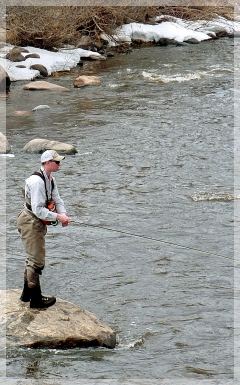 Even though I’m not an angler, whenever I read about casting my cares, I picture using a fly rod and casting my concerns out into the river so the fast moving water can carry them away to God. When we lived in the mountains, one of our favorite walking trails ran alongside the Yampa River and we often paused to watch as the fishermen (and women) cast their lines into the water. Fly fishing is all about the art of casting and a bit like poetry in motion. It was fascinating to watch an angler flick the rod back and forth, gradually increasing the speed of the motion, before finally casting the line forward so the fly would land in the perfect spot. Masquerading as a water insect, the fly is made of things like fur, feathers, fabric and tinsel and secured to a hook. Rather than purchasing flies, many fishermen spend hours tying their own flies. Not wanting to lose either fly or fish in the river, anglers use at least five different knots to securely connect the reel to the backing, fly line, leader, and tippet before finally tying on the fly.
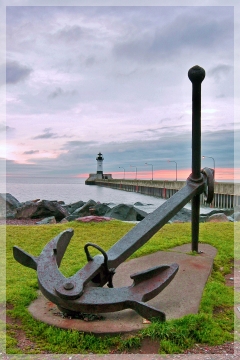 The sign in front of a nearby church read, “Our hope is anchored in the Lord,” which got me thinking about anchors. I’d never given them much thought until we took a Windjammer cruise off the coast of Maine many years ago. Accompanied by four friends and a crew of two, we sailed for a week. At dusk, we’d lower the sails and anchor in a harbor for the night. After breakfast, we’d pull up anchor for another relaxing day of sailing by lighthouses, granite cliffs, fishing villages, and even a few seals. One day, however, gale force winds replaced the gentle breeze and the calm sea turned violent. The sky darkened as rain and hail poured down on us. We immediately pulled into the nearest inlet, lowered the sails, and dropped two anchors to keep from being blown into the rocks! If we’d had two more anchors (as did the sailors in Acts 27), I suspect we would have dropped them, as well. After donning my life jacket and slicker, all I could do was pray and hope those anchors held. You really don’t appreciate the worth of an anchor until you’ve needed one in a storm!
 After Satan took Job’s loved ones and wealth, the grieving man remained a pillar of patience and faith. Rather than blaming God, the stoic man acknowledged God’s sovereign authority saying, “The Lord gave me what I had, and the Lord has taken it away. Praise the name of the Lord!” [1:21]
 Devotions of the Heart