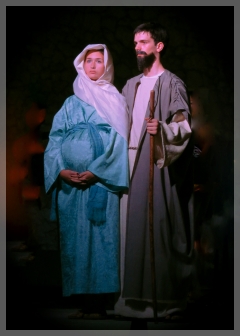
LAS POSADAS – NINE MONTHS (2)

And because Joseph was a descendant of King David, he had to go to Bethlehem in Judea, David’s ancient home. He traveled there from the village of Nazareth in Galilee. He took with him Mary, to whom he was engaged, who was now expecting a child. [Luke 2:4-5 (NLT)

Until learning about Las Posadas, I hadn’t given much thought to the difficulty of Joseph and Mary’s journey to Bethlehem or to how frightened and desperate the couple must have been that night so long ago. As the crow flies, it’s only a 70-mile trip from Nazareth to Bethlehem but Joseph and Mary weren’t crows and the route was not a straight one. Because of the hilly terrain, the most direct route south was the most physically challenging and, because it led right through Samaria, it also was the most dangerous. Wanting nothing to do with Samaritans, Jews typically detoured to the east before going south along the flatlands of the Jordan River, turning west at Jericho, going over the hills surrounding Jerusalem, and on south into Bethlehem—a trip of 90 to 100 miles. The trek from Jericho to Bethlehem would have been the hardest since it was an uphill hike with an elevation change of 3,500 feet! In good circumstances, people could walk about 20 miles a day so Mary and Joseph feasibly could have made Bethlehem in five 8-hour days. Mary, however, was about ready to give birth so a trip of seven to ten days is more likely.
Since the Bible quickly moves from the miraculous conception of Jesus to Mary’s visit to Elizabeth and then to Jesus’ birth, we probably don’t give much thought to what those nine months of pregnancy were like for Mary. Each day of the nine days of Las Posadas, however, represents a month of Mary’s pregnancy. When Scripture says Mary “hurried to the hill country of Judea” to see Elizabeth, we assume she lived nearby. Rather than right around the corner, Elizabeth lived about five miles southwest of Jerusalem in Ein Karem, meaning the newly pregnant girl (who may have suffered from morning sickness) took a similar walk to the one she’d make nine months later! Three months later, she made the same 90 to 100-mile journey north back to Nazareth. Even if Mary traveled in a caravan, it was a dangerous journey for a young woman alone! Ancient travel was no walk in the park.

Pregnancy is a blessed thing but it is a life-changing event full of physical and emotional challenges. Along with the normal mood swings accompanying changes in estrogen and progesterone, Mary had the shock of an unexpected pregnancy, saw her wedding plans turned upside down, lost her reputation, and endured the whispers of the town folk about how she betrayed her fiancé. We know how Joseph reacted to her pregnancy but we don’t know about Mary’s parents or the rest of their family and friends. Were the couple shunned or snubbed? Pregnancy is a blessing but there’s a downside to growing another being in one’s uterus: fatigue, shortness of breath, discomfort as the growing child pushes against internal organs, trying to find a comfortable position in which to sleep, back aches, bloating, frequent urination, and swollen feet (to name just a few). Pregnancy isn’t easy—even when you’re carrying the Messiah!

Once Mary and Joseph found lodging, what of the baby’s birth? Because our nativity scenes focus on the lovely scene of the Holy Family after Jesus’ arrival, we tend to forget the hours of labor leading up to that scene. The conditions weren’t sterile, there were no epidurals, and Scripture makes no mention of a midwife’s presence. Without question, there was discomfort, pain, sweat, aching muscles, tears, fear, mess, and blood. Surely, giving birth away from family, in a cave, in a strange town, and placing her newborn in a feed trough wasn’t what Mary envisioned for the child who would be called “Son of the Most High.”

Mary and Joseph were ordinary people, people like you and me, people who hurt, worry, bruise, get tired, bleed, complain, cry, throw-up, get blisters, and suffer—people who can get upset, frustrated, troubled, doubtful, surprised, disappointed, and sad. Today, consider what those nine months were like for Mary, a girl barely into her teens who became the mother of God, and Joseph, the man who would act as the earthly and legal father to God’s son. They were two ordinary people who did an extraordinary thing! Thank you, God!

And while they were there, the time came for her baby to be born. She gave birth to her firstborn son. She wrapped him snugly in strips of cloth and laid him in a manger, because there was no lodging available for them. [Luke 2:6-7 (NLT)]

Copyright ©2021 jsjdevotions. All rights reserved.

GOD-INCIDENCES

Remember the things I have done in the past. For I alone am God! I am God, and there is none like me. Only I can tell you the future before it even happens. Everything I plan will come to pass, for I do whatever I wish. [Isaiah 46:9-10 (NLT)]

monarch butterfly - milkweed

I suspect that most of us live rather ordinary and somewhat predictable lives that are occasionally interrupted by major life events (some of which are welcome and other which are not). For us, it is life’s little surprises—its happenstance and serendipity—that keep our lives from becoming humdrum.

We probably have no problem crediting God with the big blessings of life—things like the birth of a healthy child, a benign biopsy, a successful surgery, 10 years of sobriety, 50 plus years of marriage, the grand’s graduation, the better paying job, or God’s gifts of salvation and forgiveness. On the other hand, we tend to think of the little unexpected blessings—the butterfly or bluebird, the chance meeting, the out-of-the-blue phone call from an old friend, the sermon that spoke directly to our need, making the tight connection at the airport, or the humorous email that arrived when we were in the dumps—as mere coincidence or luck. After all, it seems that our Almighty God must be far too busy running the universe to deal with the minutiae of our everyday lives. Absolutely nothing, however, is unimportant to a God who sees every sparrow fall, knows the number of hairs on our heads, and has etched our names on the palms of His hands. Just as the universe is not run by random chance, neither are our lives!

God can multitask better than a one-armed paper-hanger or a mom with triplet toddlers! While God was keeping the stars and planets aligned back in 470 BC, He also orchestrated Persian King Xerxes’ insomnia and his attendant’s choice of what part of the king’s chronicles was read to him. For that matter, He is the one who placed the villains plotting the Xerxes’ death within ear shot of Mordecai. Rather than coincidences, all of the events in the book of Esther were part of God’s finely crafted plan!

Although we speak to God in prayer, we often chalk up His answer to luck or coincidence. God can speak audibly but He also speaks through seemingly random things—the day’s Bible verse, a chance meeting, a song on the radio, a casual comment, a wrong number, words in a book we accidentally open, and even a bout of insomnia. When we credit the little blessings of life to coincidence, we’re happy. When we credit them to their orchestrator, however, we become thankful. While we’re surprised by these seemingly random or capricious events, our God never is! Everything in our lives has passed through His hands!

Yesterday, we gave thanks for our food, family, health, homes, and all the major blessings of our lives. Today, let’s give thanks for the little blessings, the godsends, that make our ordinary lives so extraordinary—the things that encourage us when we want to give up, put smiles on our faces, fill our hearts with joy, answer our questions, or remind us how much we’re loved. Along with all the big things, let’s be sure to give God credit for the little ones—the God-incidences—that He scatters throughout our days. His fingerprints are everywhere we look!

You can make many plans, but the Lord’s purpose will prevail. [Proverbs 19:21 (NLT)]

And we know that God causes everything to work together for the good of those who love God and are called according to his purpose for them. [Romans 8:28 (NLT)]

Copyright ©2021 jsjdevotions. All rights reserved.

PRAISE HIM

Hallelujah! Praise God in his holy house of worship, praise him under the open skies; Praise him for his acts of power, praise him for his magnificent greatness; Praise with a blast on the trumpet, praise by strumming soft strings; Praise him with castanets and dance, praise him with banjo and flute; Praise him with cymbals and a big bass drum, praise him with fiddles and mandolin. Let every living, breathing creature praise God! Hallelujah! [Psalm 150 (MSG)]

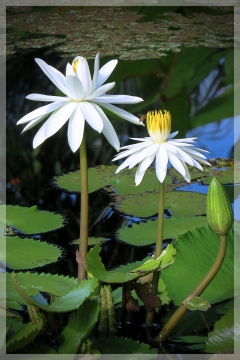
water lilyI’d gotten sidetracked taking pictures of the water lilies at the Botanic Gardens. I looked around for my husband and saw him sitting quietly on a nearby bench. Although his head was down, I knew he wasn’t snoozing. Sitting down beside him, I said, “He really is amazing, isn’t He?” We both spent a few minutes reflecting on how great our God is and thanking Him for using all 120 of the crayons in his heavenly box when he made the flowers. He’s an extraordinary artist!

Thanks and praise—we tend to lump them both together and, yet, they’re not really the same. Thanks are for gifts given; praise is for the giver of the gifts! For example, we thanked our children for the on-line cooking class that came with a box of all the necessary exotic ingredients shipped to our front door but praised them for finding such a unique, fun, and delicious present! A friend thanked me for writing this blog but it was her praise for my writing that put a smile on my face.

While it’s easy to thank God for his many gifts, I question, “Who am I to praise God for His splendor and works?” Perhaps it’s because I feel so insignificant and inept in comparison to our great and magnificent God. I tend to think we should have competency in an area for our praise to be of value. For example, while I would feel comfortable thanking virtuoso pianist Lang Lang for giving a concert, no matter how amazing I thought his performance, my lack of musical expertise would keep me from praising his interpretation of the piece or the amazing way he recovered from a career-threatening injury. While I take nature photographs, I can’t hold a candle to the work of a photographer like Thomas Mangelsen. While I could thank him for sharing his work, because I know nothing of f-stops, apertures, ISO, or shutter speeds, I question whether praise from someone who is an amateur like me would mean anything to him.

If I feel unqualified to praise mere humans, no wonder I’m hesitant to praise God. Yet, when I think about it, praise is praise, whether it comes from an expert or simply an appreciative fan. We don’t need to be accomplished in a field to know what we find inspiring, beautiful, remarkable, or impressive and something tells me that sincere praise is always music to someone’s ears.

My small brain can’t fathom the 4,500 stars I might see tonight let alone the 300 billion in the Milky Way and the estimated 70 billion trillion stars God scattered in the universe. I have enough trouble understanding the way bees make honey let alone how God managed to think up some 950,000 other kinds of insects. Try as I will, I can’t truly grasp how a cherry blossom becomes a juicy sweet cherry or how the 86 billion nerve cells in my brain make it possible for me to breathe, walk, talk, and chew gum at the same time. I have no idea how God managed to think up giggles, rainbows, bird songs, dolphins, water lilies, butterflies, peonies, strawberries, giraffes, snow, or sunsets. Nevertheless, I realize it’s not necessary to be an expert in astronomy, entomology, biology, zoology, botany, or any other science to appreciate and praise the work of our magnificent God. Our praise is music to His godly ears and surely will put a smile on His divine face.

On this day of Thanksgiving, let’s be sure to add a little praise to our thanks. Well done, God; well done!

Have you ever come on anything quite like this extravagant generosity of God, this deep, deep wisdom? It’s way over our heads. We’ll never figure it out. Is there anyone around who can explain God? Anyone smart enough to tell him what to do? Anyone who has done him such a huge favor that God has to ask his advice? Everything comes from him; Everything happens through him; Everything ends up in him. Always glory! Always praise! Yes. Yes. Yes. [Romans 11:33-36 (MSG)]

Copyright ©2021 jsjdevotions. All rights reserved.

FOUR GENERATIONS

Even before he made the world, God loved us and chose us in Christ to be holy and without fault in his eyes. God decided in advance to adopt us into his own family by bringing us to himself through Jesus Christ. This is what he wanted to do, and it gave him great pleasure. So we praise God for the glorious grace he has poured out on us who belong to his dear Son. [Ephesians 1:4-6 (NLT)]

black skimmersSince there are about 25 genealogy lists in the Bible, genealogy must be important to both God and His people. Genealogies were important to the Jews since priests and Levites could serve only if they were of pure ancestry. In Chronicles we saw how genealogies provide a connection between generations and the promises made to their ancestors. Matthew and Luke’s genealogies were important to Jewish believers because they showed that Jesus came from the Davidic line and important to Gentiles because Jesus’ Gentile ancestry shows that God sent His son for all people. What do they mean to Christians today?

Thomas Fuller (1608-1661) had an interesting take on genealogies in his book Good Thoughts in Bad Times, Together with Good Thoughts in Worse Times, Consisting of….Scripture Observations…. Published in 1659, the complete title is 34 words long so I took the liberty of shortening it along with bringing some of Fuller’s old English spelling into 21st century. When writing about our Lord’s genealogy found in Matthew 1:7-8, the churchman and historian observed the following:

“Lord, I find the genealogy of my Saviour strangely checkered with four remarkable changes in four immediate generations. (1) Rehoboam begat Abijam; that is, a bad father begat a bad son. (2) Abijam begat Asa; that is, a bad father, a good son. (3) Asa begat Jehoshaphat; that is, a good father, a good son. (4) Jehoshaphat begat Jehoram; that is, a good father, a bad son.

I see, Lord, from hence, that my father’s piety cannot be entailed [transmitted]; that is bad news for me. But I see also that actual impiety is not always hereditary; that is good news for my son.”

The power-hungry Rehoboam looked only to his desires rather than his people’s needs and his harshness in taxing the people excessively caused the division of the nation. During his troubled reign, he married foreign women and pagan practices flourished as Judeans set up Asherah poles, sacred pillars, and pagan shrines. 1 Kings tells us Rehoboam’s son, Abijah, was unfaithful to the Lord and committed the same sins as did his father. As Fuller pointed out—like father, like son!

Abijah was the father of Asa. Scripture tells us that, in spite of his sinful father and pagan mother, Asa “did what was pleasing in the Lord’s sight … [and] remained completely faithful to the Lord.” That Asa was one of Judah’s good kings shows that having a bad father doesn’t condemn one to being a bad man. While “like father, like son” doesn’t necessarily hold true, good king Asa’s son, Jehoshaphat, was like his father and “did what was pleasing in the Lord’s sight.” Sadly, we then come to Jehoshaphat’s son Jehoram. 2 Kings compares him to the northern kingdom’s evil king Ahab. Jehoram “did what was evil in the Lord’s sight” and even allied himself with Ahab by marrying one of his daughters. Clearly, as Fuller pointed out, a father’s godliness and virtue cannot be inherited. The good news, of course, is that neither can a father’s wickedness.

Fuller’s observation about these four generations reminds us that we each are responsible for our own actions. The good news of the gospel tells us that no matter who our ancestors are or what they did, we don’t have to be victims of our heredity, childhood, or circumstances. Although we inherit genes, we don’t inherit character. As Christians, our family is not determined by bloodline or the people with whom we grew up. We have a new family—God’s family! Because of Jesus, we were adopted by God, brought into His family, and became heirs to His kingdom. We have a good Father and, because of the Holy Spirit, we can be His good sons and daughters!

Instead, you received God’s Spirit when he adopted you as his own children. Now we call him, “Abba, Father.” For his Spirit joins with our spirit to affirm that we are God’s children. And since we are his children, we are his heirs. In fact, together with Christ we are heirs of God’s glory. [Romans 8:15-17 (NLT)]

Copyright ©2021 jsjdevotions. All rights reserved.

SOIL AND WATER

For the Lord is a great God, a great King above all gods. He holds in his hands the depths of the earth and the mightiest mountains. The sea belongs to him, for he made it. His hands formed the dry land, too. [Psalm 95:3-6 (NLT)]

Burgess Creek - Steamboat CO“The heavens proclaim the glory of God. The skies display his craftsmanship,” said the Psalmist. [19:1] It’s not just the heavens, however, that declare God’s glorious existence. Something as lowly as soil or as ordinary as water testify to His magnitude, creativity, skill, wisdom, and attention to detail, as well!

Unless we encounter an earthworm or beetle while digging in the garden, we probably think of soil as lifeless when, in actuality, it’s a dynamic living ecosystem. One handful of productive soil contains about 100 billion microorganisms of bacteria made up of about 10,000 different species. In that same handful of dirt are 100 meters of fungal cells of some 500 species of fungi, along with 20 million protozoa, 100,000 nematodes (unsegmented round worms) and 50,000 arthropods (like centipedes and microscopic mites), along with any earthworms and algae that may have tagged along. There are more living organisms in a handful of soil than there are human beings on our planet!

As small as all those microorganisms are, consider that one drop of water (.05mL) contains 1.67 sextillion molecules of H2O (that’s 21 zeroes). Smaller than those molecules are the more than 5 sextillion atoms of hydrogen and oxygen in those molecules! If we were counting the molecules of H2O in just ten drops of water (.17 oz.), we’d need 210 zeros (a quantity outnumbering the stars in the universe and all the organisms in the soil combined)! We really shouldn’t be surprised; after all, this is the same God who glued those beautiful microscopic scales on a butterfly’s wings (600 per square millimeter), dropped miniscule pollen grains (.006 mm) in the forget-me-not, and packed 100 billion neurons in the human brain.

We stand in awe at the enormity of the Grand Canyon, the striking colors of Yellowstone’s Grand Prismatic Spring, the red and orange hoodoos of Bryce Canyon, or the flood of water surging over Niagara Falls (757,500 gallons per second) without giving a thought to the atoms that make up every drop of that water or the microscopic life existing in the world beneath our feet. The heavens may declare His glory and existence but so does the rest of His magnificent creation!

All things bright and beautiful, All creatures great and small,
All things wise and wonderful: The Lord God made them all.
He gave us eyes to see them, And lips that we might tell
How great is God Almighty, Who has made all things well.
[Cecil F. Alexander]

They know the truth about God because he has made it obvious to them. For ever since the world was created, people have seen the earth and sky. Through everything God made, they can clearly see his invisible qualities—his eternal power and divine nature. So they have no excuse for not knowing God. [Romans 1:19-20 (NLT)]

Copyright ©2021 jsjdevotions. All rights reserved.

IN ALL CIRCUMSTANCES

Rejoice always, pray without ceasing, give thanks in all circumstances; for this is the will of God in Christ Jesus for you. [1 Thessalonians 5:16-18 (ESV)]

Writing about pesky mosquitoes yesterday reminded me of a story told by Corrie ten Boom in her book The Hiding Place. As part of the Dutch resistance during World War II, Corrie’s family harbored Jews and others hunted by the Gestapo in their home. After being betrayed by a Dutch informant, the ten Boom family was arrested and imprisoned. Corrie and her sister Betsie ended up in the Ravensbrück concentration camp. That first night, as they shared a bed in the crowded barracks, Corrie discovered their bedding was infested with fleas. Betsie reminded her sister of the Scripture passage they’d read that morning from 1 Thessalonians: “Give thanks in all circumstances.” As they began praying, Betsie listed the things for which they could give thanks, such as their remaining together and having smuggled a Bible into the barracks. But, when she mentioned the fleas, Corrie’s response was, “There’s no way even God can make me grateful for a flea.” Betsie explained that the verse said all circumstances and not just the pleasant ones, so Corrie reluctantly joined her in a prayer of thanksgiving that even included the fleas.

With their hidden Bible, the ten Boom sisters offered strength, comfort, and clandestine Bible studies in their barracks. Such gatherings were strictly forbidden and the women feared their meetings and secret Bible would be discovered. For some unknown reason, however, the German guards never entered the women’s sleeping room or searched their belongings and Corrie often wondered why. She later discovered that the guards kept their distance because they were terrified of getting fleas from the prisoners’ mattresses or clothing! Upon learning this, Corrie truly was thankful for the fleas in their beds!

As difficult as it is to thank God for the nuisances of life like mosquitoes and fleas, it is even harder to be thankful in the midst of the injury, pain, discomfort, loss, and trials that comes with our fallen world. From our viewpoint, we see our challenges as afflictions that must be borne. Perhaps we should consider looking at them through God’s eyes and seeing them simply as well-disguised blessings given out of love. Unlike Corrie, while we’re on this side of the grass, we may never discover the blessing in the fleas and other afflictions but, someday, we will meet the Lord face to face and finally understand.

Happiness isn’t something that depends on our surroundings. It’s something we make inside ourselves. [Corrie ten Boom]

Do not be anxious about anything, but in everything by prayer and supplication with thanksgiving let your requests be made known to God. And the peace of God, which surpasses all understanding, will guard your hearts and your minds in Christ Jesus. [Philippians 4:6-7 (ESV)]

Copyright ©2021 jsjdevotions. All rights reserved.