BY ANY OTHER NAME

Blessings accrue on a good and honest life, but the mouth of the wicked is a dark cave of abuse. A good and honest life is a blessed memorial; a wicked life leaves a rotten stench. [Proverbs 10:6-7 (MSG)]

Juliet: What’s in a name? That which we call a rose By any other name would smell as sweet.” [From “Romeo and Juliet” (Shakespeare)]

IMG_6949web“Where do you work in town?” my husband asked the young man who’d joined us in the gondola. He hemmed and hawed a bit before saying, “I’m an agricultural entrepreneur.” After more prodding, we learned the vague term actually meant that he grows marijuana. His response got me thinking about all of the other euphemisms we use in life. A car is “pre-enjoyed” not used, “genuine imitation leather” is really vinyl, that “courtesy call” received during dinner is anything but courteous, and do any of us actually take a rest in the “rest room”? Having a “negative cash flow” means we’re broke, and having a “frank discussion” with the boss means we got into an argument with him which led to our being “downsized” and now we are “pursuing other interests.” Euphemisms usually make bad things seem more acceptable, or at least less terrible. Torture is described as “enhanced interrogation,” genocide is “ethnic cleansing,” pornography is “adult entertainment,” if it “fell of the truck” it’s stolen, and someone who is “economical with the truth” is simply a liar. Let’s not fool ourselves about sin by using nicer words to disguise it. Gossip, pride, adultery, callousness, pride, envy, viciousness, greed and the like are far more than lapses in judgment, blunders, missteps, weaknesses, character flaws, slip-ups, moments of madness, or indiscretions. When we equivocate about our sins, we’re lying to ourselves and God. We may manage to assuage our guilt by using euphemisms but God will not be deceived. No matter what we call it, a rose will still have the sweet smell of a rose and, no matter what we call it nor how we disguise it, that which we call a sin, by any other name, will still have the stench of sin.

“Euphemism” is a euphemism for lying. [Bobbie Gentry]

These people gag me. I can’t stand their stench. Look at this! Their sins are all written out—I have the list before me. I’m not putting up with this any longer. [Isaiah 65:5-6 (MSG)]

God, you know every sin I’ve committed; My life’s a wide-open book before you. [Psalm 69:5 (MSG)]

 

SHIFTING THE BLAME

“I don’t deserve to be called your son anymore. Make me one of your hired men.” … Then his son said to him, “Father, I’ve sinned against heaven and you. I don’t deserve to be called your son anymore.” [Luke 15:19,21 (GW)]

The man answered, “That woman, the one you gave me, gave me some fruit from the tree, and I ate it.” [Genesis 3:12 (GW)]

DSC01629awebAfter brazenly demanding his inheritance while his father still lived, the prodigal son quickly wasted it all in a reckless and immoral lifestyle. Realizing the error of his ways, the ashamed and penniless youth swallowed his pride and returned to his father, hoping to be hired on as a servant. His story, one of repentance, forgiveness and redemption, is quite a contrast to that of a young woman whose tale is circulating on the Internet. She recently called into a radio show and told of getting a $90,000 college fund from her grandparents. In three years, however, she managed to blow through all of it—not just on tuition but also on clothing, college breaks and a trip to Europe. Now, having no way to pay her $20,000 senior year’s tuition, she called the show to complain—not about her recklessness and spendthrift ways but about her parents. Although any fifth grader knows enough to divide ninety by four and figure out how much money can be spent each year, she blamed her parents for not teaching her to budget; it was their fault she was broke. The young woman showed no remorse for her actions and refused to accept responsibility for her predicament. The prodigal son worked at a pig farm before returning home and was willing to work as his father’s servant. This young woman’s response to getting a job in the school cafeteria was, “That’s embarrassing.”

I wonder, however, if we’re really all that different from this young woman. Hopefully, we haven’t squandered $90,000 but we’ve all blamed others for our errors, difficulties, and even our sins. It wasn’t just Eve that Adam blamed for the apple incident; he blamed God for giving him the woman in the first place. We’re not much better. In an effort to excuse our actions, we shift the blame to our parents’ divorce, our ex-spouse’s greed, bad genes, the credit card company that shouldn’t have increased our credit, the loan officer who allowed us to refinance, the persuasive salesman, our idiot co-workers, the teacher who can’t teach, the woman who shouldn’t have been so seductive, the husband who shouldn’t have been so busy, the spouse who just didn’t understand, a troubled childhood, the bartender who over-served, and the other guy who made us angry or started the fight! We shift the blame to justify our own bad behavior and, if we show any remorse, it’s only because of the mess in which we find ourselves once we have to face the consequences.

With a repentant heart, the prodigal son took responsibility for his actions and was welcomed into his father’s house. Make no mistake about it, if we don’t accept responsibility for our actions with a humble and repentant heart, our story, unlike that of the prodigal son, will not be one of forgiveness and redemption.

When someone is tempted, he shouldn’t say that God is tempting him. God can’t be tempted by evil, and God doesn’t tempt anyone. Everyone is tempted by his own desires as they lure him away and trap him. Then desire becomes pregnant and gives birth to sin. When sin grows up, it gives birth to death. [James 1:13-15 (GW)]

If we say, “We aren’t sinful” we are deceiving ourselves, and the truth is not in us. God is faithful and reliable. If we confess our sins, he forgives them and cleanses us from everything we’ve done wrong. [1 John 1:8-9 (GW)]

IDOLS

You shall have no other gods before me. [Exodus 20:3 (RSV)]

You shall make for yourselves no idols and erect no graven image or pillar, and you shall not set up a figured stone in your land, to bow down to them; for I am the Lord your God. [Leviticus 26:1 (RSV)]

6-18-15IMG_1012webWhile Moses was on the mountain receiving the Ten Commandments from God, the Israelites grew restless and impatient with his long absence. Faith in both God and Moses flew out the window (or tents, in this case) and the people convinced Aaron they needed an idol who could lead them in their journey to the Promised Land. Gold earrings were gathered, melted down, and molded into the shape of a calf. As soon as the Israelites saw the image, they proclaimed it to be the God that led them out of Egypt. It was easier to believe in a piece of gold they could see than a real god they couldn’t. As usually happens with disobedience and idolatry, immorality soon followed. In spite of the many miracles God had already performed that allowed them to leave Egyptian captivity, the Israelites chose their golden calf over the true giver of gifts.

Like the Israelites, we often forget our blessings and the one responsible for those blessings. While we may not deify a golden calf, in spite of God’s command, we often worship other gods. Many of us tend to be more concerned about wealth, appearances, or fame than we are about God; that’s worshipping an idol. When we care more about obtaining or maintaining our possessions than we care about God, that’s worshipping an idol. When we give more attention to ourselves and our interests than we do to God, we are worshipping idols. When our standard of living is more important than our standard of giving, we are worshipping idols. These may not be graven images and we may not be worshipping them at an altar, nonetheless, they are idols. The Lord God is the only one to whom we should bow down and the only one to whom we should look up to with adoration.

When you cry out, let your collection of idols deliver you! The wind will carry them off, a breath will take them away. But he who takes refuge in me shall possess the land, and shall inherit my holy mountain. [Isaiah 57:13 (RSV)]

For great is the Lord, and greatly to be praised, and he is to be held in awe above all gods. For all the gods of the peoples are idols; but the Lord made the heavens. Honor and majesty are before him; strength and joy are in his place. [1 Chronicles 16:25-27 (RSV)]

ANOTHER KIND OF SPARK

We can make a large horse go wherever we want by means of a small bit in its mouth. And a small rudder makes a huge ship turn wherever the pilot chooses to go, even though the winds are strong. In the same way, the tongue is a small thing that makes grand speeches. But a tiny spark can set a great forest on fire. And the tongue is a flame of fire. It is a whole world of wickedness, corrupting the entire body. It can set your whole life on fire, for it is set on fire by hell itself. [James 3:3-6 (NLT)]

5-16-15DSC09069awebIndeed, the tongue can be a “small thing that makes grand speeches.” Anyone who ever heard Martin Luther King’s “I Have a Dream” speech, John F. Kennedy’s words, “Ask not what your country can do for you…”, or Billy Graham preach knows that tongues can inspire and teach, praise and bless, comfort and pray. Speech, while extremely powerful, can also be incredibly dangerous.

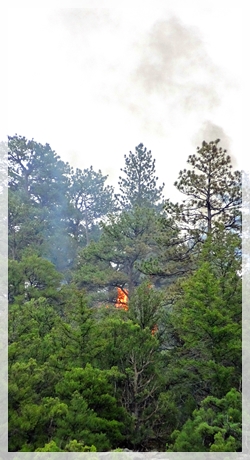
James compares the tongue to a “flame of fire.” Have you even seen television coverage of a forest fire? It’s frightening how one camper’s poorly dowsed fire or a careless hiker’s cigarette can wreak such devastation. Once the fire gets started, it’s nearly impossible to control and its damage can’t be undone. If the wind picks up, the destruction can be enormous. Last year flames came within a few blocks of my son’s house and the barren hillside following the fire was a constant reminder of how close they came to losing their home.

Our words can be as dangerous as a spark in a dry forest. They cannot be taken back once spoken and the damage can be horrendous. Bragging, gossip, exaggeration, flattery, lying, disparagement, and manipulation with our words are all examples of an untamed tongue. Before speaking, we should ask ourselves, “Is it true? Is it kind? Is it necessary?” If in doubt, we should say nothing. Just as a strong wind will fan the fire’s flames, anger can turn a few imprudent words into a raging inferno. Homes and lives can truly be destroyed by the heat of angry words.

Yesterday’s message included Kurt Kaiser’s words “It only takes a spark to get a fire going” in reference to love. It’s important to remember that it only takes a spark from an untamed tongue to get another kind of fire going!

How much more grievous are the consequences of anger than the causes of it. [Marcus Aurelius]

Those who control their tongue will have a long life; opening your mouth can ruin everything. [Proverbs 13:3 (NLT)]

A gentle answer deflects anger, but harsh words make tempers flare. [Proverbs 15:1 (NLT)]

WICKEDNESS BRINGS PUNISHMENT

DSC02558-Bern (Cathedral-Munster-Last Judgement)3-cropWEB

“The Last Judgment” – Munster Cathedral, Bern, Switzerland


Yahweh! The Lord! The God of compassion and mercy! I am slow to anger and filled with unfailing love and faithfulness. I lavish unfailing love to a thousand generations. I forgive iniquity, rebellion and sin. But I do not excuse the guilty. [Exodus 43:6-7 (NLT)]

If asked to draw a picture of God, many would probably draw a pleasant old gentleman with a gentle smile. Looking a bit like Santa Claus, he’d be dressed in a long white robe instead of a fur-trimmed red coat and hat. This kind-looking grandfatherly man would be seated on a throne with several little children in his lap. Reading the Old Testament, however, makes one rethink this picture. While we meet a loving and forgiving God, we also encounter a judgmental and destructive God: a God who sends plagues to his people, destroys whole towns, and sends his people into slavery. This is not the “warm and fuzzy” God about whom we want to think. He’s certainly not the good-natured God of my Sunday school classes.

It certainly is more comforting for us to think of God as loving and merciful and, indeed, He is. But, as the Old Testament reminds us and the New Testament warns us, God can get angry with his people. He hates sin and he is ready to hand out punishment to those who defy him. Fortunately, we also have a loving and forgiving Heavenly Father who hasn’t lost faith in his children. He saved Noah and his family from the flood. He rescued Lot and his family from the destruction of Sodom and Gomorrah. He saved Jonah from the whale after Jonah said he’d obey God’s directions. After telling Nineveh they would be destroyed in forty days, God relented when they repented their sinful ways. After punishing the Israelites for their disobedience, God finally led them to the Promised Land. Later, He rescued them from their exile in Babylon. Although we continually disappoint God with our disobedience, He mercifully gave us his only son as a sacrifice for our sins.

The righteous character of God includes both his anger and judgment along with his love and mercy. It is not enough to read and hear only God’s comforting words. We must remember that His justice goes hand in hand with His love.

Your wickedness will bring its own punishment. Your turning from me will shame you. You will see what an evil, bitter thing it is to abandon the Lord your God and not to fear him. I, the Lord, the Lord of Heaven’s Armies, have spoken! [Jeremiah 2:19 (NLT)]

BEEN HERE BUT DIDN’T DO THAT!

The servant grew up before God—a scrawny seedling, a scrubby plant in a parched field. There was nothing attractive about him, nothing to cause us to take a second look. He was looked down on and passed over, a man who suffered, who knew pain firsthand. One look at him and people turned away. We looked down on him, thought he was scum. But the fact is, it was our pains he carried – our disfigurements, all the things wrong with us. [Isaiah 53:2-4a (MSG)]

Writing yesterday’s message reminded me of another common teen complaint: “But you just don’t understand!” My teenagers were positive that I’d never experienced any of the challenges, temptations and angst they were having. I’m sure my grandchildren are equally sure their parents have no idea what their life is like. We may not have had all of the gadgets and technology of today’s teens; we didn’t have Facebook, smart phones, texting, and the Internet. We did, however, struggle with many of the same issues: mean people, SATs, crushes, insecurity, rejection, being grounded, alcohol and parties when the parents were gone.

Sometimes we’re not much different than teenagers when we talk to God. “You just don’t understand!” we protest. But, He really does. Jesus actually experienced life and all of its adversities and struggles during his thirty-three years as a man. Granted, He experienced them in a dramatically different setting and time. The First Century didn’t have the bells and whistles of today, but the temptations and challenges were much the same: sexual immorality, pride, pain, abuse, anger, doubt, desire, envy, deceit, sorrow, injustice. Not everyone liked Him, not everyone listened to Him, and not everyone believed or respected Him. He truly knows what it means to be human; He certainly knows what it is to suffer.

When we talk with God, He truly does understand. He’s been here and he was sorely tempted by Satan; the only difference is that He never sinned.

Now that we know what we have – Jesus, this great High Priest with ready access to God – let’s not let it slip through our fingers. We don’t have a priest who is out of touch with our reality. He’s been through weakness and testing, experienced it all – all but the sin. So let’s walk right up to him and get what he is ready to give. Take the mercy, accept the help. [Hebrews 4:14-16 (MSG)]