STUDENTS FOR LIFE

He also told them a parable: “Can a blind man lead a blind man? Will they not both fall into a pit? A disciple is not above his teacher, but everyone when he is fully trained will be like his teacher.” [Luke 6:39-40 (ESV)]

roseate spoonbill - corkscrew swampIn Pieces of Eight, columnist Sydney Harris tells the story of a dinner party at which an elderly Albert Einstein was seated next to an eighteen-year-old girl. Unaware of his identity, she asked the famed professor what he did for a living. “I devote myself to the study of physics,” he responded. Shocked that he still studied physics at his age, she told him she’d finished her physics studies the previous year! Without a doubt, Albert Einstein knew more about physics than anyone else of his time and yet he continued to study physics until his death. Harris’s explanation is that the physicist recognized that what he didn’t know far outweighed all that he did.

In Jesus’s day, the word disciple referred to a student or apprentice and was usually associated with people who devotedly followed a religious leader or philosopher. Christian writer Dallas Willard suggests replacing the word disciple in our Bibles with apprentice or student to get the true meaning of the word. Just as Einstein continued to be a student of physics, if we are true disciples of Christ, we must continue to be His students. Discipleship doesn’t end with accepting Christ; it begins. It requires commitment to be with and know Him, to grow more like Him, and to continually learn from Him.

Einstein continued to spend time in his physics laboratory. We must continue spending time with Jesus through prayer and Bible study. In studying the Gospels and Acts, we find His words, repeat His words, and reflect on them. In the Epistles, we learn how to apply those words. We then turn our attention from the New to the Old Testament to learn our history and how Jesus fulfilled the prophecies. Finally, we fulfill the commission given to the original disciples. The students are to become the teachers and find new students. Since the blind can’t lead the blind, we will continue to study and, after reading from Genesis to Revelation, start over again! We are life-long disciples who, like Albert Einstein, recognize that what we don’t know far outweighs what little we do.

Any fool can know. The point is to understand. … Learning is not a product of schooling but the lifelong attempt to acquire it. [Albert Einstein]

Jesus came and told his disciples, “I have been given all authority in heaven and on earth.  Therefore, go and make disciples of all the nations, baptizing them in the name of the Father and the Son and the Holy Spirit. Teach these new disciples to obey all the commands I have given you. And be sure of this: I am with you always, even to the end of the age. [Matthew 28:18-20 (NLT)]

Copyright ©2018 jsjdevotions. All rights reserved.

LITTLE BROWN BIRDS

My brothers and sisters, believers in our glorious Lord Jesus Christ must not show favoritism. [James 2:1 (NIV)]

The Lord does not look at the things people look at. People look at the outward appearance, but the Lord looks at the heart. [1 Samuel 16:7 b (NIV)]

house wren

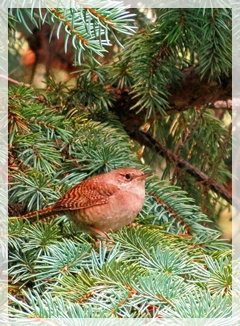
Unless a bird is impressive and memorable, I give it little notice and classify it broadly by size and color. Yesterday’s devotion reminded us that people aren’t nameless/faceless little brown birds to God. I then asked myself if they are to me. Do I truly see the people around me for the unique and beautiful individuals they are or are some just little brown birds? Think of the quiet unobtrusive people we see every day but barely notice: the bagger at the grocery, the busser at the restaurant, the lady with the schnauzer, the fast food cashier, the fellow stocking shelves, the landscaper, the old man at the coffee shop, or the parking lot attendant. Do we simply look past or even through them without a second glance? I hate to admit how many times wait staff and sales clerks have introduced themselves only to have me immediately forget both their names and faces.

Do we only take notice of the eagles, cardinals, and great blue herons of life? When Samuel anointed Israel’s first king, it was Saul. Described as the most handsome man in Israel and taller than anyone else in the land, he may have been as impressive as an eagle but he was a weak leader and a cowardly king. In contrast, Israel’s next king, David, was more like a little brown bird. He may have been handpicked by God but he was overlooked and ignored by everyone else. When Samuel came to Jesse in search of a new king, he invited Jesse and all of his boys to a sacrifice. It was only after every one of Jesse’s sons was rejected by the Lord that Samuel learned the youngest boy, David, hadn’t even been invited to the feast. In spite of being anointed by Samuel, David continued to be insignificant to his father and brothers until he defeated Goliath. It was the little brown bird rather than the showy eagle who saved the Israelites with a slingshot and a few well-placed stones.

A pharmaceutical ad begins with psoriasis patients saying the words, “See me.” It’s not just people with skin conditions who want to be seen as individuals; we all want to be seen as the unique people we are. Consider Jesus; there were many who met a poor itinerant rabbi, a carpenter’s son from Nazareth, and never really looked at Him or listened to His words. That unimpressive little brown bird they so easily dismissed was God!

We don’t need a scope or telephoto lens to help us see the little brown birds of daily life and we certainly don’t need an Audubon book to learn their identities. We just have to open our eyes to the people around us, really look at them, acknowledge their presence, and listen to their words. In actuality, rather than elegant egrets or gaudy peacocks, most of us are more like little brown birds—ordinary, inconspicuous, and easy to overlook. Nevertheless, we are extraordinary in our own ways and we all want to be seen for who we are. God doesn’t judge by outward appearance and neither should we. After all, it’s the little brown birds that sing the sweetest songs in the forest.

He grew up before him like a tender shoot, and like a root out of dry ground. He had no beauty or majesty to attract us to him, nothing in his appearance that we should desire him. He was despised and rejected by mankind, a man of suffering, and familiar with pain. Like one from whom people hide their faces he was despised, and we held him in low esteem. [Isaiah 53:2-3 (NIV)]

Copyright ©2018 jsjdevotions. All rights reserved.

AGAPE

Coronado beach - Bil PavlackaJesus replied, “The most important commandment is this: ‘Listen, O Israel! The Lord our God is the one and only Lord. And you must love the Lord your God with all your heart, all your soul, all your mind, and all your strength.’ The second is equally important: ‘Love your neighbor as yourself.’ No other commandment is greater than these.” [Mark 1:29-31 (NLT)]

Last summer, we enjoyed beautiful sand sculptures created by Bil Pavlacka on Coronado beach. One had been constructed as a memorial to the seven sailors who died on the destroyer Fitzgerald that month. It was not Pavlacka’s first memorial; he’s sculpted sand to honor a Navy Seal killed in Iraq and to recognize the victims of the Orlando nightclub shooting and the Paris and Brussels attacks. Those sculptures were labors of love—love for people he never personally knew but people he knew were his neighbors.

What a contrast his work is to the bumper stickers I recently saw on a truck parked beside us. There didn’t seem to be a minority group the driver wasn’t anxious to hate, insult or possibly worse since the back window also sported a “License to Kill Arabs.” According to the Southern Poverty Law Center, 917 hate groups (such as white nationalists, black separatists, racist skinheads, the Ku Klux Klan, neo-Nazis, neo-Confederates, anti-Muslim, anti-LGBT and anti-Semitic zealots) currently operate in the United States. Based on his bumper stickers, the truck’s owner must have belonged to several of them. How easy it is to spout hate for people we don’t even know; yet, they are our neighbors!

We are called to love one another—not romantic (eros) or friendship (philia) love—but agape or unconditional sacrificial love—like the love God had for us when he sacrificed His son and the love the good Samaritan had for a total stranger. It has nothing to do with attraction, affection or even liking one another. Agape love isn’t emotional; it is a choice. It also happens be one of God’s commands.

Agape love is like building an intricate sandcastle; it takes time, effort, dedication and patience. On the other hand, hate is like those bumper stickers or a well-placed kick aimed at a sandcastle; it is thoughtless and destructive. Jesus doesn’t ask us to like everyone but He does expect us to love them—to be kind, considerate, understanding, patient, tolerant, polite, and good to them. Fortunately, we don’t have to do it on our own—the Holy Spirit empowers us to love one another as God loves us. Like building a sand castle, however, it doesn’t come easy and there will be times our efforts fail. Nevertheless, we must keep at it until we get it right. What we can’t do is take the easy way out with hate!

It is the duty of every Christian to be Christ to his neighbor. [Martin Luther]

We love each other because he loved us first. If someone says, “I love God,” but hates a fellow believer, that person is a liar; for if we don’t love people we can see, how can we love God, whom we cannot see? And he has given us this command: Those who love God must also love their fellow believers. [1 John 5:19-21 (NLT)]

Copyright ©2018 jsjdevotions. All rights reserved.

DEMI-GLACE

If you openly declare that Jesus is Lord and believe in your heart that God raised him from the dead, you will be saved. For it is by believing in your heart that you are made right with God, and it is by openly declaring your faith that you are saved. [Romans 10:9-10 (NLT)]

mourning doveOn the days his restaurant is closed, a French chef friend works in his kitchen to make gallons of demi-glace. Hundreds of pounds of veal bones get roasted along with carrots, celery and onions. After deglazing the roasting pans with wine, he adds tomato paste, seasonings and water and simmers the concoction. At some point, he strains out the solids and continues simmering (and straining) the hot broth. More than twenty-four hours later, his stock has a rich brown color and a gelatinous consistency. After all of that simmering, less than one gallon of thick sauce remains for every ten gallons of liquid he added. Chef packages and sells this richly concentrated sauce to other restaurants that use it as the “mother sauce” or backbone of their own sauces.

I thought of my chef friend’s sauce reduction when reading about the Apostle’s Creed. The author compared our Christian creeds to a demi-glace: a creed is to the Bible as a demi-glace is to meat broth. In our creeds, the message of the Bible is reduced to a few precise and succinct paragraphs just as the meat broth is reduced to an intensely flavored thick liquid in a demi-glace. The odd bits have been strained out and all that remains is a clear concentrate. A Christian creed, however, still needs Scripture for a full spiritual meal and a demi-glace doesn’t make a meal without meat and potatoes. Nevertheless, both a creed and demi-glace condense the essence of their sources into something easy to understand and use.

As a matter of preference, some chefs use beef or chicken instead of veal or add bacon fat, but it’s still a demi-glace. I’m a vegetarian and wouldn’t use veal (or any other animal) bones. Although I could make a broth using only vegetables, reduce it by 90%, and make a thick sauce, without any meat, it wouldn’t be a demi-glace. In the same way that meat is required for a true demi-glace, certain ingredients are required for one’s beliefs to be called Christianity. For example, it’s not Christianity without the belief that Jesus was both true God and truly human or that He died and rose again. As Christians, we have unity in our creeds’ essential beliefs. Like those chefs who prefer beef bones or add bacon, Christians have liberty in non-essential beliefs such as the day we worship, the meaning of predestination or the use of alcohol.

Before graduating from Le Cordon Bleu or the Culinary Institute of America, a student chef must know the essentials of a good demi-glace. Fortunately, there are no entrance exams or finals in our churches (nor should there be). Nevertheless, when we no longer reside in this world, there just might be an entrance exam in the next. We’d better know and believe the essentials when that time arrives.

In essentials unity, in non-essentials liberty, in all things charity. [Rupertus Meldenius]

Make every effort to keep yourselves united in the Spirit, binding yourselves together with peace. For there is one body and one Spirit, just as you have been called to one glorious hope for the future. There is one Lord, one faith, one baptism, one God and Father of all, who is over all, in all, and living through all. [Ephesians 4:3-6 (NLT)]

Therefore, let us offer through Jesus a continual sacrifice of praise to God, proclaiming our allegiance to his name. [Hebrews 13:15 (NLT)]

Copyright ©2018 jsjdevotions. All rights reserved.

WIDENING THE CIRCLE

zebras - serengetti - tanzaniaWalk in wisdom toward outsiders, making the best use of the time. Let your speech always be gracious, seasoned with salt, so that you may know how you ought to answer each person. [Colossians 4:5-6 (ESV)]

I was attending a “Women and Wealth” seminar when we were asked to name the most important value we wished to pass on to our families. The answers were variations on the value of education, self-sufficiency, financial independence, business expertise, and a good work ethic until it came to me. When I said, “Faith in God,” my answer was met with stunned silence. Of sixteen of us, mine was the only one involving faith in God or any of the things that go along with it such as compassion, gratitude, forgiveness or generosity.

After Bible study that evening, many from our church gathered for fellowship at the nearby food court. The woman beside me confided that she didn’t know how or what to pray for her critically ill niece and we talked about prayer and faith in God. Although I don’t know her well, our shared belief made us comfortable sharing our thoughts and concerns. As I looked around the gathering, I had a pretty good idea how the rest of our group would have answered that morning’s question about values. They all recognize the importance of education, financial security, and work but they are people of faith; more likely than not, their answers would have indicated that faith.

Studies have shown that the longer one is a believer, the fewer interactions he or she has with non-believers. My experience that day told me why—when we’re with our brothers and sisters in Christ, they get “it.” Even when we don’t know one another well, we have an ease with each other that makes us family. We’re on the same wavelength; even when we disagree, we talk the same language and love the same Lord. The longer we are believers, the tighter our social group tends to become. We’re with one another during worship but also in choir practice, small groups, planning committees, service projects, or social events. Looking at the past month’s calendar, I saw that the majority of my social life centered around church activities and Christian friends; not all bad, but not all good, either.

In our last small group study (about evangelism), it was pointed out that most Christians aren’t very good about sharing the gospel, but not because we don’t want to share it. We spend so much time with other Christians that we’re rarely hanging around anyone who needs to hear it shared! It was suggested that we make a point of spending time with those outside the faith. We’re not talking about preaching on street corners or walking the beaches handing out religious tracts; we’re talking about making friends with people who aren’t believers. No one is asking us to abandon our circle of Christian friends but we should consider widening it.

Sydney Harris said that people tend to buy nonfiction books they think will agree with them. Saying they’re looking for enlightenment, they’re actually looking for confirmation of their beliefs. Pointing out that, “The stone of opposition sharpens ideas,” he adds that we’ll never truly understand our position until we understand our opponent’s. While he was writing about political opinions, his point is well taken. I know that I tend to seek out friendships with people who look, think, believe and act much the same way I do. Yet, when I think about it, some of my most rewarding friendships have been with people quite unlike me. Those are the friendships that have broadened my horizons and helped to define my faith. I hope that they’ve helped other people see Christ in a new way, as well.

Pastor Bill Hybels speaks of evangelism as simply walking across the room but we can’t do that if we’re never in a room with an unbeliever. That women’s seminar meets again next month and, while I’m not sure I have much in common with the rest of the attendees, maybe I can learn a little more about them and their beliefs and, maybe, just maybe, they’ll learn a little more about mine!

As Christ followers, we’re accountable for regularly moving in circles with people far from God, uncovering their stories with compassion and grace, and then naturally and consistently making ourselves available when God opens a door of opportunity. [Bill Hybels]

And as he reclined at table in his house, many tax collectors and sinners were reclining with Jesus and his disciples, for there were many who followed him. And the scribes of the Pharisees, when they saw that he was eating with sinners and tax collectors, said to his disciples, “Why does he eat with tax collectors and sinners?” And when Jesus heard it, he said to them, “Those who are well have no need of a physician, but those who are sick. I came not to call the righteous, but sinners.” [Mark 2:15-17 (ESV)]

Copyright ©2018 jsjdevotions. All rights reserved.

OUT OF FEAR

turkey vulturesBut if you refuse to listen to the Lord your God and do not obey all the commands and decrees I am giving you today, all these curses will come and overwhelm you… The Lord himself will send on you curses, confusion, and frustration in everything you do, until at last you are completely destroyed for doing evil and abandoning me. [Deuteronomy 28:15,20 (NLT)]

In writing about the mezuzah last week, I learned that 4,649 laws govern every aspect of its writing. Each of the 713 letters must be perfectly shaped, written on handmade specially processed parchment made from a kosher animal, inscribed in black ink formulated from a specific recipe, with a unique quill pen, by a qualified scribe. Why so many rules to fulfill a requirement that was only a few words in Scripture?

The fourth commandment about the Sabbath is the longest one but pretty straightforward: make it a day of rest rather than work. Although Scripture referred to conducting business, field labor, treading in a winepress, loading animals, traveling and kindling fire as forbidden work, it never provided an all-inclusive list of prohibited activities. To further clarify the commandment, work was classified into thirty-nine categories of forbidden activity. To obey perfectly, however, more interpretation was needed. Since reaping (clearly field labor) was forbidden, what if someone climbed a tree and accidentally broke a branch or rode an animal and detached a stick to hit it? Since an accidental sin was still a sin and, technically, breaking a branch was reaping, those activities were prohibited, as well.

I’ve often given the Bible’s Pharisees, Sadducees, and scribes grief over their pettiness regarding the law. After studying Deuteronomy 28, however, I’m beginning to understand how the system of laws governing the conduct of the Jewish people became so complex. After listing the blessings for obedience, Moses laid out the many curses for the Israelites’ disobedience to God and those curses are far more extensive than the blessings. They include everything from wasting diseases, plagues, captivity, inflammation, boils, military defeat and scorching heat to becoming food for scavenging birds, madness, swarms of insects, starvation, and cannibalism. It’s not a pretty picture Moses paints as he warns the people to obey all the words of the law.  After reading those curses, it’s easy to see how fear of punishment led to legalism and why the minutiae of the law became more important than a relationship with the giver of the law. Fearful of punishment and striving for absolute obedience, the Jews wanted to cover every eventuality.

Although the law pointed out sin, what the people didn’t understand was that the law, no matter how intricately interpreted or followed, could not keep people from sin. We must never make the mistake of thinking we can reach a level of perfection good enough for God; the Israelites couldn’t and neither can we. In actuality, the law revealed that people are sinful and can never attain righteousness through obedience to it; no matter how carefully they try, they will always fall short. Righteousness is attained only through faith in Jesus Christ.

Several weeks ago, I received the following “wisdom” in my email: “Love God and do as you please.” A paraphrase of St. Augustine’s words, it is not carte blanche to sin. Rather, if we genuinely love God with all our being, we will want to do only what pleases Him. We don’t please him to avoid captivity or pestilence or to work our way into His good graces; we please Him out of love. We don’t do it on our strength, but through the power of the Holy Spirit. As for me, that seems a whole lot easier than having the Sabbath quandary of whether or not I can turn off the alarm clock, open an umbrella, or pick up the button that fell off my jacket.

Once and for all, I give you this one short command: love, and do what you will. If you hold your peace, hold your peace out of love. If you cry out, cry out in love. If you correct someone, correct them out of love. If you spare them, spare them out of love. Let the root of love be in you: nothing can spring from it but good. [St. Augustine]

Love does no wrong to others, so love fulfills the requirements of God’s law. [Romans 13:10 (NLT)]

Copyright ©2018 jsjdevotions. All rights reserved.