
For I am already being poured out as a drink-offering; my departure time has arrived. I have fought the good fight; I have completed the course; I have kept the faith. What do I still have to look for? The crown of righteousness! The Lord, the righteous judge, will give it to me as my reward on that day – and not only to me, but also to all who have loved his appearing. [2 Timothy 4:6-8 (NTE)]
 Although the Apostle Paul seems to have mixed figures of speech by referring to the military with “fought” and “fight,” athletics with “race,” and religion with “faith,” all three references relate to athletics. The word used for fought was agónizomai (the root word for the English word “agonize”) which meant “to contend for a prize” or “struggle.” The word translated as “fight” was agōna, meaning “a gathering, contest, struggle.” Rather than a conflict or dispute, it referred to a gathering to see contests like the ancient games held at Olympia or the games themselves. Paul’s audience would have understood that he meant something grueling and, in their 1st century world, athletic competitions were so fierce and brutal that even the winners usually carried scars.
Continuing the theme of athletics, the word usually translated as race or course, was dromos and literally meant a race course or track and the word translated as faith, pistis, referred to a guarantee or warranty that the contender fulfilled his obligations honorably. When Paul spoke of the crown awaiting him, rather than diádēma, meaning a royal crown made of gold and precious stones, he used stephanos which was the circular wreath or garland awarded to victors in ancient athletic games. We could paraphrase Paul’s words as “I have competed well in the struggles of life. I followed the course God set before me, wasn’t disqualified, faithfully finished what I began, and won the victor’s wreath.”
When reading Paul’s words, I remembered the story of John Stephen Akhwari, a marathon runner representing Tanzania in the 1968 Olympics in Mexico City. Having come from a nation with an average altitude of 2,769 feet, the over 7,300-foot altitude of the city caused the runner to cramp up early in the race. Nevertheless, Akhwari kept going. When jockeying for position at the 19K mark, however, he collided with another runner, fell down, injured his shoulder, and cut and dislocated his knee. Seeing his injuries, spectators assumed he would quit (as 18 of the original 75 runners eventually did). The Tanzanian runner, however, chose to fight the good fight and complete the course. After getting his leg bandaged, in spite of the altitude, heat, pain, and knowledge that he couldn’t even place in the race, Akhwari continued.
More than an hour after the winner had crossed the finish line and the medals had been awarded, when the sun had set and the stands were nearly empty, John Stephen Akhwari hobbled into the stadium to complete the 42K race he’d begun nearly three-and-a-half hours earlier. With the few spectators remaining in the stadium cheering him on, Akhwari stepped up his pace and finished the race by running the last hundred meters. When asked why he finished the course, he simply replied, “My country did not send me 5,000 miles to start the race; they sent me 5,000 miles to finish the race.”
Akhwari didn’t receive a medal or a wreath at the 1968 Olympics, but he was the real hero of that race because he did more than start—he finished what he’d begun in spite of overwhelming obstacles. He kept the pistis. Do we have that same kind of determination to fight the good fight—against Satan, disappointment, discouragement, discomfort, and pain? Are we as determined as were the Apostle and Akhwari to finish the course that God has set before us? Will we keep the faith by finishing our course without fouling out or quitting? Of course, in an athletic contest, there’s only one winner—only one gold medal or wreath to place on the victor’s head. The crown of righteousness, however, is available for all who fight the good fight, finish the race, and keep the faith!
Just as coaches use Akhwari’s story to inspire their runners, Paul is encouraging young Timothy to let the Apostle’s story inspire him. May both of their stories inspire us!
Life is a fight, and only the faithful will finish strong. [Brian Tome]
 The skink is a reptile that looks as if it can’t decide whether it’s a lizard or a snake. As one scampered away down the boardwalk, it looked more lizard-like than usual because it was missing the pointed end of his long tail. Like many lizards, if a predator manages to catch a skink by the tail, the tail will break off. Since the detached tail continues to wiggle, the predator gets distracted which allows the lizard to escape. Even though a raccoon, snake, or hawk had appropriated its tail, that skink escaped to see another day. Although skinks don’t have much with which to defend themselves, with their detachable tails (caudal autonomy), God provided them with an effective mode of escaping trouble!
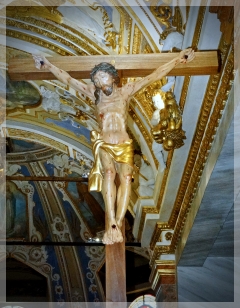 In any cathedral or art museum, we’ll find many pictures of Jesus and even rather graphic depictions of Him on the cross. None of them, however, tell us anything about His appearance because they were created long after His time. Still, in a world where we seem to memorialize everything with pictures, you’d think one of Jesus’ followers would have sketched Him while blessing the children, giving the Sermon on the Mount, or feeding the multitude! 1st century rabbis in Judah, however, vehemently objected to the depiction of human figures because the second commandment prohibited making a “graven image.” With its Jewish roots, this prohibition carried into the early church and inhibited early Christian art.
 After Satan took Job’s loved ones and wealth, the grieving man remained a pillar of patience and faith. Rather than blaming God, the stoic man acknowledged God’s sovereign authority saying, “The Lord gave me what I had, and the Lord has taken it away. Praise the name of the Lord!” [1:21]
 Saturday mornings we usually walk through a nearby park that is home to a unique subspecies of squirrel found here in southwest Florida: the Big Cypress fox squirrel (or BCFS for short). Larger than a common gray squirrel, the BCFS has a black head and back, buff sides and belly, white ears and nose, and a long bushy tail.
 In a recent Pearls Before Swine comic (drawn by Stephen Pastis), Rat asked Pig if he would be getting out of bed that day. Replying no, the sweet little swine explained, “I fear the big bad world and want no part of it.” When Rat told him he couldn’t stay in bed forever, Pig disagreed. “I have a bed, a bathroom, and a food delivery app that I’ve asked to just throw my food through the window.” In the next frame, we see Rat snug in bed with his friend and asking to borrow a pillow. I understand. There certainly are days in this crazy world of ours that we’d all prefer to just snuggle under the covers and never have to get up to face the challenges of the day, especially if DoorDash would deliver bedside. That, however, is not an option.
 Devotions of the Heart