
Remember this—a farmer who plants only a few seeds will get a small crop. But the one who plants generously will get a generous crop. [2 Corinthians 9:6 (NLT)]
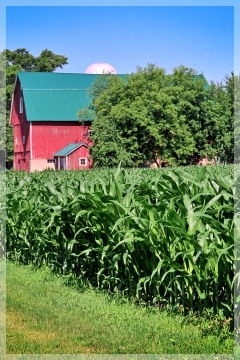 While we often reap what we’ve sown, farmers don’t plant on one day and expect to harvest the next and neither should we. No matter how good the soil, it usually takes about two weeks for a corn shoot to appear and two to three months before it’s ready for harvest. Spiritual farming is even less predictable than growing corn and we shouldn’t expect immediate results after sowing seeds of God’s love and Word. Rarely does an apology yield instant reconciliation, words of correction yield an immediate change, or our first witness produce an instantaneous conversion. It often takes considerable plowing and sowing to soften a hardened heart.
In both agriculture and “farma,” even with the best seeds, richest soil, and the farmer’s diligence in tending the field, not every seed sowed will survive to harvest. Between insects, wildlife, and weather, millions of farm acreage are ruined every year. For example, between 2020’s derecho windstorm and its late summer drought, nearly one million acres of crops in Iowa were destroyed. When seeds of God’s love and Word have been sowed, instead of animals or weather, it is Satan who ruins the crop. Just as wildlife steal soybeans and corn, he tries to steal every seed sown in God’s name. Just as hail and wind can break a cornstalk, by breaking down people with storms of his making, the enemy attempts to keep seeds of righteousness from maturing.
Sadly, not every seed will bear fruit and not every hand extended in love will be accepted. Not every person to whom we witness will respond, not every hearer will believe, and not every soul will be saved. Nevertheless, we are farmers in God’s world and our job is to cultivate His fields and sow His seed. Like the local farmers, we don’t give up when the crop is slow in coming or the enemy ruins the harvest. Even if we have to replough and reseed, we faithfully continue to do our part by sowing the seeds of God’s love and Word.
With nearly a third of the world’s population Christian, there are plenty of potential farmers. Unfortunately, that percentage has remained about the same for more than a century and appears to be dropping. Apparently, we haven’t been sowing anywhere near enough seeds to defeat the enemy and bring forth a bountiful harvest.
 “There is nothing personal going on here,” were the words that helped author Jane Smiley get through her acrimonious divorce. Although no divorce is pretty, the circumstances surrounding hers were especially ugly. Realizing that her husband was acting out his own drama helped her to better understand and deal with his dreadful behavior and hurtful actions. Smiley explained, “This is a wiser way of understanding the people around you … how they have their own passions, motivations, and histories, that sometimes (always) grip them in ways, that even they do not grasp—ways you don’t have to respond to automatically.” Her words impressed me so much that I wrote them down after reading them several years ago. The author wrote that remembering the phrase, “There’s nothing personal going on here,” has helped her deal with other difficult people and situations in her life. I find them useful, as well.
 The guest pastor shared an experience when he was an intern at a large church. Posted on the door leading into the senior pastor’s office was this quote by Stephen Covey: “The main thing is to keep the main thing the main thing.” At eye level and in large letters, anyone entering the pastor’s office was sure to see it. He’d given the sign little thought until one day, hot under the collar and ready to voice a complaint, he started to knock on his boss’s door. Seeing the sign, he paused, quietly returned to his desk, gave his complaint more thought, and asked himself if he was keeping the main thing main with his grievance.
 Earlier this week, I wrote about the ten Boom sisters giving thanks in their horrible circumstances. Because of the physical pain I’ve been experiencing these last several weeks, I know how easy it is to talk the talk but how hard it is to actually walk it. Indeed, when you’re hurting, giving thanks in all circumstances is far easier said than done.
 When we’re hurting, it’s not easy to reconcile how an entirely good, ever-loving, and all-powerful God can allow pain and suffering. The simplest answer is that, since He gave us free will, we can’t hold Him responsible for what mankind has done with that free will. We can’t blame God for global warming, tooth aches, concentration camps, genocide, cancer, red tide, wars, tornadoes, torn ligaments, or rising COVID cases. We alone are the ones responsible for mankind’s poor choices and the disease, death, destruction, and suffering that have accompanied us since we were evicted from Eden.
 One morning, the self-assured Joseph went out to check on his brothers’ flocks and, by nightfall, Jacob’s favorite son had been stripped of his beautiful robe, thrown in a pit, betrayed by his brothers, and sold to Ishmaelite traders. That day seventeen-year-old Joseph found out how capricious life could be. For the next month, he journeyed through the desert before ending up in Egypt. Imagine how alone, frightened, and lost the young shepherd from Canaan was when, unable to speak, read or write the language, he found himself in the most advanced civilization of the time—one with monumental architecture, centralized government, papyrus, ship building, and a military force.
 Devotions of the Heart